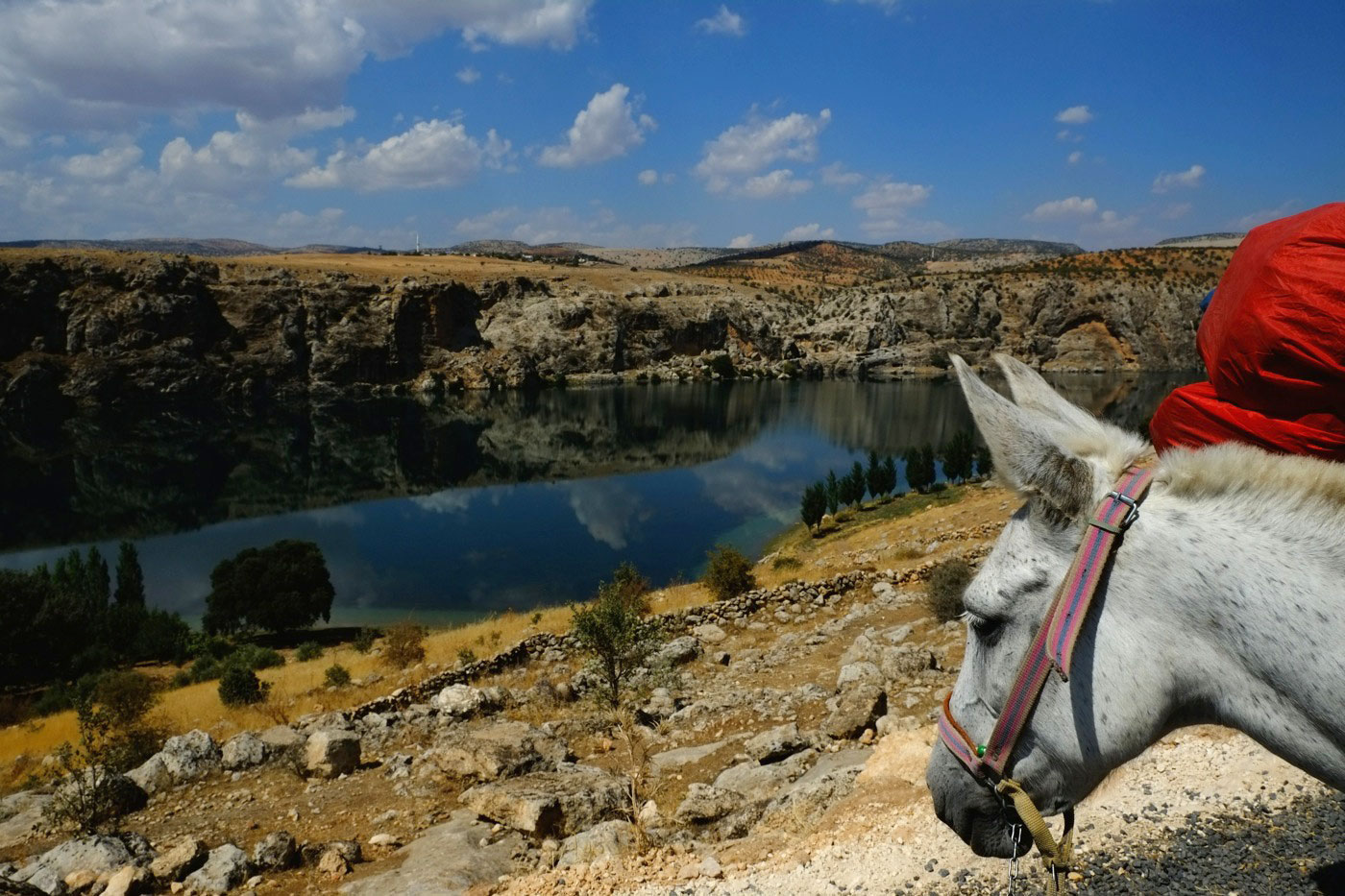
We parked the mule on the Euphrates and took a hire car to Edessa:
A famous pilgrimage town in Mesopotamia. Founded by Assyrians. Traded at the point of a sword among the Greeks, Nabateans, Romans, Sassanids, Byzantines, Arabs, Armenians, Seljuks, Crusaders, and Seljuks again. About 4,000 years ago its cruel king, Nimrod, ordered Abraham burned alive for rejecting the Assyrian pantheon. Abraham’s God saved the prophet by turning the flames into water and the coals into fish. According to Muslim tradition, God then punished Nimrod by sending a mosquito up his nose to bite his brain. The deranged king ordered his men to knock his head with felt-wrapped mallets, then with wooden clubs. Nimrod died that way. A pool in the modern city, now called Sanliurfa, commemorates Abraham’s miracle. The pool is filled with sacred carp. People feed the fish with a lira’s worth of pellets. The fish are immortal and quite fat. Eat one, and you go blind.
Next to Abraham’s pool is an old bazaar from the days of the Silk Road. The tailors there are Kurds. They sit in a shady courtyard where menders have patched holes for a thousand years. They sip tea. They ruin their eyesight spearing licked thread through needles.
The fates of mighty empires once rose and fell according to the flow of commodities across the worn plank shop counters of Sanliurfa. Maybe they still do. Today, the tailors hunch over antique American-made sewing machines that were sold a century ago by Sears, Roebuck & Company. The tailors pump the machines by foot. Sturdy artifacts from another time. From an age before the rise of disposable Chinese polyester. From a world where America exported more than its titanic debt.
“We’re the last generation,” tailor Muhammed Sadik Demir says with no self-pity. He shrugs. “People don’t repair clothes anymore. They throw them away.”
Actually, it is Deniz Kilic who says this.

On the trail near Tarsus, walking partner Deniz Kilic stands before graffiti commemorating his namesake, a 1960s revolutionary.
Paul Salopek
Kilic, my Turkish guide, my interpreter, is going home.
He has suffered like no other walking partner on the long Out of Eden Walk trail out of Ethiopia. Shin splints. Sore feet. Blisters on top of blisters. He has endured, too, the torment of my lectures on walking landscapes—avoiding beelines, contouring hills. Yet Kilic never stopped. In the mornings, he pounded on his boots. He tottered on. He loved the slow journey. It allowed him to deploy his streetwise charm. Teasing, joking, he disarmed all we meet. He called the humblest farmer hoca—master, teacher. From Mersin to Sanliurfa, across more than 200 miles of mountains, roads, beaches, and fields, he was my wise-guy window to Anatolia. He forced me to watch my first 3-D movie—Dawn of the Planet of the Apes—claiming it was research. His parents had named him after the 1960s revolutionary Deniz Gezmiş, Turkey’s version of Che, and he was bracingly cynical about all politicians. He completed his thoughts with snatches of pop songs.
Crossing a creek with the mule: “We all live in a yellow submarine …”
Frowning up at storm clouds: “Here comes the rain again, falling on my head like a memory …”
I will see you again, I tell him.
Like all of the walk’s guides, Kilic is invited to the Beagle Channel between Argentina and Chile, to the finish line of the journey. This is the dream: Every walk partner who has helped shape the route will regroup in 2020. I see Mohamad Banounah, a son of Mecca, walking in Tierra del Fuego bundled against the Antarctic wind. I see Noa Burshtein, a young woman recently discharged from the Israeli army, walking the cobbled shores there. And Elema Hessan, the Afar fossil hunter from the bone-colored plains of the African Rift. And the Bedouin guide Hamoudi Alweijah al Bedul from Petra. And Bassam Almohor from Ramallah. There will be Russian guides. Chinese and Colombian guides. Twenty-one thousand miles’ worth of fellow voyagers. We will stride together, en masse, along the final mile of the human journey, to last beach of human imagining. Kilic will sing, “Baby, it’s cold outside …” This journey belongs to them. Warp and weft, they have sewed its story into existence.
Your absence has gone through me Like thread through a needle. Everything I do is stitched with its color.
— W.S. Merwin
In a bazaar in southern Turkey, Kurdish tailors pump antique sewing machines by foot.
Video by Paul Salopek