Nodar says: Stop.
Stopping is good, he says.
Why? Because life is short, and only friendship lasts. Friendship is perhaps the finest treasure in life, Nodar says. It is beyond price, and possibly above all forms of love. How does one acquire this precious jewel, this rare prize—friendship? How does one keep it? By stopping. By pausing. By walking into Nodar’s little café in the old Armenian quarter of Tbilisi. There, one must sit down at one of the small wooden tables. One must order a coffee to sip. Or a beer. Or a yellow Kakhetian wine with an aftertaste of Georgian clay. The drinks matter little: It is the patrons who make all the difference. Azerbaijani journalists in exile. Linguists from Austria. Lovelorn Turks. A Frenchman who walked to Nodar’s door from Paris. An Iranian who dances like a wild crane between the spoons and white cups, his face lit with the shining smile of a mystic. The regulars.
“These people”—Nodar says, smiling closed-eyed, spreading his hands—“these people are my friends. They can be your friends, too. Allow me introduce you.”
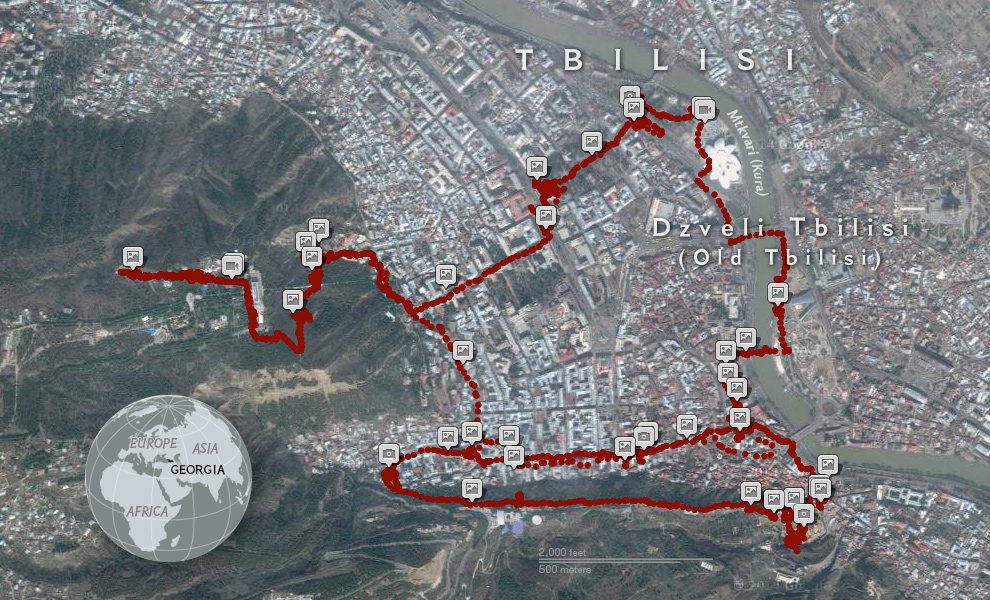
So on an elbow of the Mtkvari River in Georgia, under the peeling facades of the crumbling fin de siècle mansions, beside the old brick domes of medieval steam baths, and among packs of stray dogs taking themselves out for walks, I sit down. I order a drink. I halt my journey for a season.

Urban pemmican, Tbilisi.
Paul Salopek
For the past eight months, National Geographic has been petitioning Iran on my behalf for a visa to trek through that land of deep history. For eight months, Iran has declined to answer. This long silence has knocked the Out of Eden Walk’s route sideways—into the far north of Eurasia’s high and freezing mountains. This is perfectly acceptable, of course: This journey is guided largely by chance, and obstacles are part of the story. But now, the most favorable trailhead into Asia starts in the vast Karakum of Turkmenistan: a black desert that broils at 130 degrees Fahrenheit in July. I have no choice but to wait out the brutal days of summer in the Caucasus.

Beaten to Georgia by 1.8 million years. Dmanisi humans at the Georgia National Museum, Tbilisi.
Paul Salopek
Over the next three or four months, you will read on this page dispatches from one of the great crossroads of the world—from Georgia, Armenia, and Azerbaijan.

The world is a circle: Mural of the Western (“Wailing”) Wall in Jerusalem— a walking landmark some 2,000 miles behind—plastered outside a synagogue in Tbilisi.
Paul Salopek
These stories will feature Bronze Age chiefs found embalmed in honey. There will be tales of artists and gold miners, of proto-humans who walked here from Africa 1.8 million years ago. We will walk with modern nomads who believe they are descended only from Adam (not Eve). And perhaps I will take you on city stroll with Guram—a new Georgian friend—who repairs the rooftops of Tbilisi while hanging from ropes. Guram always looks up as he walks. He knows this ancient capital as crows do. Up on its red tiles, its rusted tin, he finds the spent bullets from three recent revolutions.

Ego, meet technology. Nothing really changes in the long journey of our wandering species.
Paul Salopek
And out beyond the last houses, the global walk awaits. It beckons as Nodar does at his doorway—into a familiar space: warm, welcoming, dimly starred, of deeper stories, deeper connections.