We stand on a high plateau that holds shining Lake Paravani like an open palm—a broad, timeworn flat of grasslands turned russet and gold under a weak autumn sun, an upland of bitter winds, winds that streak over the boulders shaped like colossal skulls, a wilderness of pale and glassy light, the Siberia of Georgia.
“Is this Murat’s underwear?” Dima Bit-Suleiman, my new walking guide across Georgia, jokes.
This is where we begin. At an old camp fire.
The charcoal is dusty ten months after giving its last heat. It was here, in a ruined house by a snowed-in alpine road, that I arrived last winter on foot from Turkey. It was here that I staggered with frozen feet, bruised, exhausted, facing a grim subzero night, after rolling down a snowy white mountain. There were four of us walkers. Murat Yazar, a Kurd, one of my guides, burned his gloves to kindle a life-saving fire. We hugged the flames close. Our clothes steamed. We jabbered idiotically out of pure relief. The faded rag-end that Bit-Suleiman now toes with his boot could indeed be Murat’s discarded long johns. Or mine. And this squalid hearth—one of hundreds of fires sparked along the 4,000-mile trail from Ethiopia—marks the start of a new phase of the Out of Eden Walk.

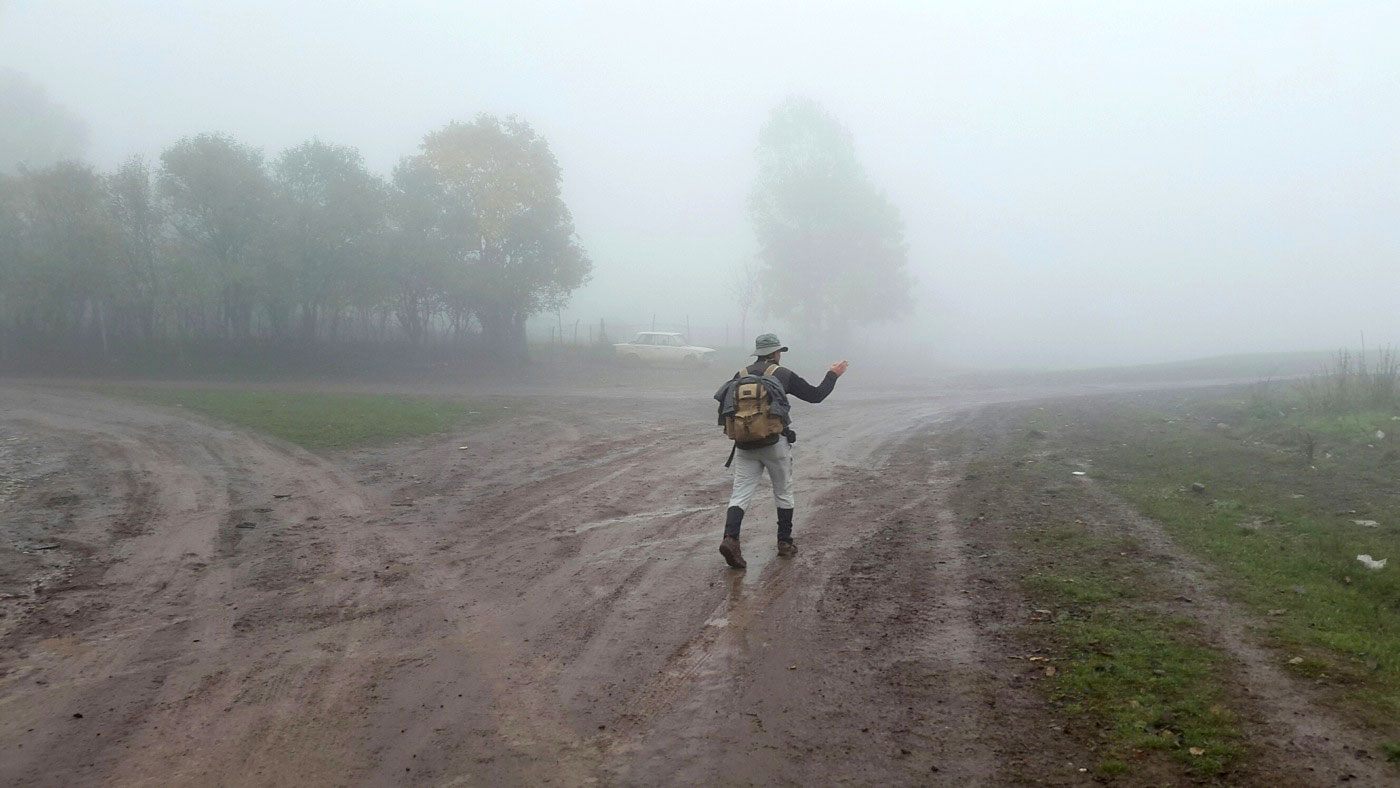
Bit-Suleiman in the dripping green lungs of the Lesser Caucasus near Ipnari.
Paul Salopek
A walk across the world is like a long passage of music.
It has its frantic tremolos. (A manic, 35-mile march made one day in the Hejaz desert of Saudi Arabia to reach a precious well.) It has its adagio passages. (Weeks of strolling—literally strolling—between Anatolian villages.) And it has its fermata: the grand pauses between movements. Since December, the Caucasus has been one such break, one such hiatus.
The first humans to discover the world in the Pleistocene—the Stone Age pioneers I am following on this storytelling project—faced enormous obstacles in their paths. In Beringia, the now vanished land bridge linking Siberia and Alaska, they waited 4,000 winters for the glaciers to recede before striding into North America. My own barriers are not of ice, but of imagination, of wisps of ideas, and yet no less maddening: borders and visas. Having been funneled ever northward by the volatile politics of the Middle East, I found myself last year at one of the fabled crossroads of the world—the Caucasus, the rumpled nexus of Europe and Asia. But in our anxious times, even an intersection can become a cul-de-sac. Country after country found reasons to close its doors to the walk. I pivoted. And pivoted again.
No longer.
The way eastward into the immense belly of Asia now lies open.
Dima Bit-Suleiman and I will trek through lush forests, hills, and plains of southern Georgia to reach the border of Azerbaijan. There, I will shake hands with an Azerbaijani walking partner, and pace off the great Caspian Plain down to Baku. From that port city a ship will carry me to the oceanic steppes of Kazakhstan. I will follow the old silk roads into an antique region now globalized, made strategic, by its vast energy reserves.
We climb the first pass, Bit-Suleiman and I, through swells of straw-colored grasses. From its summit we peer toward China.

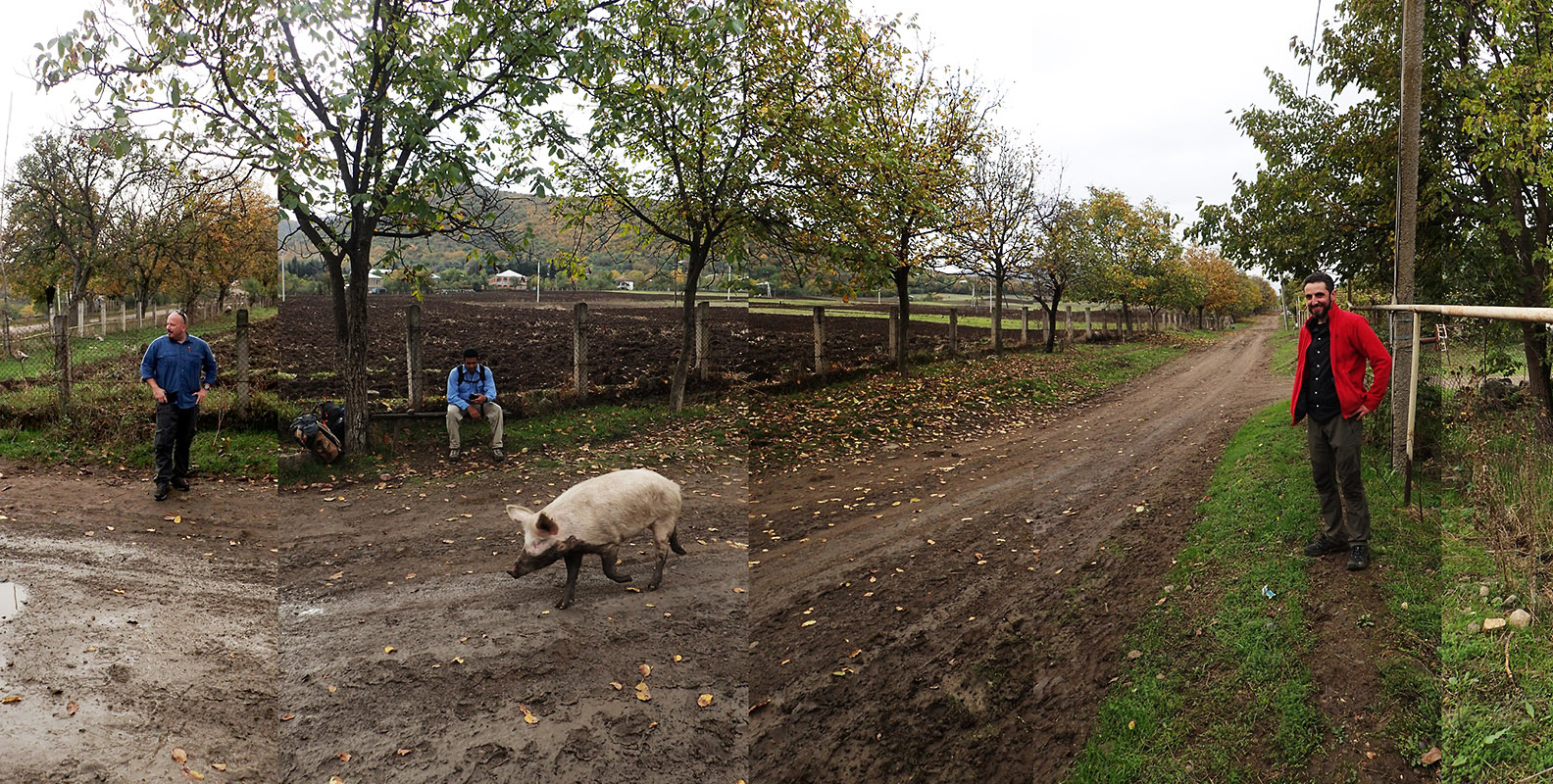
Ziauddin Nasibov counting sheep at the first oasis farm enroute. “Farming here, you neither live or die. You just exist.”
Paul Salopek
Then it is down, down, down—on rubbery, city-softened legs—down slopes of grey scree. To the first ethnic Azeri farmstead. Back into a mosaic of Christianity and Islam, each village different. (Georgian, Armenian, Azeri.) To the plank wood tables of farmers who receive total strangers unfazed. Who offer tea. Who crack us their walnuts chilled by the cold earth under their trees. Who chop their slab-like hands in the direction of the next shelter. A familiar mode of life reawakened: a balance of vulnerability and trust that cuts both ways. The magic, once gain, of first contacts.
We walk east through mist, through mud. Through dripping, dank tunnels of trees—oaks, birches, crab apples—leached lemon-yellow in the fog. Through mud puddles that are hallucinogenic orange like the laterite African roads. And one morning, in the distance: a man carrying a flag slung over his shoulder.
This man travels on foot from village to village, collecting alms during the Shia holy month of Muharram. He seems a primordial wanderer. I tell Dima: Let’s catch him up. And I quicken my footsteps. And I pull out my notebook, my pen, wanting to know more. But I suddenly check myself. I let him go: a mysterious ghost figure in the muzzy distance. We walk on. It is better this way. “Our task is to love that which we do not understand.” A poet wrote that once, to a student.