We live in a motorized world.
When you traverse continents on foot, this becomes painfully obvious in the utter subjugation of the human landscape to the rubber wheel, to our automobiles.
Space is parsed, diced, scissored, and torn into unnaturally straight lines (highways) and into right angles (streets). We lose track of the truly vast scale of our homes—our towns, our provinces, our countries—because our brains have atrophied, grown flabby, through unearned speed. (Twitch your right ankle muscle, and the accelerator pedal underfoot annihilates miles, hours.) Even more unnerving: The oldest, most natural, form of locomotion in the human experience—walking—often elicits suspicion in motorized societies. To be a walker on a planet conquered by cars is to be an outsider, a marginal figure, and a potential source of trouble.
Hence: the “Out of Eden Walk” police stop map. Click to view the interactive map.

Plots police stops along the walk’s route.
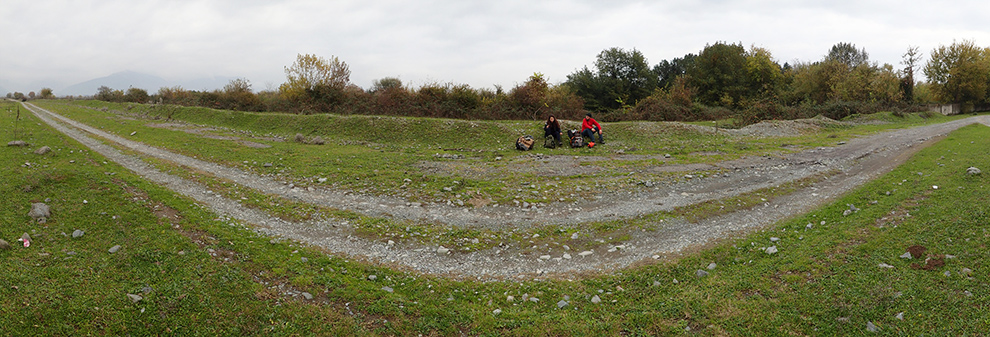
Two weeks into the relaunch of the world walk, I have recorded and geotagged my 43rd police stop. The last one, in November, was in Turkey. There, stone-faced gendarmes, heavily armed, had photographed my documents with their phones, because they didn’t quite believe my story. The latest stop was much friendlier. Two Georgian police officers in a pickup truck pulled up on a lonely village road near the Azerbaijan border. My local walking partner, Dima Bit-Suleiman, leaned into the cab window. He explained we were out for a stroll. They nodded. And they gave us their phone number. It was in case we should need help. A humanitarian gesture—to people so impoverished, so vulnerable, as to be car-less.