We strike out north along the Caspian, a landlocked sea that pools atop a big crack between Asia and Europe, its verdigris waves breaking on shores 200 feet below sea level. We pass fishermen masked in white balaclavas against the biting wind. We step over car-squashed snakes. We wade through drifts of tiny clamshells that shine like bands of foam in the sun. We pivot eastward across lumpy grasslands to a cemetery holding a headless man.
He is Esembet: one of the world’s many unsung freedom fighters.
Esembet was a Muslim preacher, an Adai nomad and guerrilla who didn’t bow when Imperial Russia pushed into Kazakhstan, annexing the vast Central Asian region in the early 19th century much as Americans colonized the Wild West, with light cavalry, end-of-the-world forts, smoothbore rifles, the telegraph, and the buying off of indigenous leaders. Russian officers delivered Esembet’s head to the tsar in St. Petersburg in 1820. The tsar shrugged and shipped it back. Today head and body lie reunited beside a shrine roofed with masts taken from old Russian sailing ships. (There are few trees in western Kazakhstan.)
“Put your hands closer,” the robed cemetery keeper says, stoking a sheep-fat fire by which to ceremonially cleanse us in smoke. “The flames of the ancestors never burn.”

Maze of wealth: navigating oil and gas pipelines in Mangystau.
Paul Salopek
We walk on.
There are four of us. We are following the Silk Roads east toward the old khanates of Khiva and Bukhara.
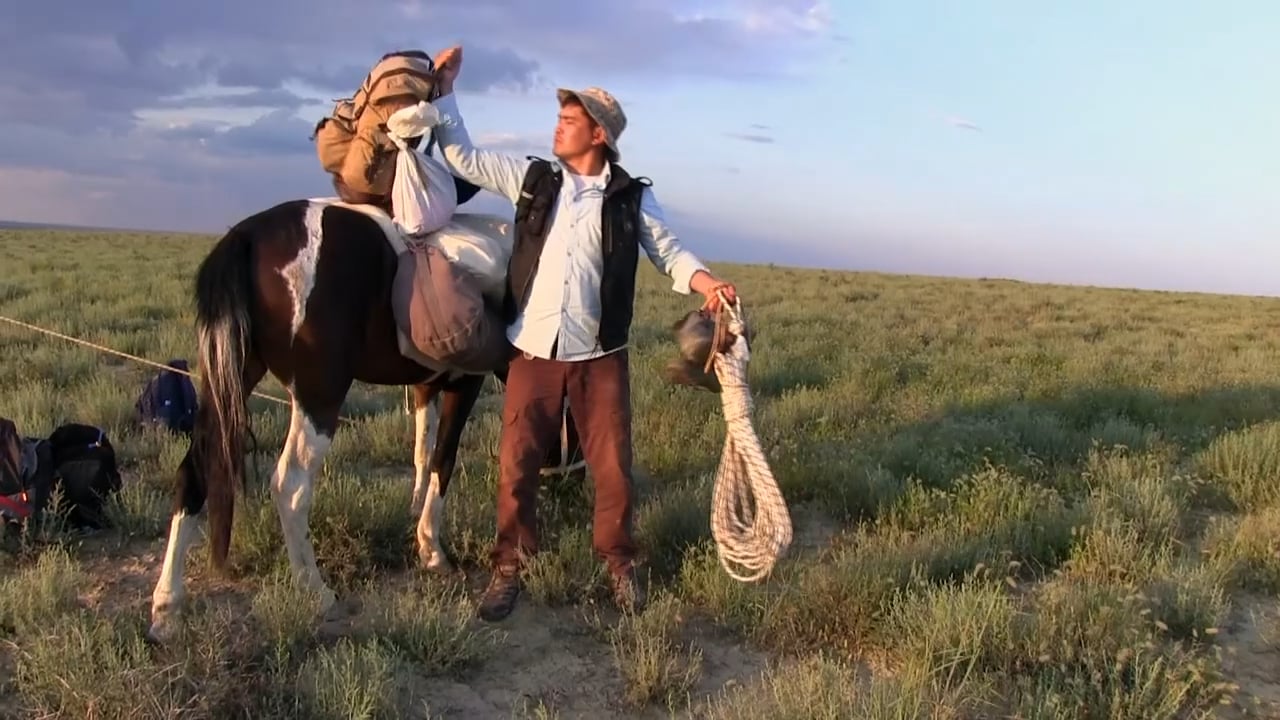
Talgat Omarov, the translator, is a former oil worker who sells halal meat from a family butcher shop in Aktau. (You will never see Talgat’s face: a devout Muslim who rejects graven images, he refuses to be photographed.) Our logistician is Daulet Begendikov. Begendikov is an ex-soldier, forensic investigator, civil magistrate, and gymnasium operator. Both join the 350-mile journey across the barren but oil-rich Mangystau region—the West Texas of Kazakhstan—for a medley of reasons: local pride, curiosity, learning, adventure. The fourth partner, a balding Kazakh cargo pony named Alex Moen, reserves opinion.
We hit pipelines on the second day. The steel capillaries stretch waist-high across the steppe carrying gas and oil to refineries in Europe. They stop us cold. The horse can’t cross them. There is little else to do but shrug, and walk right or left.
We plod into an aul, a remote ranch, occupied by woman who gives me a knife as a gift. The handle is made of antelope horn. The blade, an old kitchen shank, is stropped to razor sharpness. Aliya Tovurbayeva, 41, had been a shepherd her whole life. She likes the clean air and peace of it. As for the young—without cell signals or TV, they consider the steppe a prison. Their morals are down. I ask Tovurbayeva for walking advice. “Most people are liars,” she says. “Don’t trust in them too much.”

Aliya Tovurbayeva, modern pioneer of the steppe.
Paul Salopek
We walk on. We camp.
The steppe is a gargantuan bowl. Its edge curves up to meet a porcelain sky. Shepherds’ tracks climb the grasslands to the horizon. To the clouds. Turtles walk them.
On day three, we meet a man who greets us at his outpost door in his underwear. In his underwear he rummages for, finds, displays and proudly loads a hunting rifle. In his underwear he gives us a tour of his house with the weapon slung on a bony shoulder. His name is Kyrlybek Utetilyenov, and he is an amateur historian. In his underwear he lectures us about Beket-Ata, the 18th-century Sufi mystic who established underground mosques in the steppe and prayed in numerological code, like the Kabala. (“786” meant: “Bismillah Al-Rahman Al-Rahim,” the first line in the Koran.) In his underwear he plays for us the dombra, the two-stringed lute of Central Asia.

Kyrlybek Utetilyenov playing the dombra in his longjohns.
Paul Salopek
We walk on. Into a brown dust storm.
In two minutes it loads every eyelash with sand. I pop an eruption of blisters on walking partner Begendikov’s feet. “Go, go, go,” he says, refusing to give up. Bloodred poppies grow in endless sheets of grass.
At a hilltop hut surrounded by screaming camels we find Jamila Utekeyeva. She is a migrant from Uzbekistan. She chases after wayward camels and milks a cow. She is 25 and has never owned a phone. She has a baby but no husband. She says she doesn’t like the steppe at all—its terrible loneliness—and she dreams of working one day in the city, in a restaurant. She serves us breakfast: handmade bread and apricot jam and shobat—frothy camel’s milk. Out in the yard I watch her work. She stoops to pluck flowers, sniffing them for a moment before discarding them. They are thorny thistles.
We walk on through loose herds of wild horses.
Stallions scream, rearing to bite and kick over the mares. We lie down on the steppe in the slender radial shadows of light poles, moving with the shadows.
Outside the remote village of Zhyngyldy, a kind man invites us to rest a few days in his palatial house. He is a retired officer with the anti-corruption police. He has a dining room 40 yards long. It is presided over by a life-sized portrait of himself wrapped in the simple white cotton of the hajj. His daughter-in-law mixes koumiss, fermented mare’s milk, in the washing machine. My guide Omarov and I race the household children to a spring where horses take water. It is impossible not to feel giddy. It is like the pastures of heaven.
We have been walking a week. We pause.
In the afternoon a driver we hire to resupply us says, yawning, that the boring desert road from Aktau city, our starting line, took him little more than an hour.