“The desert teaches by taking away.” — William Langewiesche
Paul Salopek is walking the global trail of the first humans who migrated out of Africa in the Stone Age. His continuous 21,000-mile foot journey, called the “Out of Eden Walk,” is recorded in dispatches.
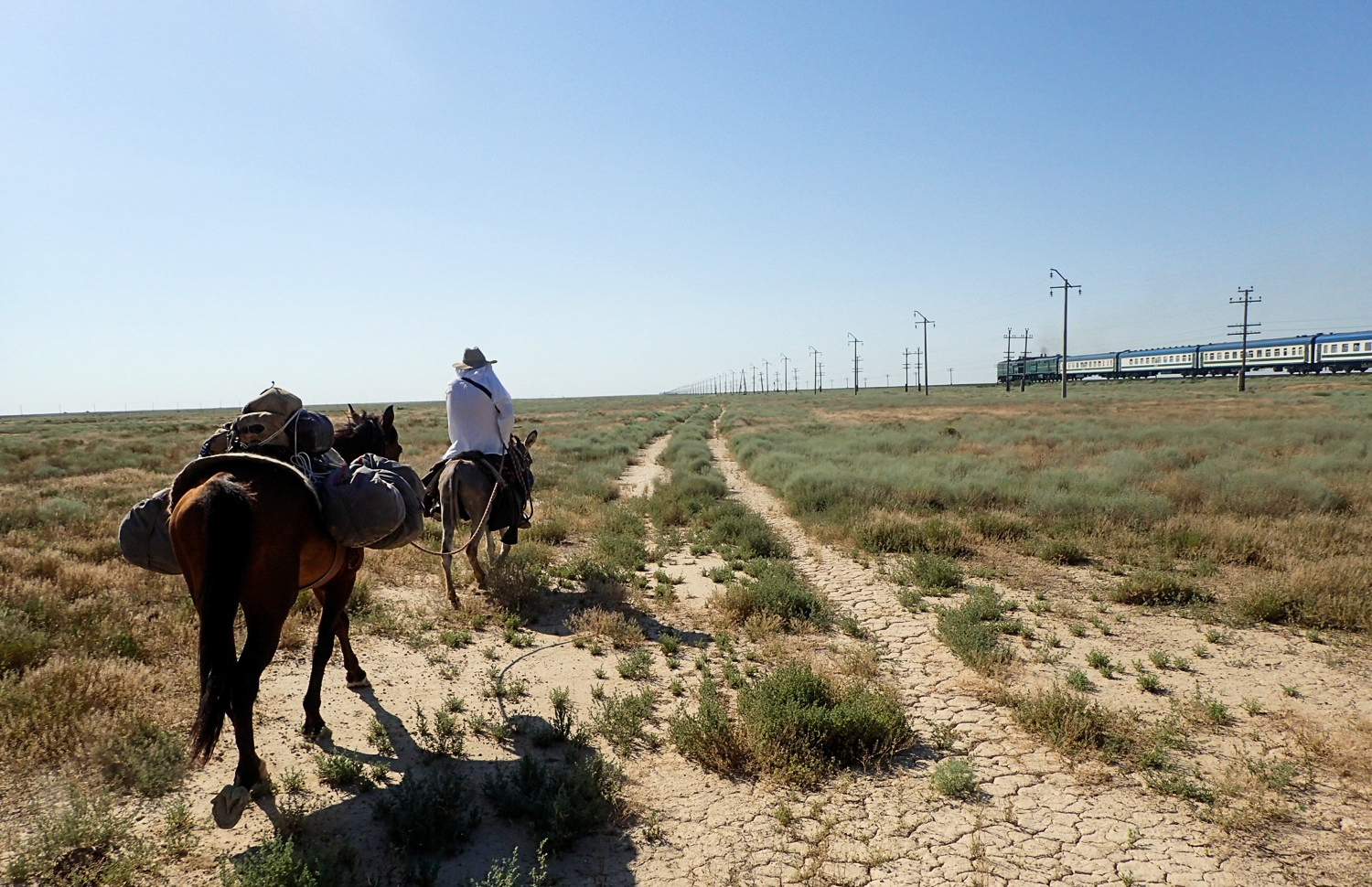
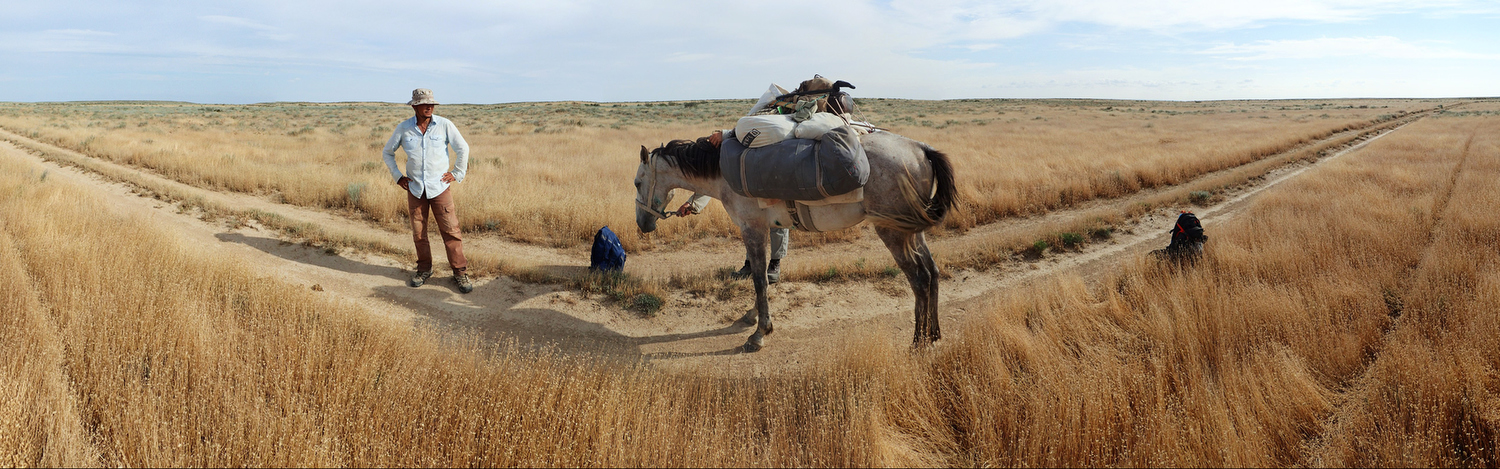
The Ustyurt Plateau covers 70,000 square miles of Central Asia. Half of this iron-flat tableland lies in western Kazakhstan. The other half sprawls into Uzbekistan. It is an immense land feature largely unknown to the outside world and, because of its extreme isolation, underappreciated even by Kazakhs. The Ustyurt supports herds of gazelles, antelopes, and mountain sheep. A desert nature preserve on the Ustyurt could qualify as a UNESCO World Heritage Site. Its ragged steppes are crisscrossed by ancient migrations: Neolithic hunters, Silk Road camel drivers, and the armies of Scythians, Mongols, Russians. Over the summer I walked across this mostly deserted upland with two men—Daulet Begendikov and Talgat Omarov—and a Kazakh cargo horse. Our journey was possibly the first foot traverse of the Ustyurt in 80 or more years, since the forced settlement of Central Asian nomads under Stalin.
*
Wolves still roam the Ustyurt.
Chobans—Kazakh shepherds—distinguish between “good wolves” and “bad wolves.” A bad wolf is a young beta male exiled from his pack, skulking across territories, maddened by loneliness, massacring every sheep he comes across. (Such wolves will kill 30 animals and eat one, shepherds say.) A good wolf is the same male who fights and either kills or drives off another male from an established territory. When this occurs, the bad wolf will keep all other wolves at bay, and only hunt over the horizon. If you are a choban working at such a location, this invader becomes, in effect, a good wolf, a wolf-shepherd. He will protect your sheep.

Nomad hospitality: Onaihan Orynbaeva slaughtered a sheep for us.
Paul Salopek
Walking the horse closer to camp one night, I heard whistling.
It was Omarov, my guide, and a visiting hunter friend. They were signaling that four wolves were trailing close behind me in the dark. They identified the wolves by their eyes. Wildcats and jackals stare steadily into a flashlight. But you glimpse the reflected eyes of wolves—twin orbs of pale green—only for the briefest flicker of a moment. Because they always ghost away when seen. Because they are glancing over theirs shoulders as they run. Because they hate men.
Begendikov, my walking partner, sometimes fires a starting pistol loaded with blank cartridges where we camp. The detonations are supposed to scare away wolves. Under the icy blue powdering of the Ustyurt’s star-scape, the pistol goes: pop pop.
It is the smallest sound in the world.
*
Jinns, or genies, have lived always on the Ustyurt.
How can you identify one of these spirits?
Karim Junelbekov, a Kazakh who hunts atop the Ustyurt, provides tips:
From a distance, jinns can look like normal people—even like a typical choban. But when you get closer, you will notice something wrong: their feet. They are on backwards. Or: The left foot is on the right leg, and vice versa. Look down.
Not all jinns are malevolent. Some are just mischievous. But most will do you harm. A favorite jinn trick is to confuse you into becoming lost. They will appear like a sincere person, offering helpful directions on the featureless grasslands of the Ustyurt. Then they will lead you in endless circles until you die of thirst.
When a jinn approaches you, Junelbekov offers these suggestions: Sit down on a rock. Don’t move. Don’t be afraid. Don’t react to what the jinn says. Think good thoughts. Eventually, the jinn will grow bored and go away.
This is fine advice for many situations, including the aversion of loneliness.
*

Storm camp.
Daulet Begendikov
The storms of the Ustyurt are unlike any other in the world. Their violence is mesmerizing, terrible, gorgeous.
One afternoon cloudburst turned to ice. Hail dropped like ball bearings—it fell in shining white columns like marble, like pillars of translucent stone, against portals of indigo air.
“One-hundred percent beautiful!” said my guide Begendikov. (He used percentages to modulate his imperfect English: “You are hundred-percent being watched by the KGB!” “This road is wrong—75-percent!”)
Another Ustyurt storm revealed, at magenta dawn, a steppe littered with polished gold coins: fiery sunlight mirroring in a billion pools of rain.
You look on such scenes and have emotions, and you can remember those feelings. But you can never really have them again.
*
Dana Begentayeva lived on the Ustyurt’s rim.
Begentayeva was a waitress at Manata, a teahouse made of stones, old tires, scraps of plywood. The teahouse slumped beside a lonesome highway. Truckers from Turkey—from Kazakhstan, Azerbaijan, Russia—paused there for a plate of mutton, a few hours’ sleep, cold beer. Begentayeva ordered them around, chivvied them out of the bucket shower stalls, hollered at them (then winked) when they messed her two tables. She had spent a lot of time around traveling men.

Dana Begentayeva entertains another road warrior—this time, a national park ranger.
Paul Salopek
We walked to Manata to resupply.
“What’s your name?” Begentayeva said.
Paul, I told her.
“Пол ?” She used the Russian word pol: “floor.”
Paul, I said.
“How do you do, Mr. Floor,” she said. “Я Г-жа Потолок”—I am Miss Potolog. Miss Ceiling.
I was leaving Kazakhstan. We were making for the Uzbek border. The Manata teahouse sat at the farthest margin of the well-trod world—at the crossroad of wind, of space, of absences. Begentayeva poured green tea and vodka at the edge of an empty steppe sky.
“I like it here,” she told me. “Fresh air. No Internet. No SMS. No WhatsApp. No distractions.”
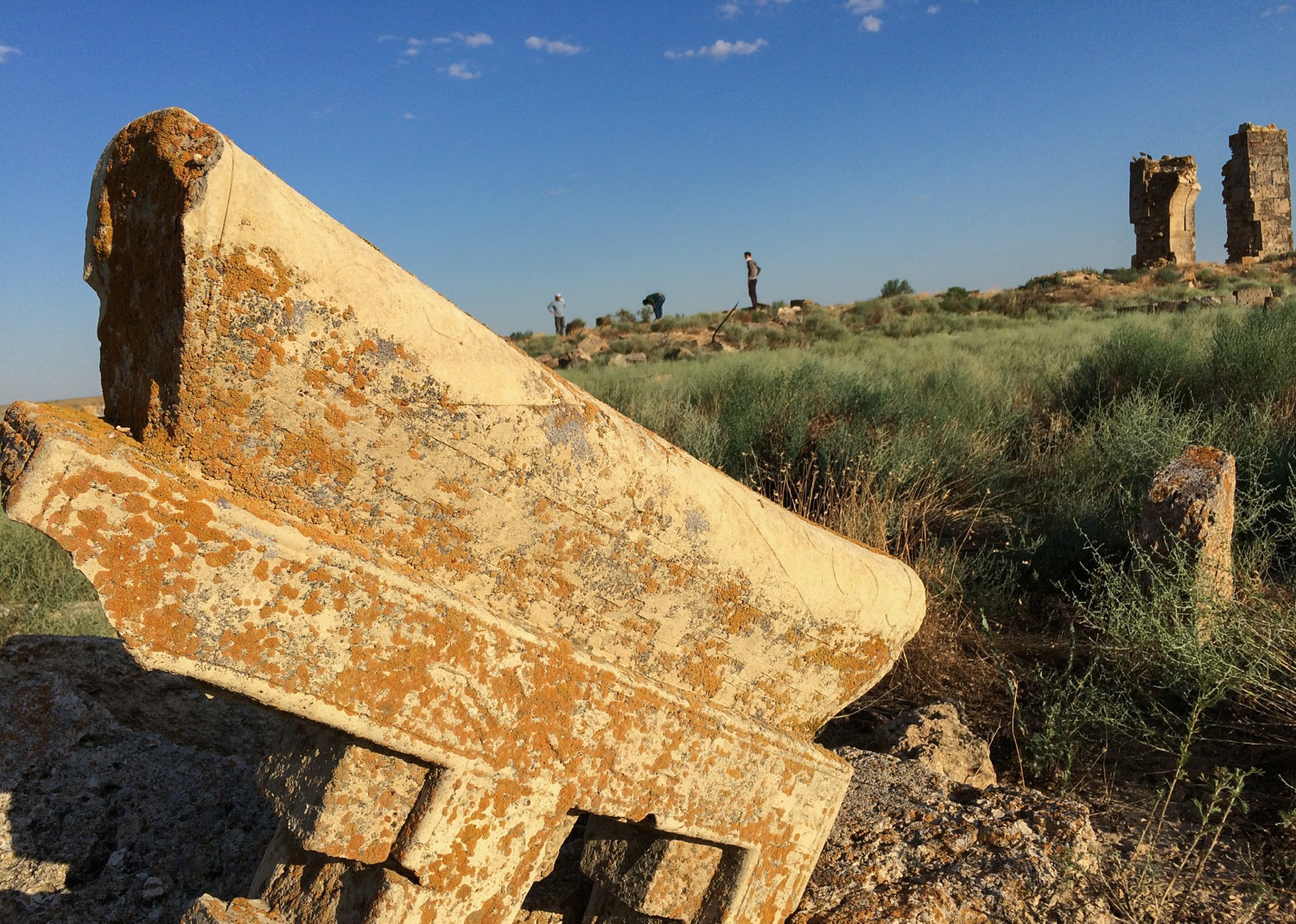
But she complained honestly, the way people do to strangers they will never see again, about singlehood. About being an antique at age 30. Later I saw her pacing the dusty sunset in her pedal pushers. She walked back and forth in the desert, past an old truck stop wind turbine that went chuff chuff chuff. She waved her cell phone in the air, trying to snatch a whisper from the outside world. Across the asphalt road lay the rubble of a 14th-century Silk Road caravanserai. A fiber optic phone cable burrowed through the ruin’s forgotten cemetery, carrying its torrent of words against silence.