Its steel rails are oxidized the color of sunburned skin. They ping and gong in the scorching midday heat of Central Asia. They twang like a slide guitar at the approach of distant trains—the sturdy passenger cars built in East Germany, the freight wagons from Tajikistan, from Russia, from Belorussia. We pause on the steppe to listen to the tracks’ haunting, metallic songs. Few others do: This is one of the most desolate railways in the world.
I am walking in a new country: Uzbekistan. We are making for Tashkent. It is a thousand miles away. There are five of us.
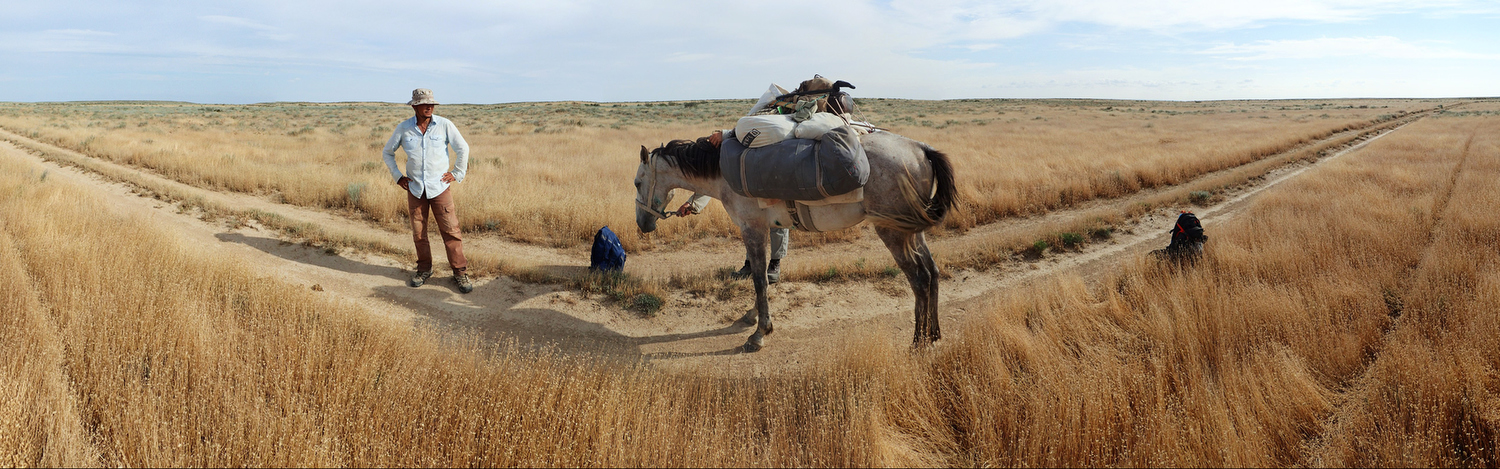
Azizbek Khalmuradov is my Uzbek guide. A worldly, funny, urbane storyteller. A man prepared, wearily, for calamity yet willing to be surprised by good news. A traveler. His feet weep with watery blisters. Jailkhan Bekniyazov, our assistant horse wrangler, a tattooed former Soviet soldier and a farmer from the banks of the Amu Darya River, looks on, shaking his head in rural superiority. “Put Aziz on the train, and you and I can walk on,” Bekniyazov says. Except that Bekniyazov himself doesn’t walk. He rides a donkey. Bekniyazov’s long legs drag plastic-booted feet through the dust, leaving two furrows across the world behind us. We walk with a cargo horse called Kungrad (Brown Horse), but our donkey has no name. Donkeys are numberless in the Uzbek countryside. To name a donkey is to give a name to a stone, a thorn, a fly. Nobody wishes to christen the stubborn little beasts. In my mind, I dub ours Donkey Xote. Bekniyazov calls him haram—unclean.
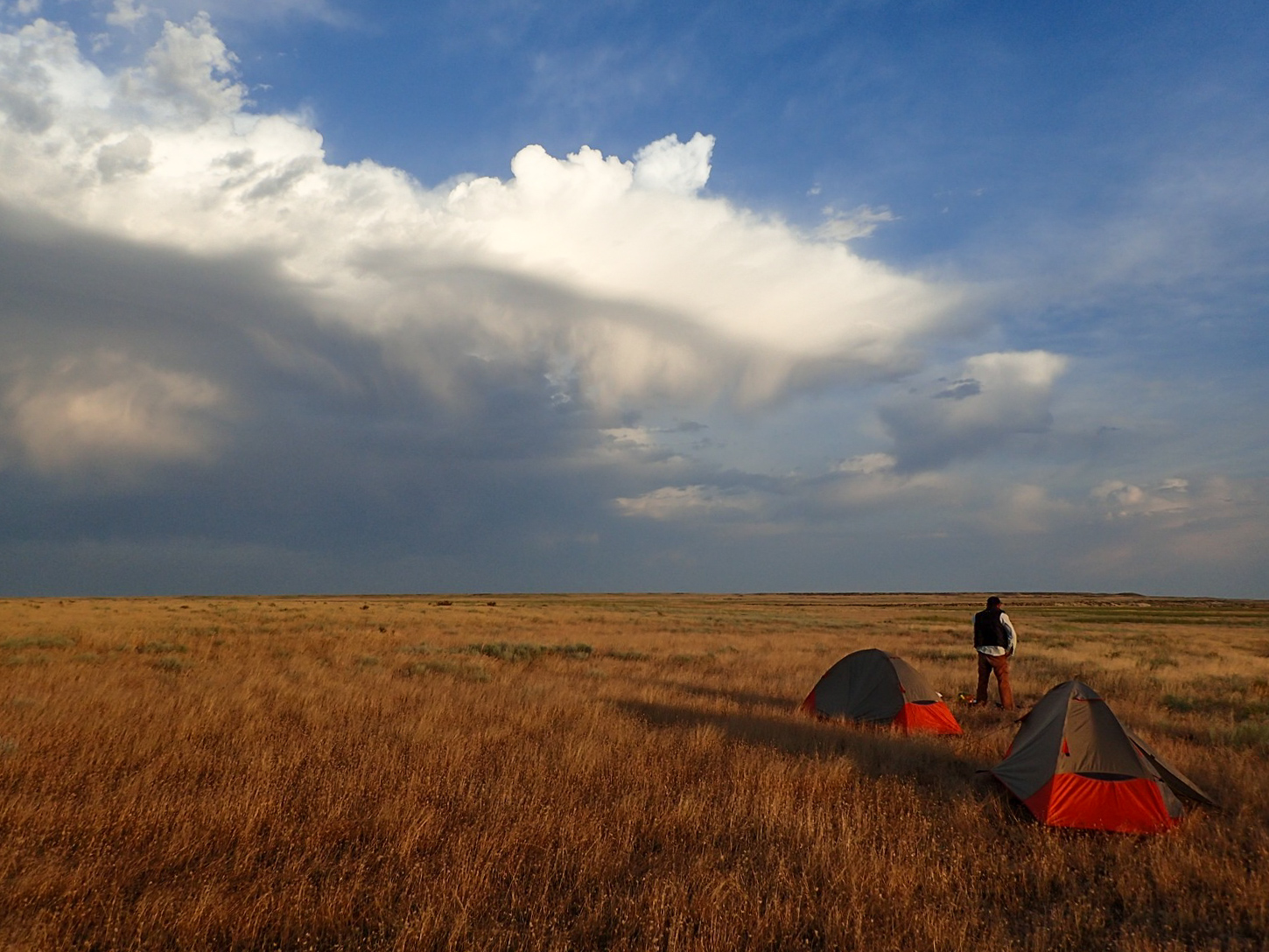
We slog east. We follow the rails under a sledgehammer sun. The locomotive engineers wake us at our desert camps with friendly blasts from their horns.
“In general, the railway is built on top of the ancient Silk Roads,” says Aytmurat Aniyazov, the head of the Research Institute of Humanities, of the Karakalpak branch of the Academy of Sciences, in Nukus, Uzbekistan. “You are following the old camel caravans.”
Video by Paul Salopek
The stations are our caravanserais.
Aktobe. Berdak. Quanish. Kyrkyz. The remote train stations are beautiful in their minimalism: small, whitewashed cubes of brick, dropped an accidental day’s walk apart on the austere landscape—about every 15 to 20 miles. Lonesome trees shade them: the only trees in the visible world. From a distance these brave elms look like green lollipops. We hear their birds chittering from a mile away. Toy trains skate by. Or puff black smoke at the sidings. Men wearing singlets and Navajo faces attend them. These are the stationmasters.
The famous Silk Roads were not like modern highways.

Hobo shower: The antidote to a broiling day along the rails — water from a tanker car.
Paul Salopek
For more than 2,000 years, the precious commodities of China and Europe were not transshipped far across the empty steppes, oases, mountain passes, and salt flats of Central Asia. No. They moved in short hauls—a local trader with 15 camels, a clan of herders rambling to summer pasture, the nomad warrior chieftain on patrol. Each helped carry Chinese silks, Venetian glassware, and Russian furs for a few miles and days, for a toll. Central Asia was a vast, busy, and mobile bazaar, a crowded conveyor belt.
In this way we too are passed from hand to hand along the Uzbek rail line.
The railroad men ply Khalmuradov, Bekniyazov, and me with water, tea, shelter. Once, they share a pilaf made with the meat of a steppe hare chased down on foot. They laugh at our insanity. During the Great Depression in America, hobos riding the rails marked generous households with secret symbols, perhaps just a rock tossed by a gate. Shouldering my rucksack at the sentinel stations of western Uzbekistan, I begin to leave such stones.
Hobo shower: The antidote to a broiling day along the rails — water from a tanker car.
Paul Salopek
For more than 2,000 years, the precious commodities of China and Europe were not transshipped far across the empty steppes, oases, mountain passes, and salt flats of Central Asia. No. They moved in short hauls—a local trader with 15 camels, a clan of herders rambling to summer pasture, the nomad warrior chieftain on patrol. Each helped carry Chinese silks, Venetian glassware, and Russian furs for a few miles and days, for a toll. Central Asia was a vast, busy, and mobile bazaar, a crowded conveyor belt.
In this way we too are passed from hand to hand along the Uzbek rail line.
The railroad men ply Khalmuradov, Bekniyazov, and me with water, tea, shelter. Once, they share a pilaf made with the meat of a steppe hare chased down on foot. They laugh at our insanity. During the Great Depression in America, hobos riding the rails marked generous households with secret symbols, perhaps just a rock tossed by a gate. Shouldering my rucksack at the sentinel stations of western Uzbekistan, I begin to leave such stones.