We plod across the historic Fergana Valley. We walk among dormant winter villages en route for the border of Kyrgyzstan. It is cold. The sky is the grey hue of a battleship. At a lonesome crossroad, next to a fallow cotton field, we meet two representatives of the world’s beauty industry. They too are on foot: a middle-aged man and young girl, wrapped inside their tired old clothes, members of a settled nomad group called the Mugat, a minority often associated with the Roma, or Gypsies, in Uzbekistan.
“Wait,” says my guide, Aziz Khalmuradov. He calls the couple over. They obligingly open the grain sacks they carry.
“What is it?” Khalmuradov asks me.
“It looks like hair,” I say. “A lot of hairballs.”
“That is correct,” Khalmuradov says approvingly, master to pupil. “Human hair for export to China.”

The Mugat community in Andijan survives off migrant labor and recycling scrap metal and plastic bottles—and hanks of human hair.
Paul Salopek
When you walk across the world you must expect the unexpected.
Everything that you see can surprise you. But rarely will you be startled. This is because, as the Spanish philosopher José Ortega y Gasset once pointed out, by walking, you assume the attitude of the hunter, the seeker, the eternal problem solver—the “alert man”—for whom “the solution might spring from the least foreseeable spot on the great rotundity of the horizon.” The solution in this case is a story.
People everywhere want to look their best. This is natural. We all wish to be beautiful.
In the more affluent societies of the Earth, this human desire lately has translated into sewing or clamping a stranger’s hair—sterilized, trimmed, dyed to your preferred color—into your own tresses: hair extensions. It is a fashion popularized as usual by celebrities. The procedure, carried out in any top salon in Tokyo, Paris, or New York, can cost anywhere from a few hundred to more than one thousand dollars. Such hair-grafting business is booming. Global trade in hair extensions is valued at many hundreds of millions of dollars.
But where does the raw material come from? Human hair, after all, does not grow on trees! It is not mined from mountains! No. It comes from only one place—from the scalps of people. Some is collected from devout women who shear their locks at religious festivals in India. Some is clipped from the heads of destitute Russian women who hawk their long golden braids for pocket money. (Blond hair brings a premium price). Middlemen in rural China and Peru gather some. And some is harvested door to door in places like the Fergana Valley of Uzbekistan.

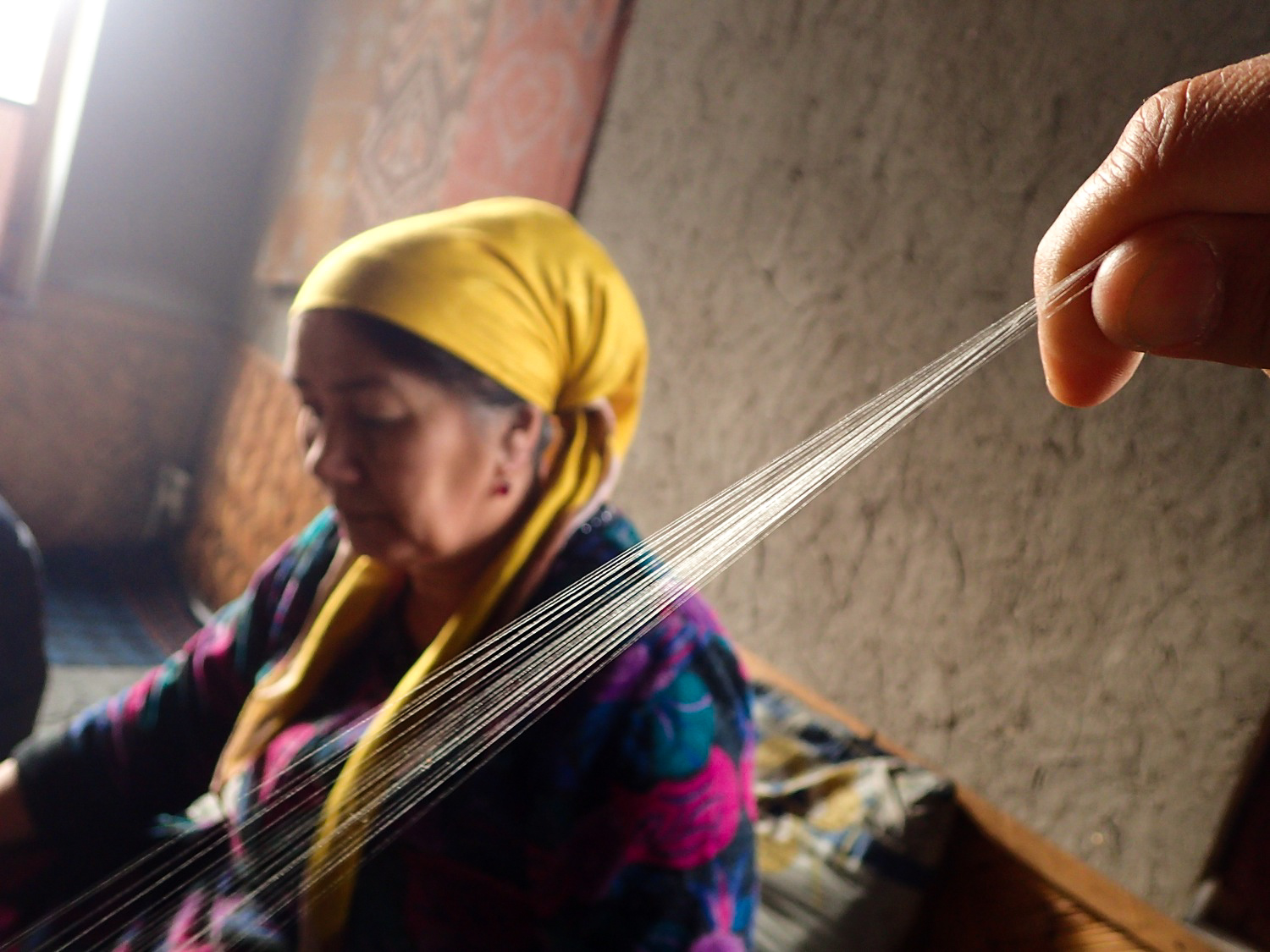
Protein “gold”: Human hair, collected door-to-door, offers some economic relief to the marginalized Mugat community in Uzbekistan.
Paul Salopek
“We don’t cut our client’s hair,” explains one Mugat hair collector, a wary old woman we meet in the border city of Andijan. “Women here just pull it from their combs or drains and save it up for us. We pick it up once every few months. It takes a long time to grow hair.”
The collector does not want to tell us her name.
This is not because the hair trade is in any way illegal in Uzbekistan. It is simply that the industry is cutthroat. The Chinese buyers—the bulk of Uzbek hair is shipped in large bales to China for processing—jealously guard their supply lines. The old woman says she earns a pittance: perhaps a dollar a kilo, or about 50 cents a pound, for her protein wares. But this turns out to be false. The wholesale price of human hair in Uzbekistan is closer to $25 a pound. Villagers’ hair—tresses that may one day be taped to a Kardashian’s skull—is the Mugat’s gold.
There are about 12,000 Mugats in Uzbekistan.
Uzbeks refer to them, often with contempt, as Lyuli or Gypsies, though there is scant genetic evidence linking them to the world’s Roma diaspora. The group divides itself into a caste system that suggests a migration from the Indian subcontinent into Central Asia centuries ago. Traditionally the Mugat were wandering musicians and entertainers. Today they live in tight-knit neighborhoods that are considered no-go zones by other Uzbeks. They are one of the world’s marginal peoples. Many survive by begging, or by recycling scrap metal or plastic bottles.
“Hair is much better,” says Barno Urmanova, a hair broker in the Mugat district of Andijan. “It is more profitable. And we help people feel good around the world, don’t we? Our hair also goes into wigs for cancer patients.”
Urmanova is tough, unafraid, a seasoned matriarch.
Young collectors come and go from her courtyard all day, bearing bags of human hair for weighing on an electric scale—for export. They are Mugat women dressed in long skirts, their own hair covered with kerchiefs. They bring tales of life on the hair trail. They roam the villages for a month at a time, they say, trading hair for cheap plastic table utensils. People sic their dogs on them. Or slam doors in their faces. Men say bad words to them. There are police hassles. The Khorezm district around Bukhara is the worst.
“Some people try to trick you by mixing in men’s barbershop clippings in their supply,” says Urmanova. “It’s too short.”
My guide Khalmuradov and I walk out of Urmanova’s neighborhood of lumpy dirt streets, chained dogs, and frozen junkyards. Many of the men are away, doing menial work in Russia. Good luck charms hang on doors. About a dozen Mugats accompany us to the road. They are very friendly yet seem a little sad. They wave goodbye.
I try to recall what I know of hair.
Hemingway was a hair fetishist. It is a myth that hair continues to grow after death. (It is the tissues that shrink, exposing more follicles.) Each of our bodies is covered by about five million hairs. And now this. We sell everything to each other—the poor and the rich. Our hair is the least of it.
Protein “gold”: Human hair, collected door-to-door, offers some economic relief to the marginalized Mugat community in Uzbekistan.
Paul Salopek
“We don’t cut our client’s hair,” explains one Mugat hair collector, a wary old woman we meet in the border city of Andijan. “Women here just pull it from their combs or drains and save it up for us. We pick it up once every few months. It takes a long time to grow hair.”
The collector does not want to tell us her name.
This is not because the hair trade is in any way illegal in Uzbekistan. It is simply that the industry is cutthroat. The Chinese buyers—the bulk of Uzbek hair is shipped in large bales to China for processing—jealously guard their supply lines. The old woman says she earns a pittance: perhaps a dollar a kilo, or about 50 cents a pound, for her protein wares. But this turns out to be false. The wholesale price of human hair in Uzbekistan is closer to $25 a pound. Villagers’ hair—tresses that may one day be taped to a Kardashian’s skull—is the Mugat’s gold.
There are about 12,000 Mugats in Uzbekistan.
Uzbeks refer to them, often with contempt, as Lyuli or Gypsies, though there is scant genetic evidence linking them to the world’s Roma diaspora. The group divides itself into a caste system that suggests a migration from the Indian subcontinent into Central Asia centuries ago. Traditionally the Mugat were wandering musicians and entertainers. Today they live in tight-knit neighborhoods that are considered no-go zones by other Uzbeks. They are one of the world’s marginal peoples. Many survive by begging, or by recycling scrap metal or plastic bottles.
“Hair is much better,” says Barno Urmanova, a hair broker in the Mugat district of Andijan. “It is more profitable. And we help people feel good around the world, don’t we? Our hair also goes into wigs for cancer patients.”
Urmanova is tough, unafraid, a seasoned matriarch.
Young collectors come and go from her courtyard all day, bearing bags of human hair for weighing on an electric scale—for export. They are Mugat women dressed in long skirts, their own hair covered with kerchiefs. They bring tales of life on the hair trail. They roam the villages for a month at a time, they say, trading hair for cheap plastic table utensils. People sic their dogs on them. Or slam doors in their faces. Men say bad words to them. There are police hassles. The Khorezm district around Bukhara is the worst.
“Some people try to trick you by mixing in men’s barbershop clippings in their supply,” says Urmanova. “It’s too short.”
My guide Khalmuradov and I walk out of Urmanova’s neighborhood of lumpy dirt streets, chained dogs, and frozen junkyards. Many of the men are away, doing menial work in Russia. Good luck charms hang on doors. About a dozen Mugats accompany us to the road. They are very friendly yet seem a little sad. They wave goodbye.
I try to recall what I know of hair.
Hemingway was a hair fetishist. It is a myth that hair continues to grow after death. (It is the tissues that shrink, exposing more follicles.) Each of our bodies is covered by about five million hairs. And now this. We sell everything to each other—the poor and the rich. Our hair is the least of it.