When I was only seven years old, and living in the Uzbek countryside, my parents began sending me on foot to a nearby store to buy groceries. It was then that I began to understand what a kilometer truly means, and how much time you need to move through one.
Guiding tourists in Uzbekistan today, I still travel a lot by foot. I prefer to avoid the popular attractions. I take visitors into residential areas—mountain villages and small towns where life seems not to have changed since the days of the Soviet Union. Wherever farmers live and work, you’re sure to find genuine hospitality and kindness. Ordinary people invite you into their homes and treat you to tea. Tea is followed by all sorts of food and interesting conversations.
I came to guiding for a simple reason. In the 1990s the country I grew up in disappeared. By the time I turned 17, the Soviet Union had fallen apart, and the gigantic empire I once belonged to was gone. I needed to adapt to new realities. By chance, an American businessman offered me a job and sent me on assignments across Uzbekistan. I practiced my English, worked for the first time in an office, and learned about a wider world.
I led my first tourist excursion in the spring of 2000. It was to the old Silk Road city of Samarkand. My foreign clients were satisfied and helped convince me that I could succeed as a guide. For two decades I also worked as a logistician for different international organizations and foreign companies. Between those jobs I showed visitors our cities and soon realized that I liked guiding best.

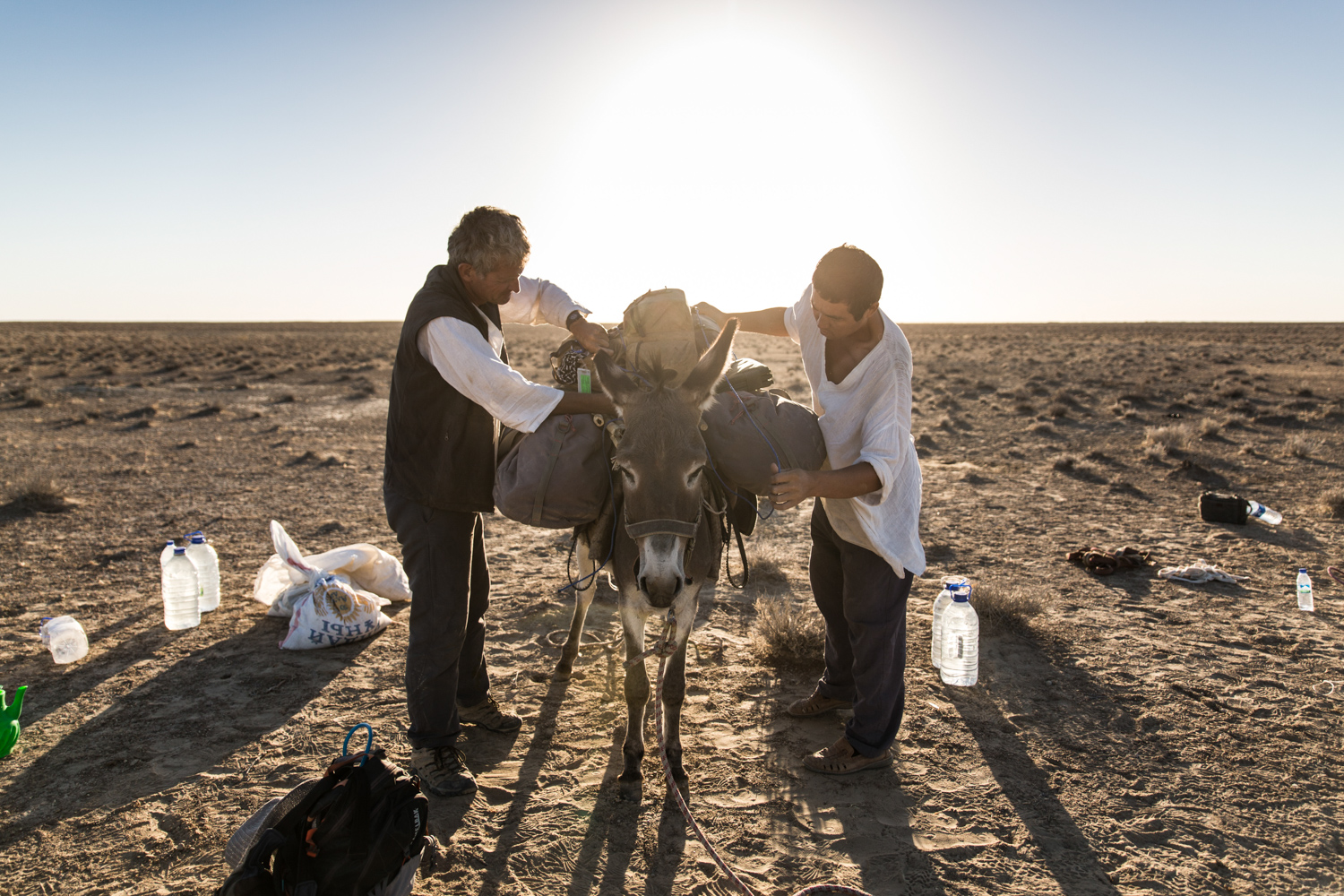
Aziz (right) digging up a water cache in the Kyzyl Kum Desert.
Paul Salopek
Traveling with Paul Salopek, I experienced true asceticism and realized that you can be happy with just a few things in a backpack. We talked a lot about various sensitive issues. We seemed to resolve all the problems of the world by just walking together. With Paul, I learned about another Uzbekistan. We walked pathways I never knew existed. We met people who mistook us for spies and called the police. And many others wondered at our unusual appearance. But I’m infinitely glad that we broke stereotypes and encouraged ordinary people to understand that Paul, who moves long distances on foot, is just like the ancestors who connected us all together. When they got it, even some policemen later called Paul a “knight errant.” It was good to hear!
We started our hike in Uzbekistan at the westernmost point of the country. This desolate region is called the Ustyurt Plateau. If globally the concept of the “West” for many means something well-developed and civilized, then to Uzbeks, in my opinion, the concept means the exact opposite. The west of our country has fewer people and cities. It is a landscape dominated by steppes and deserts where there are few tall trees and little water. It is hard to imagine that here an ancient state called Khorezm, irrigated by the currents of the Oxus River, once flourished.
We watched many sunrises and sunsets. The most beautiful twilights in Uzbekistan are in the Ustyurt Plateau and Kyzyl Kum desert! The landscapes of this region are like the sea—waves of sand frozen in the form of small hills, and on them, a tsunami of light from a rising red sun sweeps the Earth, only to ripple back as a dying sunset.
When you come to villages after a long passage through the hot desert, you clearly hear the sounds of the foliage of the trees and the birds singing. You can hear a bleating goat and a cow mooing. You hear the voices of children playing in the backyard. You can hear and see a peaceful life. These are things you do not attach much importance to until you experience desert silence.
I wondered if warriors attacking villages from the world’s deserts ever felt the same way. And if so, how they could possibly commit violence after finding such silence and relief from exhaustion.

A spectral Aziz walks through the Fergana Valley.
Paul Salopek
In the desert there is a smell. In the morning a light dew moistens the wormwood, and the air is saturated with its wonderful aroma. And in the evening comes the smell of red-hot sands and the smell of the saxaul bush. This was a smell I once recognized in a cold northern city more than 3,000 kilometers away. Out of curiosity, I Googled the weather forecast on that day and was stunned: The wind was blowing in from the deserts of the Middle East.
I miss the evenings spent in the desert under a sky full of stars. I miss chats over a delicious dinner cooked atop a fire beside my tent, where I once lay under a transparent panoramic ceiling, missing a bath and all the amenities of a city apartment.