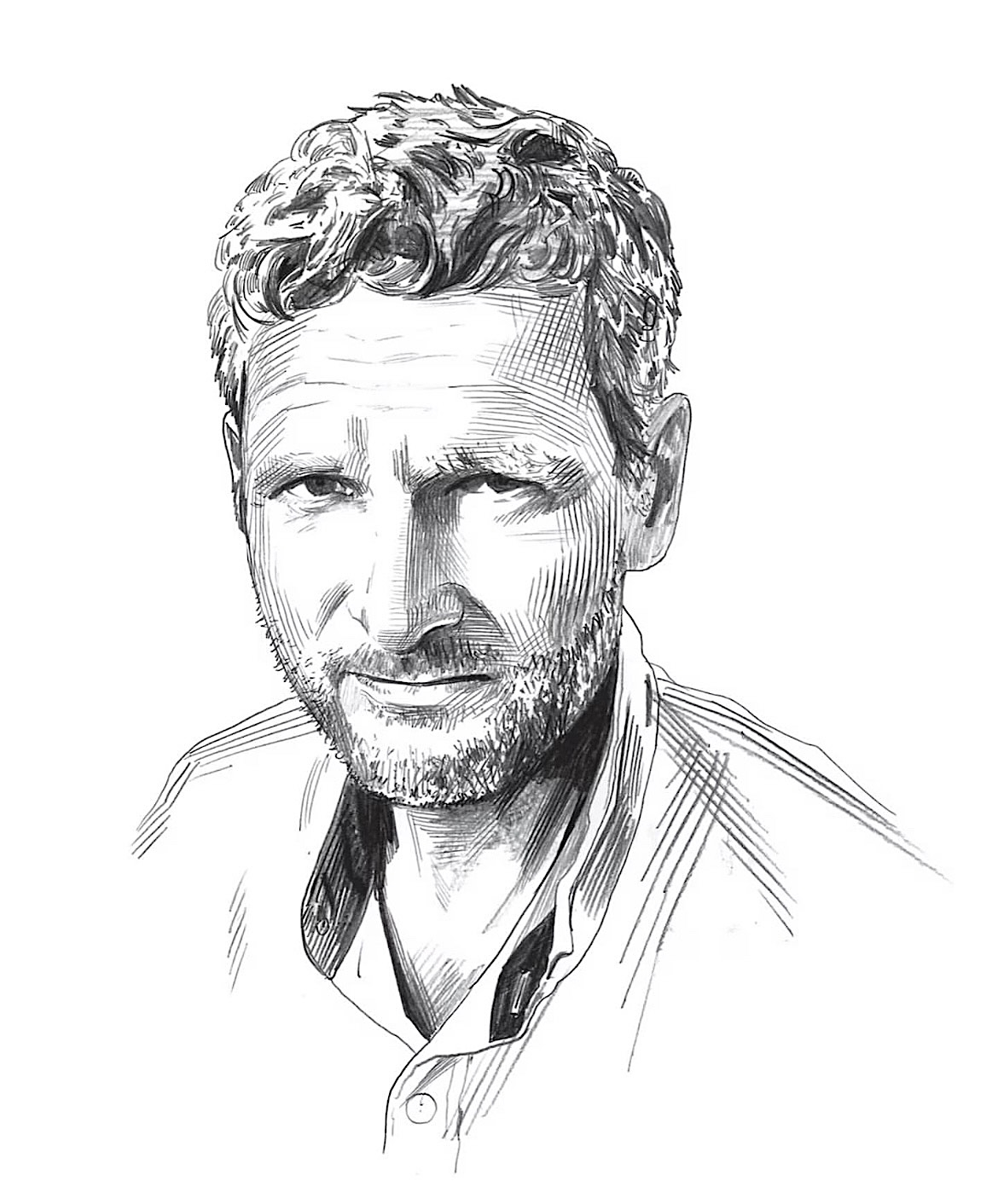
Like most archaeologists, Andrey Astafyev has spent his life looking down.
Over the past two decades, the Russian scientist has walked the brown saltwort deserts of western Kazakhstan, carefully scanning its dust for clues dropped by the parade of humanity that once migrated through Central Asia: Stone Age hand axes, shell beads dating from the Bronze Age, arrowheads from the Silk Road era, and an occasional musket ball from forgotten 19th-century Tsarist forts. This winter, though, after climbing a remote mountain in his vast and largely unpopulated study area, Astafyev peered down at the landscape and decided to leave a few artifacts of his own. Big ones. Copying the designs of local petroglyphs, he used GPS technology, a quadrocopter drone, and a railroad tie roped to his car to sketch colossal geoglyphs across the steppe.
The result of five month’s toil? A 500-foot-long Argali sheep, a mounted archer taller than three football fields, a stylized camel stretching nearly a quarter mile from nose to tail, and two other gigantic motifs borrowed from local history. When Google Earth updates its satellite imagery of Central Asia, you’ll be able to appraise Astafyev’s artwork from orbit.

A centuries-old water well along the old Silk Road is one of the cultural relics studied by Astafyev in Mangystau.
Paul Salopek
“The question was, how to do this without destroying the natural aesthetics,” he wrote me in an email, noting that his inspiration was the famous Nazca Lines of Peru. “I have always been attracted by the brilliant single-tone palette and simplicity of the petroglyphs of the local nomads. With them, everything is harmonious!”
I am walking across the world. And Astafyev’s one-and-a-half man project—he was assisted by his 13-year-old son, Artem—is just the latest boot-level evidence I’ve encountered of humankind’s compulsion to literally redraw the Earth.
Most of these marks are of course modern. We live in the Anthropocene, a geological era utterly shaped by human appetites and technology. So it’s no surprise, then, that our industrial society’s maze of highways, pipelines, dams, reservoirs, railroads, vast cities, and plantations dominate our thumbprint on the globe: Colossal obstacles that are grueling to traverse on foot, because they’re erected by—and designed for—machines, not human muscle and sinew.
But among this boggling matrix of concrete and steel endures a faint tracery of unnatural yet more delicate lines, curves, mounds, depressions, and rills. These are the works of a vanished world: a subtle record, a fading text, a palimpsest, of the 99 percent of our species’ history before the advent of machines. Jason Ur, a Harvard archaeologist who uses satellite photos to map the footpaths between Mesopotamian cities, aptly calls these antique lines and networks “hollow ways.” Worn by the feet of generations of people and animal hooves, or built by hand from the land itself, this web of mark-making is largely invisible to people who travel by car.
At the start of my journey in the Rift Valley of Ethiopia, for instance, I came across horizon-spanning assemblages of stone mounds: a colossal necropolis of pastoral Afar nomad graves utterly unknown to those who traveled the few paved roads.

The ancient rock curbs of the pilgrims’ road. Tarik al hajj, Saudi Arabia.
Paul Salopek
Walking the Hejaz desert of Saudi Arabia, I stumbled into grooves worn through the mountains by centuries of camel caravans bound for Mecca. Often, these beautiful relics snaked unnoticed within sight of booming superhighways.
And on the sun-hammered Ustyurt Plateau of Kazakhstan and Uzbekistan, I tripped over low rock curbs that stretched through dry grasses for miles: hunting traps designed by Iron Age hunters to channel herds of migrating antelope into killing pits.
Andrey Astafyev’s geoglyphs strangely bridge both worlds: the ancient and the new.
I met Astafyev in Aktau, a remote Caspian port that anchors the western shores of the Kazakh steppes. He was proud of the natural and cultural treasures of his cold and semi-arid backyard, a wild district the size of Washington State called Mangystau. The region’s grasslands, salt flats, and jutting buttes still shelter packs of wolves and a few relict populations of antelopes and Iranian leopards. The climate preserves archaeological sites as if in a giant open-air museum. Astafyev experimented with different techniques to make his giant drawings. He ground-up white rocks to “paint” the designs on the soil. He settled on dragging a railroad tie after researching the long-term effects from nearby railroad construction.
“I must paraphrase, on the scale of Mother Nature, the biblical commandment: ‘Do no harm!’” he wrote me.
He is pleased to report that after the spring rains, when the Kazakh steppes fuzz green, his work faded seasonally from view.
The ancient rock curbs of the pilgrims’ road. Tarik al hajj, Saudi Arabia.
Paul Salopek
Walking the Hejaz desert of Saudi Arabia, I stumbled into grooves worn through the mountains by centuries of camel caravans bound for Mecca. Often, these beautiful relics snaked unnoticed within sight of booming superhighways.
And on the sun-hammered Ustyurt Plateau of Kazakhstan and Uzbekistan, I tripped over low rock curbs that stretched through dry grasses for miles: hunting traps designed by Iron Age hunters to channel herds of migrating antelope into killing pits.
Andrey Astafyev’s geoglyphs strangely bridge both worlds: the ancient and the new.
I met Astafyev in Aktau, a remote Caspian port that anchors the western shores of the Kazakh steppes. He was proud of the natural and cultural treasures of his cold and semi-arid backyard, a wild district the size of Washington State called Mangystau. The region’s grasslands, salt flats, and jutting buttes still shelter packs of wolves and a few relict populations of antelopes and Iranian leopards. The climate preserves archaeological sites as if in a giant open-air museum. Astafyev experimented with different techniques to make his giant drawings. He ground-up white rocks to “paint” the designs on the soil. He settled on dragging a railroad tie after researching the long-term effects from nearby railroad construction.
“I must paraphrase, on the scale of Mother Nature, the biblical commandment: ‘Do no harm!’” he wrote me.
He is pleased to report that after the spring rains, when the Kazakh steppes fuzz green, his work faded seasonally from view.