The wildflower meadows of Kyrgyzstan are an overlooked glory of Central Asia. At least to outsiders.
In fact, the most democratic of the former Soviet “Stans” celebrates its floral wealth with much the same nationalist pride that less enlightened countries reserve, say, for flippantly sacrificing such natural wonders. According to one botanical website, of the 80 varieties of tulips in the world, 22 can be found in Kyrgyzstan. “Holland is commonly known as the Tulip state,” the site notes testily, “but the original Tulip state is in fact Kyrgyzstan.”
I am walking across the world. I once studied biology.
As I hike out of Kyrgyzstan, traversing the lush valleys of the Alai Mountains bound for the neighboring state of Tajikistan, I rack my brain to recall the names of the constellations of flowers that, mile upon mile, I wade through: Poppies. Vetches. Bedstraws. St. John’s wort.
Naturally I lifted these delightful names from the British press.
It is reassuring to know—in these anarchic, shark-pool, digital media days—that English newspapers still not only employ “gardening correspondents” but also send them on far-flung assignment to remotest Kyrgyzstan to botanize, on horseback, for readers. (“Under hot sun we trot ever higher past wild white roses and rocks crammed with saxifrage and campanulas.”) It is no accident that Evelyn Waugh chose a mild-mannered nature writer as his foil in the novel Scoop, his classic satire of war correspondence. (“Feather-footed through the plashy fen passes the questing vole," writes his garden-columnist hero, who is shipped off to an African war zone by mistake.)

Joldoshbaev's horse is named Jackie Chan.
Paul Salopek
But the flowers of Kyrgyzstan are worthy of greater poets.
The lush grasslands south of Sary Mogol roll like a chlorophyll sea against the high snowy peaks of the Pamirs. These pastures are smeared with dense archipelagoes of purple, white, yellow, red and blue corollas. It is impossible not to feel giddy, light-hearted, besotted with splendor as I bound from flower petal to flower petal.
In the epic of Manas, the immensely long and old Kyrgyz poem of national identity, the warrior hero takes his rest at an oasis where nightingales sing 40 melodies and the flowers shined with 40 colors.
Yunus Emre, the 13th-century dervish mystic, was said to have whispered “Allah! Allah!” every time he smelled a rose.
Between 35,000 and 45,000 years ago, an aged Neanderthal was buried with flowers—one of the earliest hints of human compassion on record.
“I have seen almost more beauty than I can bear,” wrote Everett Ruess, a young vagabond-poet who disappeared while wandering the deserts of the American Southwest in 1934.
Nearly 3,900 vascular plants bloom in Kyrgyzstan. This is about a quarter of the flora of the entire United States—packed within an area just one-fiftieth the size of the larger country. Tiny Kyrgyzstan offers the world a dazzling bouquet of biodiversity.
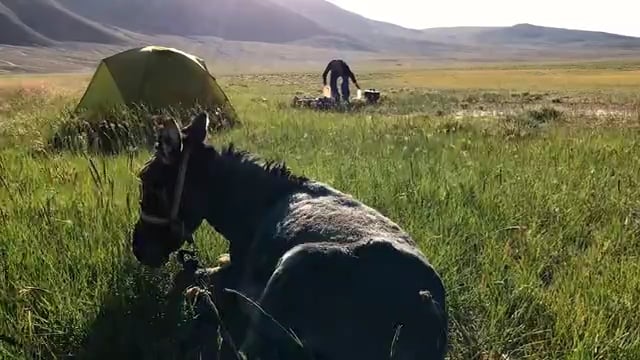
I walk 27 miles across the Alai Valley. I camp in flowers. I sit in flowers. I cook in flowers. I dream in flowers. Flower petals float in my evening cups of tea. I am walking, pollen-coated, to the border checkpoint of Tajikistan.
“Why are there so many flowers?” I ask Eshembay Joldoshbaev, my Kyrgyz guide, who leads the way on horseback.
“Lazy shepherds,” Joldoshbaev says, shrugging. “Too far to bring sheep to graze here.”