The relaunch of the Out of Eden Walk in Central Asia has not been without hiccups.
First, barely two days before departing, while chewing into breakfast in Bishkek, Kyrgyzstan, I cracked a molar in half. (“I’ll try to get you to India,” the dental surgeon said, doubtfully.) Then mountain guide Sergei Gnezdilov fell ill with adult-onset chicken pox and had to abandon the trail, swollen in misery, for a hospital in the capital. Our first (and quickly retired) Kyrgyz cargo donkey bit a team member in the crotch. And after crossing the Tajikistan border, our second pack donkey escaped not once, but twice, in the same evening—the second time into an ice storm howling above 14,000 feet.

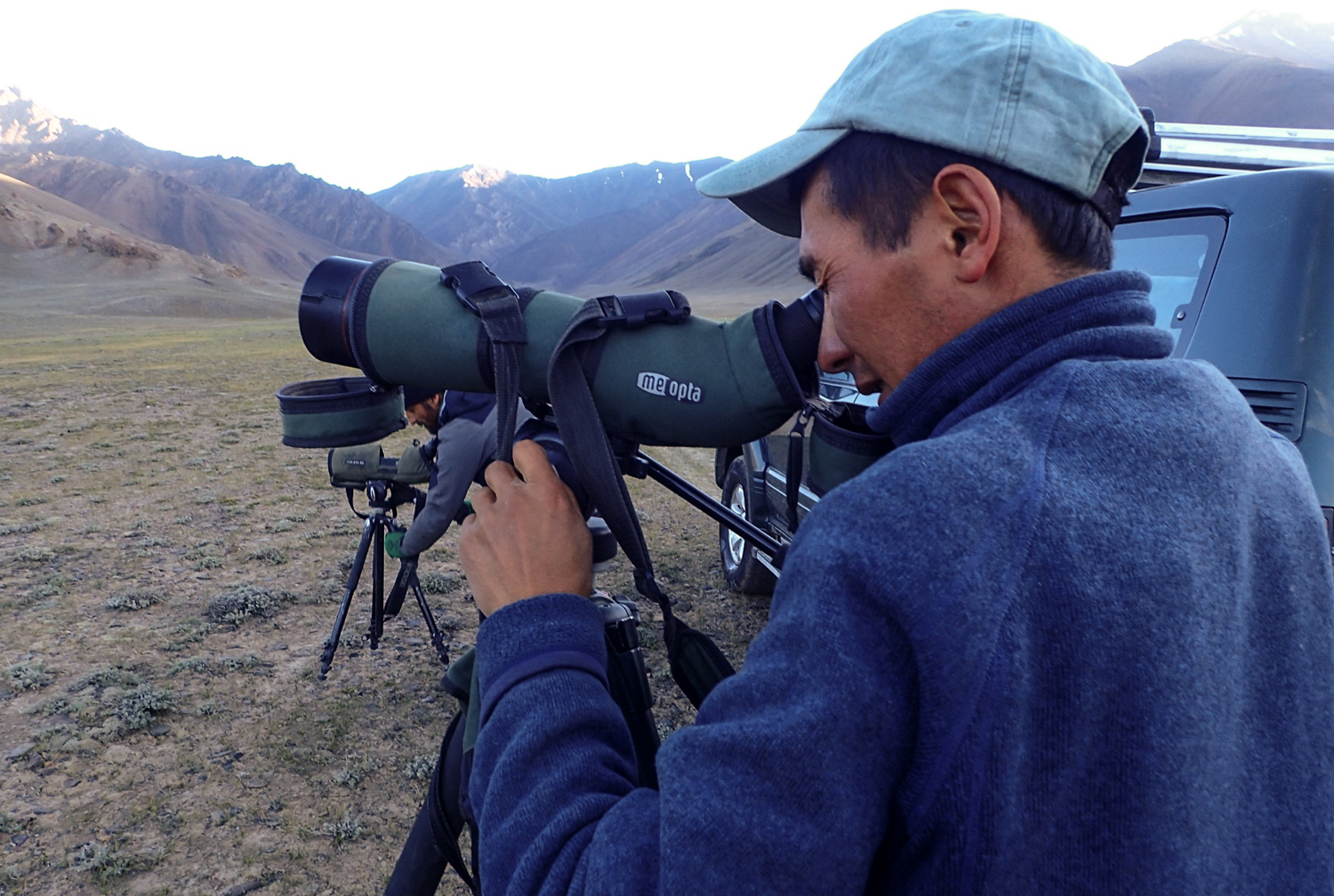
Furough Shakarmamadova (right) and Safar Ali trying to locate a lost pack donkey.
Paul Salopek
“Woooooo! Cool!” hooted Furough Shakarmamadova, pumping her arms in the air in triumph when at last we found our long-eared Houdini by hiring a truck to conduct a reconnaissance. (The donkey had trotted all the way back to the Kyrgyz border, a day’s walk away, and was detained by alert border guards.)
Shakarmamadova, 23, does this often: She cheers victories large and small. My new partner, a Pamiri mountain guide, is a woman of enthusiasms. So is her colleague, Safina Shoxaydarova, also 23, my second walking partner in the rugged Pamirs. Together they are among the first generation of Muslim female trekking guides in the rugged and remote mountains of eastern Tajikistan, and I intuited my luck would change after engaging them.
So it has.

Shakarmamadova: a woman of enthusiasms
A. Jegnaradze
Along with Safar Ali, our wry donkey wrangler, we have been pacing off 20-mile days en route to India, through the crystalline sharpness of life at high altitude. We have at last found our balance across a dizzying Central Asian cordillera known as the “roof of the world.”
Seven centuries ago, Marco Polo described the craggy redoubt of the Pamirs as “nothing but a desert without habitations or any green thing, so that travelers are obliged to carry with them whatever they have need of.” Kyrgyz shepherds moved in during the 1600s. And in the 19th century, Russian, and British spies skulked through the desolate wilds of the Pamirs, hoping to push out the edges of their colonial empires in a Victorian cold war called “The Great Game.” (One British officer diplomatically advised his subordinates not to flinch if they encountered their geopolitical frenemies on the trail—and were subjected to Russian bear hugs.)
We walk along the Pamir highway—Soviet-built in the 1930s, crumbling back into the elements, and the second highest road in the world after the Karakoram. We take shortcuts across the high, cold desert of Karakul. We follow the new border fence marking moonscape frontier lands recently ceded to China.
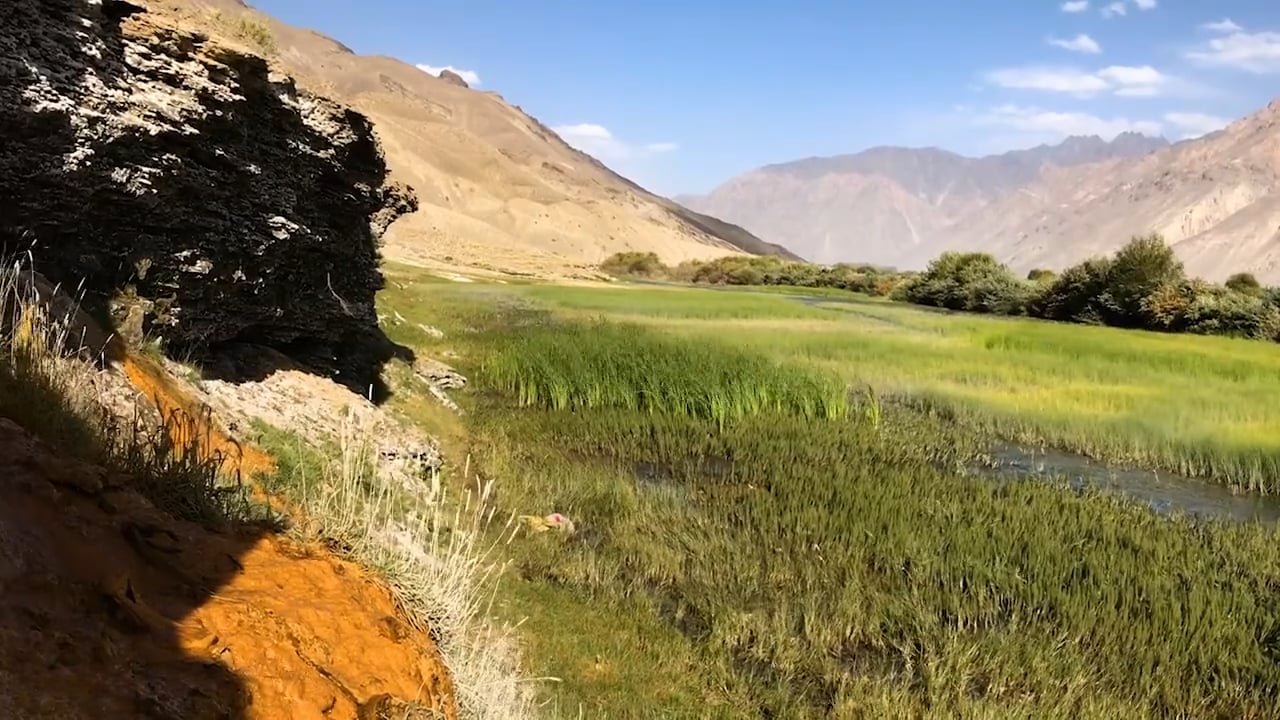
We camp in high, lush meadows.
Here the streams are like the capillaries of the mountain range: sand-dry in the afternoons but refilled with snowmelt each evening, a pulse of geological heart-water that beats magically, once in a day.
These streams aren’t the only signs of deeper rhythms, older heartbeats, in the Pamirs.
The mountains also breathe like a supine giant. In the mornings the cold night air flows heavily down into the valleys like a cool intake of breath. And in the afternoons the same air heats and expands in the lowlands, blowing upslope toward the summits like a long, hot exhalation. In this way, every 24 hours, the cordillera’s anabatic and katabatic winds shift in a moment’s pause, mimicking the act of breathing.
The Pamirs are alive.
Shakarmamadova: a woman of enthusiasms
A. Jegnaradze
Along with Safar Ali, our wry donkey wrangler, we have been pacing off 20-mile days en route to India, through the crystalline sharpness of life at high altitude. We have at last found our balance across a dizzying Central Asian cordillera known as the “roof of the world.”
Seven centuries ago, Marco Polo described the craggy redoubt of the Pamirs as “nothing but a desert without habitations or any green thing, so that travelers are obliged to carry with them whatever they have need of.” Kyrgyz shepherds moved in during the 1600s. And in the 19th century, Russian, and British spies skulked through the desolate wilds of the Pamirs, hoping to push out the edges of their colonial empires in a Victorian cold war called “The Great Game.” (One British officer diplomatically advised his subordinates not to flinch if they encountered their geopolitical frenemies on the trail—and were subjected to Russian bear hugs.)
We walk along the Pamir highway—Soviet-built in the 1930s, crumbling back into the elements, and the second highest road in the world after the Karakoram. We take shortcuts across the high, cold desert of Karakul. We follow the new border fence marking moonscape frontier lands recently ceded to China.
We camp in high, lush meadows.
Here the streams are like the capillaries of the mountain range: sand-dry in the afternoons but refilled with snowmelt each evening, a pulse of geological heart-water that beats magically, once in a day.
These streams aren’t the only signs of deeper rhythms, older heartbeats, in the Pamirs.
The mountains also breathe like a supine giant. In the mornings the cold night air flows heavily down into the valleys like a cool intake of breath. And in the afternoons the same air heats and expands in the lowlands, blowing upslope toward the summits like a long, hot exhalation. In this way, every 24 hours, the cordillera’s anabatic and katabatic winds shift in a moment’s pause, mimicking the act of breathing.
The Pamirs are alive.
A Camp in Heaven
Out of Eden Walk