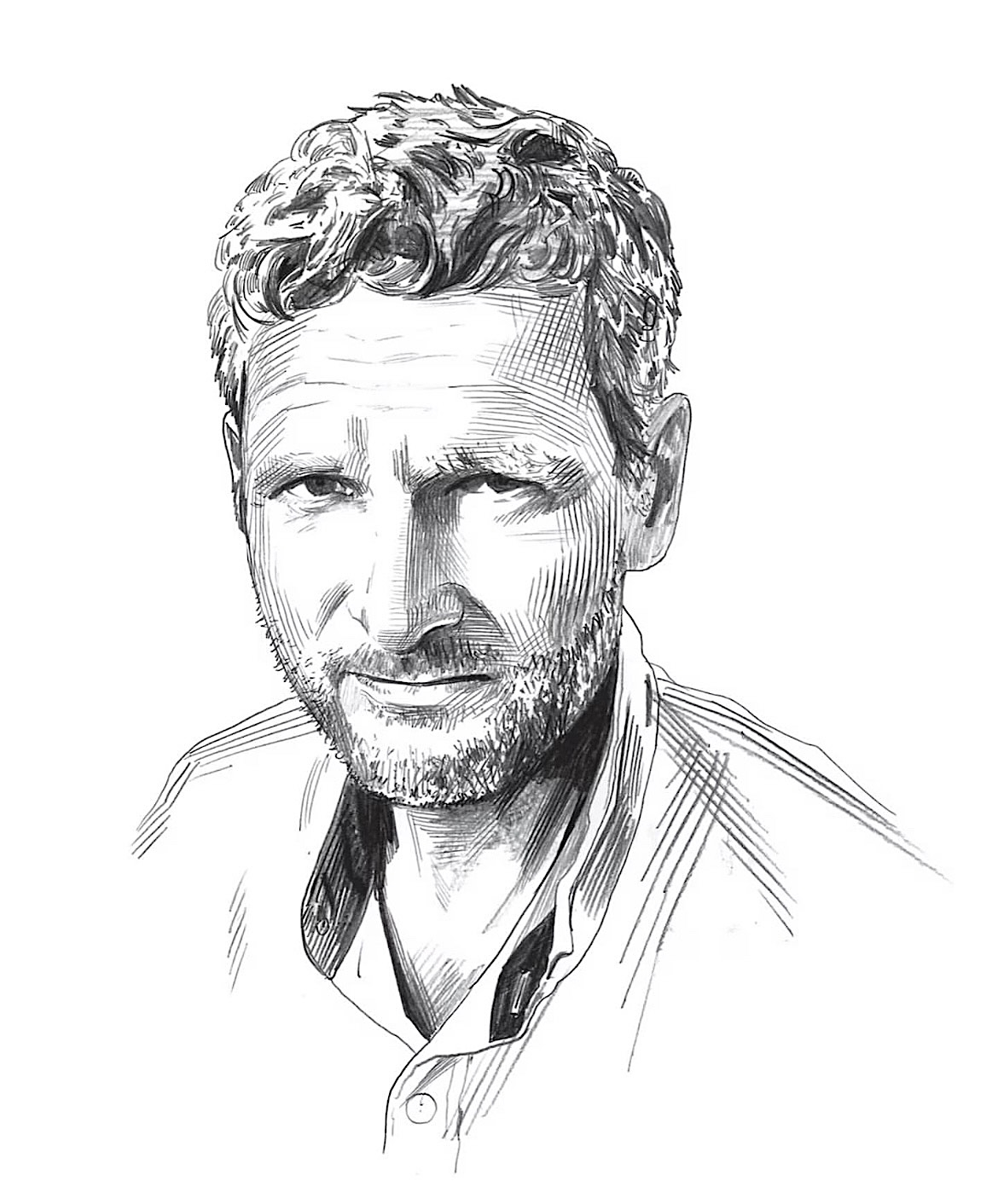
It is Mahan Atabaev: skinny, wind-burned, a pastoralist in a baseball cap. He stands in a chilly alpine dawn, urging me look through a spotting scope.
The scope is trained on a valley high in the Pamir range of Tajikistan. I crouch to peek, and what I see is this: animals that appear to be carved from light. They literally shine. They graze on the steep mountainside, glowing pale in the sunrise, perfect in every detail. They are wild Marco Polo sheep. A big ram, easily weighing hundreds of pounds, carries a crown of spiral horns. Atabaev grins happily at me.
Over the past five years, the population of wild sheep in this rugged Central Asian valley has grown from zero to more than 70 magnificent animals. In fact, over the same period, the number of Marco Polos in the surrounding mountains has boomed 10-fold from just 50 to some 500. Ibex, a wild antelope, also have expanded their ranks. And local sightings of one of the world’s most elusive predators, snow leopards, have ticked up from zero to six cats.

School students in Alichur pretend to be snow leopards and their prey in a game of “predator-proof your corral.”
Paul Salopek
“We missed our animals,” Atabaev tells me back in Alichur, his dust-blown village of ethnic Kyrgyz sheep and yak herders. “Our ancestors safeguarded the wildlife for us. Then we hunted it until it was all gone. Now we want it back.”
Atabaev is not your typical environmentalist.
He admits to killing at least 800 wild animals in his career as a poacher for his remote community, especially during Tajikistan’s hungry years in the 1990s, when civil war erupted after independence from the Soviet Union. (To feed his neighbors, Atabaev once gunned down 15 ibexes on a single hunt, using a Kalashnikov assault rifle.) Yet today he is leading his village in a pioneering experiment in community conservation, a grassroots approach that puts the care of often ravaged ecosystems into the hands of the local people who actually inhabit the landscape. The effort has succeeded so well in tiny Alichur—generating income from commercial hunting and, hopefully soon, from ecotourism—that the villagers who repurposed 250 square miles of their high-altitude pastures to benefit scarce wildlife now plan to add nearly 150 square miles more to their Burgut Community Conservancy.
I am walking across the Earth.
Over the past four years, I have retraced the footsteps of the first humans who colonized the planet in the Stone Age. Sometimes I follow the ancient migration corridors of wild animals that once drew our ancestors to unexplored horizons. Environmentally, it’s been a sobering experience. Apart from my trek’s starting line in the Rift Valley of Ethiopia, where I camped among free-roaming ostriches and hyenas, my 7,000-mile route so far has been largely devoid of wildlife sightings.
In the sprawling Anatolian peninsula of Turkey, for example, I spotted mainly turtles and foxes over the course of more than 750 walked miles. The colossal herds of saiga antelope that teemed within living memory on the Ustyurt Plateau of Kazakhstan and Uzbekistan were almost gone. And in Saudi Arabia I stumbled into a metaphor for our lonesome times: Falconry hunters were broadcasting birdcalls on loudspeakers into the desert sky, attempting to lure in prey for their hooded raptors. The tinny birdsongs vanished into empty space.
This is hardly a surprise.
As the environmental journalist Elizabeth Kolbert writes in her book The Sixth Extinction, humanity today is living through one of the most catastrophic die-offs of biological diversity in our planet’s history. By the end of this century, many scientists warn, up to half of all life forms still alive on the globe will be driven to extinction. A major study last year projected that by 2020 the number of vertebrate species will plummet to just a third of the levels recorded only 50 years ago. The source of most of this carnage, of course, is us.
As I plod the continents from Africa through the Middle East and on to Central Asia, en route to my walk’s finish line at the tip of South America, I have witnessed at boot level a planet utterly transformed to suit the needs of Homo sapiens, not snow leopards or salamanders. Mile after slow mile, I have seen wild habitats shunted aside by roads, factories, industrial farming, and exploding megacities. Windblown trash has been nearly inescapable, even in the remotest stretches of my walk. To believe that a planetary biosphere can be torn apart in this way without consequences—to believe that humans too aren’t animals—is a folly that only can occur to people drugged by cars.

Herder Maderbek Tajikbaev has benefited from a predator-proof corral thanks to the conservation organization Panthera. In exchange, he promises not to trap snow leopards.
Paul Salopek
This is why the small but significant counter revolution I encountered while walking in Central Asia is heartening: It is a green movement led by ordinary people, by shepherds, teachers, and farmers, and not by governments or global media campaigns.
Community conservation isn’t a new idea.
The concept was first tested decades ago in Africa, mainly to save endangered and charismatic species such as elephants from slaughter. The premise is simple: Reintegrate wild spaces—and the animals that live in them—back into the economies of local people. You won’t poach a rhino, the model predicts, if that rhino brings you and your village a concrete value such as tourism dollars, or game ranger jobs. In effect, nature becomes shared capital. It is “owned” by the community. A wild mountain and the ibex living on it are as prized as a power station or a herd of cows.
Community conservation has had its ups and downs. Management plans can be disrupted by greed. Wars and political upheaval have destroyed fragile community-run wildlife parks. But in two nations in Central Asia, Tajikistan and Kyrgyzstan, the effort has taken promising root.
“I used to think conservation was only about animals,” says Tanya Rosen, a field biologist sharing community-based conservation methods in both countries for an American conservation group called Panthera, with support from the National Geographic Big Cats Initiative. “But 80 percent of my job is about people—about marketing, diplomacy, economics. After you take care of all that, the animals don’t need much help. Animals sort of take care of themselves.”
The hardest part of such grassroots conservation solutions, Rosen adds, is patience: "The payoff can take years."

A wildlife officer displays a list of 20 village men who have volunteered as game rangers to protect wild animals in a community conservation area in the Alai Mountains of Kyrgyzstan.
A. Jegnaradze
In Kyrgyzstan, roughly 5,000 inhabitants of two villages in the Alai Mountains advised by Rosen have agreed to impose a five-year moratorium on all hunting in the region in order to allow devastated populations of ibex, bears, and lynx to recover. The villagers’ plan is to eventually reopen hundreds of thousands of acres of their craggy green pastures to monitored sport-hunting safaris and build yurt camps for eco-friendly hikers. Twenty local men have volunteered as rangers, in the meantime, to guard against poaching.
In Alichur, the isolated village of shepherds in Tajikistan, such community organizing is already yielding results for both the animals and humans.
Not only has long vanished wildlife begun to return to the area. For the first time ever villagers are receiving half of the licensing fees imposed on foreigners who come to trophy hunt sheep. A Marco Polo permit costs $45,000. Alichur’s cut has gone toward building three new houses for destitute village families. Ten families also earn income from jobs as hunting guides, cooks, and yak wranglers for international hunters.
“Some foreigners say they don’t like any type of hunting at all,” says Atabaev, the village leader organizing his community’s conservancy. “But here are old Marco Polo sheep or Ibex that will die anyway, and those are the ones we allow to be hunted.”
Alichur’s conservation plan is hopeful, layered.
The villagers want to use the surrounding nature to attract the Western tourists who bicycle past their homes on the otherwise desolate Pamir Highway. Their conservancy also pays local herders to “predator proof” their corrals with wire mesh. This prevents snow leopards from killing sheep, thus minimizing human-cat conflict. Some ideas will work. Others won’t. It’s an ongoing innovation.
When I walked through Alichur, the village school and Panthera were co-hosting a wildlife camp for students. The children of shepherds drew wild creatures that only their grandparents had seen and that were prowling again in their mountains, back this time as partners in survival.