Almost 130 years ago the representatives of two unequal empires faced off inside a royal tent in the remote Gilgit-Balistan region of Pakistan.
Sir Francis Younghusband, a British colonial officer and master spy, arrived in full regimental uniform—shining with brass and braid—hoping to overawe the court of the fiercely independent kingdom of Hunza. Safdar Ali, the wily ruler of that small and reclusive mountain state, peacocked to the meeting in equally resplendent silks. The summit didn’t go well. Each man ended up lecturing the other about the superiority of his respective nation. “He was under the impression”—Younghusband sniffed of Ali—“that the Empress of India, the Czar of Russia, and the Emperor of China were chiefs of neighboring tribes.”
History hasn’t been kind to haughty outsiders in Gilgit-Baltistan.
The feudal principalities of far northern Pakistan, home to walled villages, yak herders, glacial rivers, golden poplar forests, and snow leopards, have held off—or played off—would-be conquerors ranging from Alexander the Great to 19th-century Sikhs. The British were no different. They decamped from South Asia in 1947. But the political autonomy of tiny Hunza, a 900-year-old dynasty, endured for another quarter century: The last king of Hunza ceded sovereignty to Pakistan only in 1973. Even today the region still clings to a strong identity, thanks to its shield of extreme geography—the greatest concentration of 25,000-foot peaks in the world puncture the sky here—and political sensitivities. (The area is contested by India in the unresolved Kashmir dispute.) Foreigners were barred from much of the district until the early 1980s.
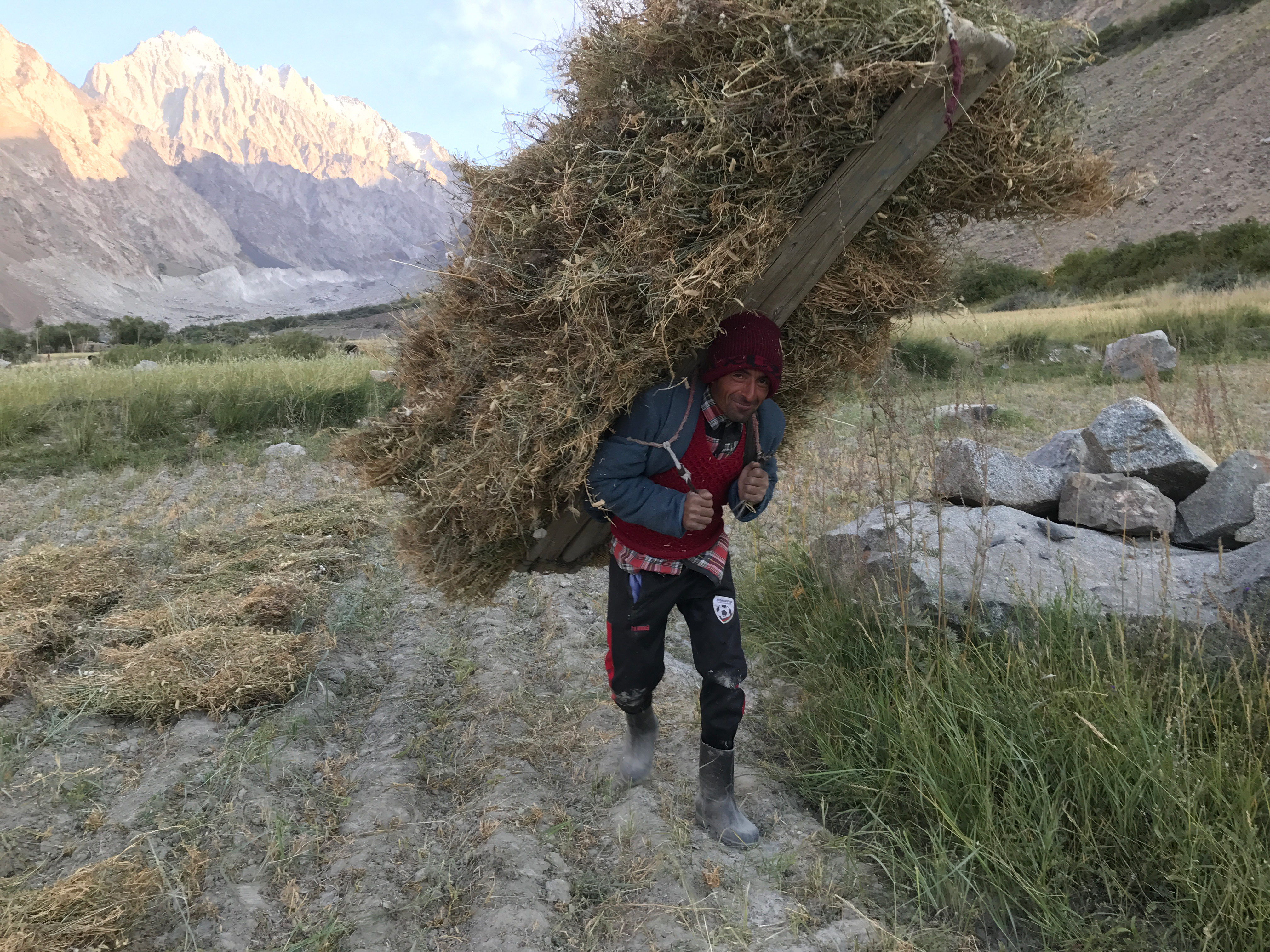
“The first trucks arrived in my father’s time, and people put bundles of hay in front of them,” said Naveed Akhtor, a clinic worker in a remote valley that still barters with neighboring Afghanistan via yak caravan. “Farmers thought the vehicles were animals. So they tried to feed them.”
Gilgit-Baltistan is the unknown face of Pakistan.
Rugged, cold, wild, and largely untroubled by security concerns haunting other parts of the country—the only terror attack against foreigners in the region occurred five years ago—it is a high-altitude wilderness often compared in scenic beauty to alpine Switzerland and the Rockies. Its settled valleys, plied for centuries by Silk Road traders from China, India, and Central Asia, shelter a mosaic of ethnic groups and local languages. The inhabitants, many of them moderate Ismaili Shiites, have the highest literacy rates in Pakistan. And the region’s sprawling Deosai National Park, a habitat for the Himalayan brown bear, has been proposed as a UNESCO World Heritage site.
Yet today Gilgit-Baltistan’s long isolation is ending.

Clawing the thin mountain air, the peaks of Cathedral Ridge, near the village of Passu, are a tourist magnet.
Paul Salopek
Recent upgrades to the Karakoram Highway—financed by Beijing as part of its ambitious China-Pakistan Economic Corridor project, which aims to link Xinjiang to the Arabian Sea—is cracking open Pakistan’s hidden north as never before. Major hydropower projects are underway. Fiber optic cables are being laid. And the biggest tourism boom in Pakistan’s history, fueled by road construction, has brought an astonishing 1.7 million domestic visitors this year to the ecologically fragile Himalayan uplands bordering Afghanistan and China. “I’m Googling at night about Nepal,” says an overwhelmed local administrator grappling with infrastructure challenges similar to those faced by the world's most famous mountain tourism destination: sanitation woes, trash, and pell-mell development.
The Out of Eden Walk will ramble through little seen Gilgit-Baltistan in the weeks ahead. The rapidly changing landscapes of this old Silk Road frontier are no more evident than in Gulmit, the site where British captain Younghusband and Hunza king Ali parleyed in 1889.
The village’s dirt main street, overlooked by a dilapidated royal cottage, sometimes doubles as a polo field—the sport of vanished kings. A brand-new resort located nearby on the Chinese-paved highway offers Italian pastas on its menu. The chef was trained in Arizona.