We are walking the Grand Trunk Road.
There is nothing in the least unusual about this fact.
The Grand Trunk Road has been in use as a walking track for perhaps 2,300 years. It is one of the oldest conveyors of both people and trade in Asia—and probably the world. It connects the Bay of Bengal, on the lush, steaming, tropical coastline of India, to the high, dry, and wind-stripped plateaus of faraway Afghanistan.
Today the government of Pakistan has built a modern bypass—a soulless, high-speed motorway constructed of mile after mile of sterile concrete—around the windier, historic, now traffic-clogged lanes of the Grand Trunk Road. Yet the GT, as it is locally known, still roars chaotically on. It howls with the din of mixed traffic: colorfully painted trucks, motorized rickshaws, donkey carts, motorcycles, cars, bicycles, horsemen, tractors, and thousands of dazed pedestrians. Each of these humans, animals, and conveyances jockey, in no discernable pattern, for every inch of space on the road’s narrow belt of asphalt. Life on the Grand Trunk, which ribbons away for thousands of miles east into India, hasn’t changed appreciably in the century since Kipling described it in Kim:
“All castes and kinds of men move here. Look! Brahmins and chumars, bankers and tinkers, barbers and bunnias, pilgrims and potters—all the world going and coming. It is to me as a river from which I am withdrawn like a log after a flood.”
This is why mere car commuters—as opposed to genuine travelers—avoid it today.
My walking partner, Naveed Khan, and I trek the Grand Trunk Road for 190 miles across the Punjab from the Pakistani capital of Islamabad to the walled city of Lahore. For three weeks we dodge homicidal drivers. We bend forward as if against a gale, shouldering through a sonic wall of deafening engine noise. (Walking two strides apart on the road’s verge, we must scream into each other’s ears to make ourselves heard.) We wipe our faces with tissues at the end of each day: The paper comes away black with car exhaust. We sneeze out asteroids of carbon from our noses, our lungs. The road’s pollution is so dense, it reflects light: a peppery mist from hell. In Rawalpindi we encounter our first fiberglass cows. They are life-size. They stand in road medians.
“The city commissioned them,” explains Mohamad Mehtab Ansari, a fiberglass sculptor who lives along the GT. “They remind you of village life.”
They don’t. (Some of the cows are purple.)

The Grand Trunk Road near Rawat: teeming with cars, trucks, bicycles, and motorbikes—and watched over by a fiberglass brontosaurus.
Paul Salopek
We find Ansari easily: What other house on the Grand Trunk Road features in its front yard a 35-foot-tall brontosaurus? Ansari shows us a gallery of his past work on his phone: a giant horse, a leopard, more cows.
Several men in plainclothes approach. They gather around Ansari’s phone.
Who are these strangers?
They are young military intelligence officers sent to walk with us—discreetly, a few hundred yards behind. It is for our own security, we are told. We tell them: It is not necessary. But our complaints are useless. Still, they are good boys. “Will you please call our major?” one of the officers asks my partner, Naveed Khan. “Can you say that you don’t need us?” He says his feet are sore.
Who built the Grand Trunk Road?
The Pakistani writer Salman Rashid awards this laurel to Chandragupta, the remarkable founder of the Mauryan Empire. (321 to 185 B.C.) Chandragupta was the great unifier of the Indian subcontinent. Raised by a cowherd, he built an empire in South and Central Asia that in its five-million-square-mile sprawl matched the area of the territories conquered by Alexander of Macedon and later by Rome. He gave away his throne willingly and died poor, as a Jain monk, after starving himself to death in a cave. Why have you probably not heard of Chandragupta? Possibly because you have been taught only Western history. Which is to say: You have learned a fraction of the extraordinary story of the world.
Rashid, the writer, quotes the Indika, a journal kept by an ancient Greek diplomat to the Mauryan court:
The Indika tells us that Chandragupta had the equivalent of the modern Highways Department whose overseers ensured that the roads were in perfect fettle. That there were inns at intervals equal to a day's journey and that these roads were shaded by spreading trees. Thank heavens some moron had not yet brought the accursed eucalyptus out from Australia. At crossroads signs told travellers what town or city lay in which direction and presumably bills were not plastered over them as it happens in Pakistan today.
In the Punjab a tree stands sentinel near an old railway line at Wazirabad.
Paul Salopek
We cross the Chenab River, one of the tributaries of Indus, on a high bridge.
There is a famous legend about the Chenab.
Sohni, a beautiful potter’s daughter, falls in love with a handsome buffalo herder named Mahiwal. Their dalliance is forbidden by strict caste laws. But when have such obstacles ever stopped true love? The couple meet secretly along the riverbank at night. Sohni paddles to her lover: She crosses the muddy Chenab inside a large clay pot. One day a jealous sister-in-law spots Sohni returning from her tryst and replaces the girl’s baked pot with a pot of unfired clay. This vessel melts away in the river water. Sohni cries out to Mahiwal. Mahiwal dives in to save her. Both lovers drown.
Countless songs, poems, and Bollywood films commemorate this Romeo and Juliet of the Punjab. When I inform an Islamabad friend, Husanara Mahmud, that I am walking across the Chenab, she sings me a version of the folktale via WhatsApp.
“Life for young people has changed a lot since those old days,” says Areeba, 24, a chicly dressed advertising student who sips iced coffee at a Starbucks clone on the north bank of the Chenab River. “Back in the day, girls didn’t have the liberty to roam or even to go into a public space alone without facing negative gossip,” she says. “That was a time of arranged marriages.”
Her fiancé, a business major named Nauman, 26, nods in agreement. “With the passing of time, people get more educated,” Nauman says. “My family is open-minded.” The couple plan to marry next year. They are a modern love match.
Several days later, Nauman sends a text message: They want to be written about anonymously.
Why? I ask, perplexed.
“Our families don’t want it,” he replies. “So it is my humble request that you please fake our names and blur the pictures.”
We walk on.
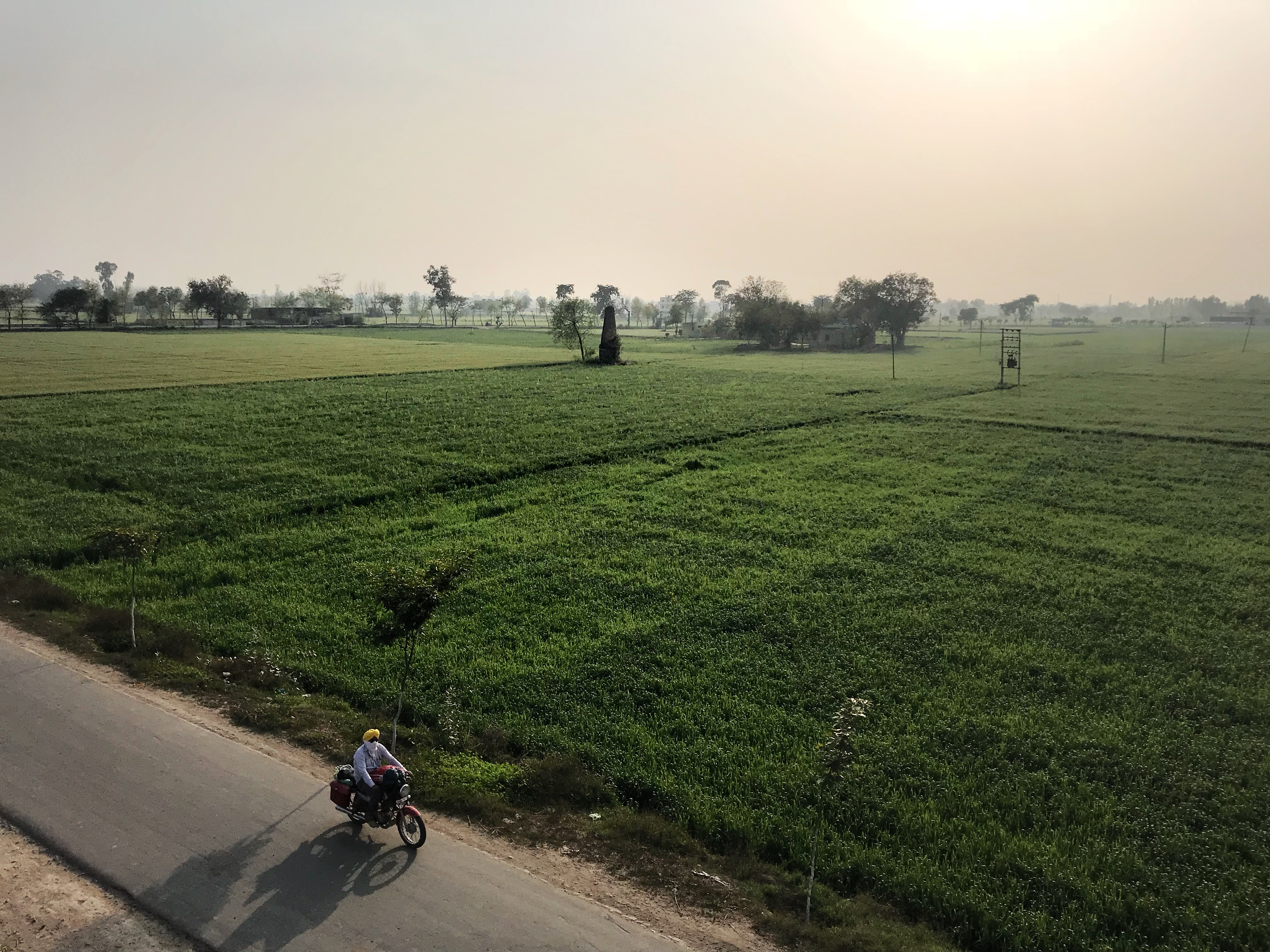
We pass fields of wheat so incandescently green they burn out the eyes. We pass thickets of wild marijuana.
We sleep in farmers’ homes. In cavernous hotels next to equally gigantic and boxy wedding halls. (Pakistani weddings have guest lists hundreds of names long.) We bed down at truckers’ flophouses. We unroll our sleeping bags inside a police station.
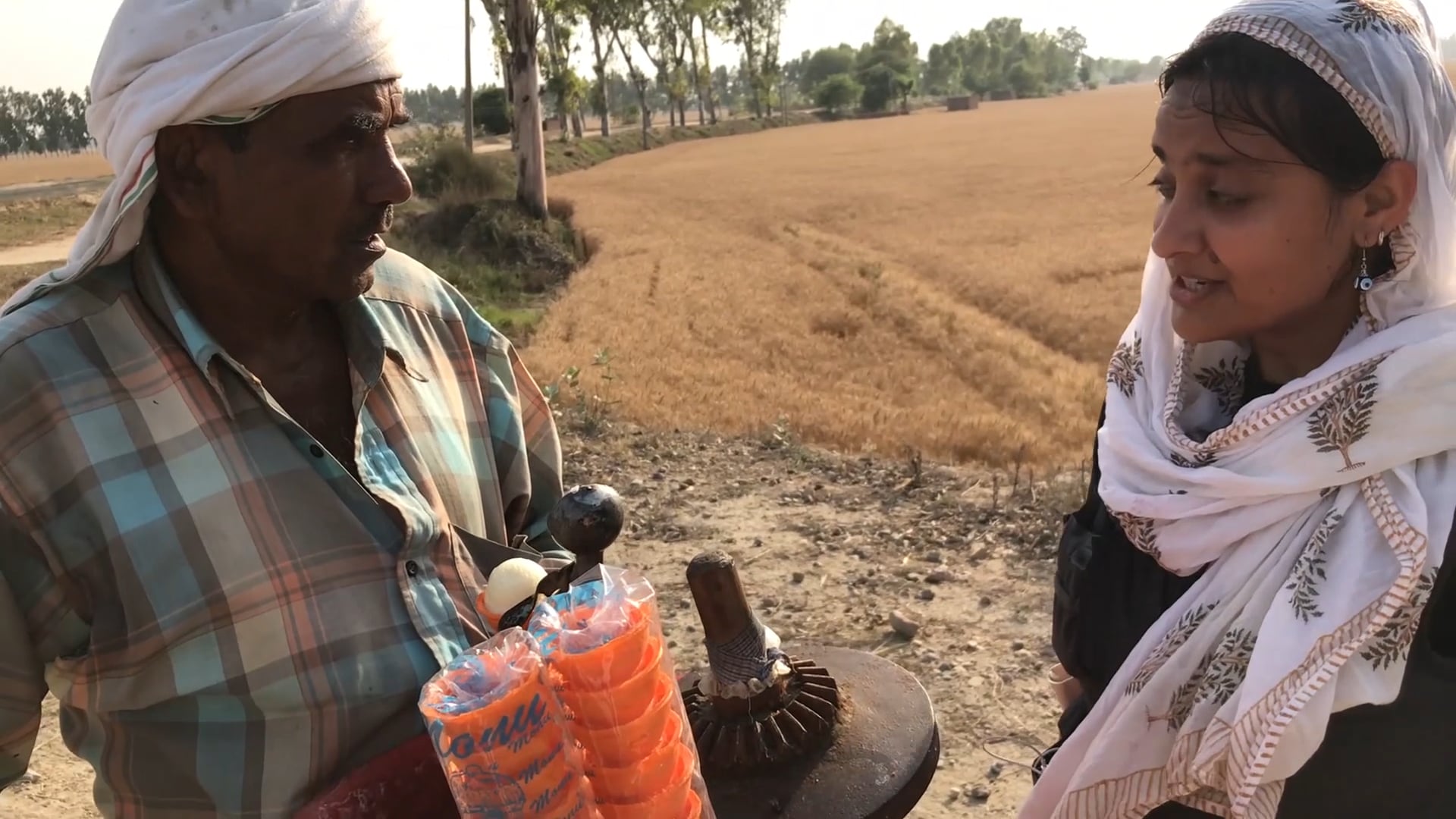
Everywhere while walking along the Grand Trunk Road, at every point on the compass rose, a private story unfolds before our eyes. It always has been this way throughout human history. Until only yesterday, when we locked ourselves inside our suburban mansions and city apartments, most of life’s dramas, triumphs, and grievances were acted out in public. The GT is such a stage. Here: Old men argue at an open-air barbershop. There: A woman wipes a baby’s bum. Schoolchildren play cricket in the dust just one step away from howling traffic.
We cross another river, the Jehlum. Alexander the Great invaded South Asia along these baking sandbanks in the spring of 326 B.C. It was the limit of his global conquests. His exhausted and battle-weary soldiers threatened to mutiny rather than push on into India.
The Punjab was rich then: a vast agricultural oasis. It remains so today. We are invited into the Usman Rice Mill. About 2,000 bags a day of super basmati grains are polished here using machinery so purely mechanical that it seems not just from another time but from a vanished world.
Out of Eden Walk
A farmer, Mohamed Saim, scythes clover in a field next door.
I can hear Saim talking to himself as he works. He swings his blade. Yet he is sunk in steady conversation—but with whom? No other soul is visible in his acres of crops! When we approach to investigate, he grins. He pulls up his knit cap. Under it, tucked over his ear, is a cheap dumb phone. “I am talking to my wife,” he says. “We are having a baby. We are talking about how to decorate its room.”
Out of Eden Walk
We walk on, Naveed Khan and I, braving torrents of belching cars and trucks coursing down the Grand Trunk Road.
We will reach the banks of the Ravi River, almost at the gates of Lahore, in a smoggy dusk. The antique forms of cargo camels kneel beside the asphalt, appearing and disappearing in the flashes of passing headlights. Relicts of the vanished Silk Road.
Yet what I remember most from the slog along the GT is not the romance of its distant past. Nor am I haunted by its maddening present: the terrible assault on the senses—the painful ringing in the ears at night, almost reeling into bed after hours of hammering traffic noise. Or the spoonfuls of road grit swallowed daily. Or the mental strain of contesting every single footfall along the road with a subcontinent on the move. No. Instead what comes to mind most vividly are moments when this loud world submerged, fleetingly, into the pool of a barely glimpsed face.
Like the concentrated brow of an orange vendor who stepped out from behind his stall when he spotted us approaching on foot. He stood at stiff attention in his tatty shalwar kameez and, singing, exclaimed the only English he knew: “Happy birthday to you.”
Or into the smile of a whitebeard pushing a bicycle up a dirt path. He stopped as we passed and raised a hand. “Hello, young men!” he bellowed at us with such force that it was clear he was not seeing us. He was seeing a mirage of his lost youth. Or maybe his long-ago dead. Some chimera that wandered those selfsame paths from a time when all the world still walked. And against all evidence, all odds, his craggy face was so consoled that I had to turn my own face away, that my guide Naveed Khan would not see the wetness in my eyes.