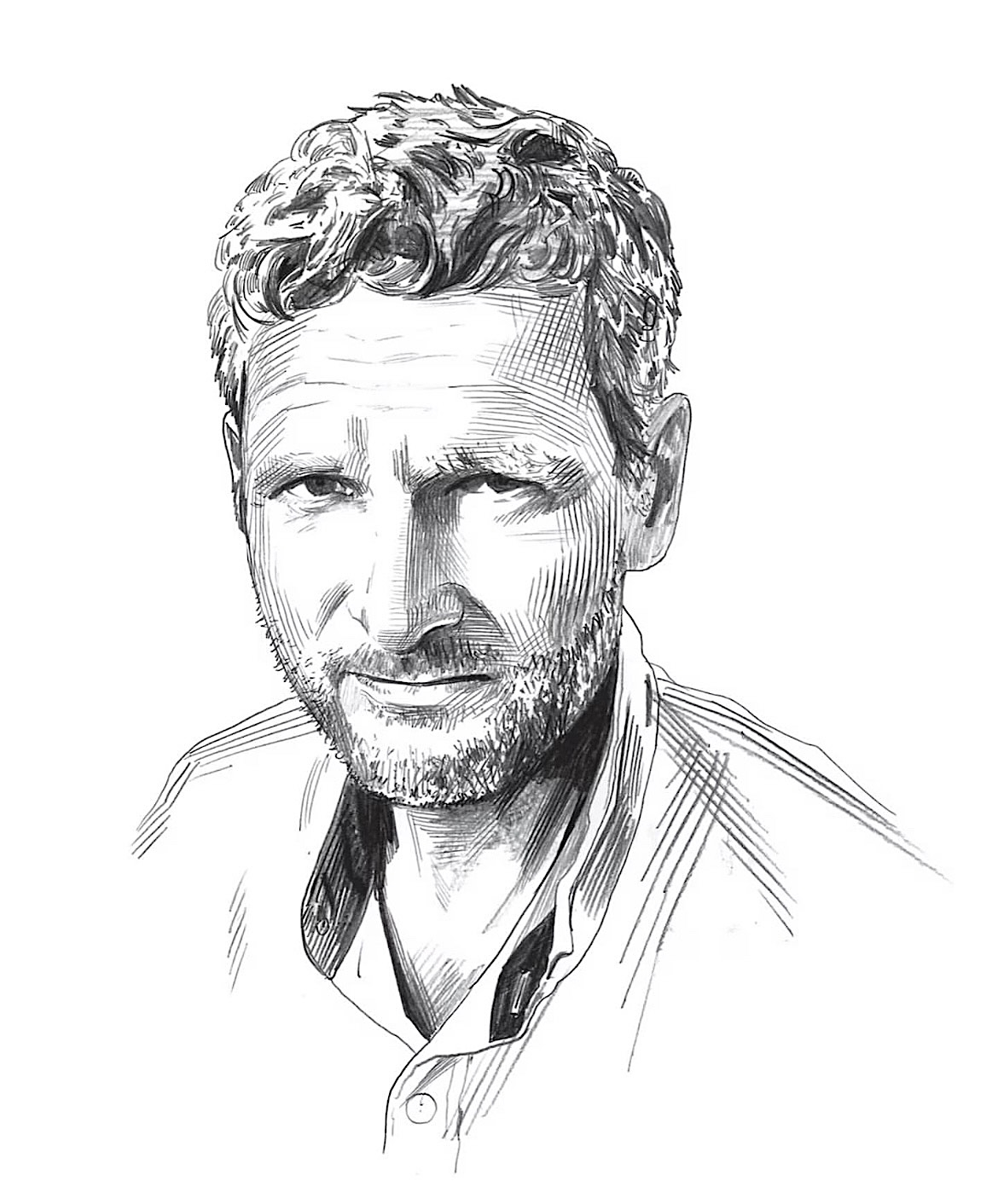
Tianyuan Cave, China: 39° 39′ 28″ N, 115° 52′ 17″ E
We are climbing the green hills west of Beijing.
Apricot and walnut trees grow wild. Their little fruits are hard and bitter. Flocks of Eurasian tree sparrows squeak neurotically in the foliage. In the valley floor far below, a village glows silent and white under the sun. How is it possible that such an Eden still exists within sight of a metropolis of 22 million people? It is like a dream. It is a mystery. Up ahead on a dusty and zigzag goat trail plods Professor Gao Xing, leading the way to a cave mouth barred with an iron gate: Tianyuan. This is among the earliest Homo sapiens fossil sites found in China.

“Maybe Tianyuan Man ate such things.” Gao Xing, an expert on Stone Age China, examines wild walnut trees near Tianyuan Cave, the site of a 40,000-year-old Homo sapiens fossil discovered near Beijing.
Paul Salopek
“About 40,000 years old,“ says Gao, a reserved man with a compact build and the assured stride of a longtime field archaeologist. He is a stone tool expert at the Institute of Vertebrate Paleontology and Paleoanthropology at the Chinese Academy of Sciences. He shields himself against the radiation of the cosmos with a wide-brimmed bucket hat and long sleeves. He smiles at me. “How does it feel?”
It feels good. I am happy. I am moved.
For more than a decade, I have been walking toward Tianyuan Cave—a waypoint famous among anthropologists who specialize in the primordial human migration across the world. I have been trekking continuously out of Africa since 2013, following the dispersals of the earliest bands of anatomically modern men, women, and children who first explored our planet during the Stone Age. I write about history and current events along my foot trail. I interview fossil hunters and poets. And here, barely one day’s hike outside the Chinese capital, I at last encounter one of these ancient pioneers. I feel a special connection to Tianyuan Man: a wanderer who laid down his bones, never to rise again, in the forgotten mornings when all the Earth shined new to humankind.
Discoveries of early modern Homo sapiens bones are incredibly rare. Collected at one spot, a global cache of their fossilized remains, cracked pieces of finger bones, teeth, and fragments of skulls, might fill a large shed.
“Maybe Tianyuan Man ate such things.” Gao Xing, an expert on Stone Age China, examines wild walnut trees near Tianyuan Cave, the site of a 40,000-year-old Homo sapiens fossil discovered near Beijing.
Paul Salopek
“About 40,000 years old,“ says Gao, a reserved man with a compact build and the assured stride of a longtime field archaeologist. He is a stone tool expert at the Institute of Vertebrate Paleontology and Paleoanthropology at the Chinese Academy of Sciences. He shields himself against the radiation of the cosmos with a wide-brimmed bucket hat and long sleeves. He smiles at me. “How does it feel?”
It feels good. I am happy. I am moved.
For more than a decade, I have been walking toward Tianyuan Cave—a waypoint famous among anthropologists who specialize in the primordial human migration across the world. I have been trekking continuously out of Africa since 2013, following the dispersals of the earliest bands of anatomically modern men, women, and children who first explored our planet during the Stone Age. I write about history and current events along my foot trail. I interview fossil hunters and poets. And here, barely one day’s hike outside the Chinese capital, I at last encounter one of these ancient pioneers. I feel a special connection to Tianyuan Man: a wanderer who laid down his bones, never to rise again, in the forgotten mornings when all the Earth shined new to humankind.
Discoveries of early modern Homo sapiens bones are incredibly rare. Collected at one spot, a global cache of their fossilized remains, cracked pieces of finger bones, teeth, and fragments of skulls, might fill a large shed.
Inspecting Tianyuan Cave, source of spectacular clues about the deep human past.
Out of Eden Walk
As is often the case, Tianyuan Man was found accidentally. In 2001, local farmers exhumed his partial skeleton, along with the bones of extinct deer and hedgehogs, while pickaxing into a cave floor looking for a new source of spring water.
“They destroyed the stratigraphy,” says Gao with a sigh. “It may have been a burial. But it also could have been a crime scene. We don’t know. We found no cultural artifacts. We found no signs of fire. And the space is too small for habitation.”
Tianyuan Cave is indeed very cramped—one must stoop and mind the elbows, as one does in a Manhattan studio apartment. The tiny limestone grotto extends perhaps only 20 paces into the side of a hill. Gao says that Tianyuan Man might have been killed and his body dumped into this tight space. Or perhaps he crawled into the shelter, sick or injured, to die of natural causes. His skull was missing. Some predator—or perhaps modern villagers—may have detached it.

Paul Salopek interviews ancient humans expert Gao Xing at the entrance to Tianyuan Cave, the fabled site of one of the earliest Homo sapiens fossils found in China.
Photo courtesy of Gao Xin
This is what we know:
He was male. He died between 39,000 and 42,000 years ago. Tooth wear indicates he was 40 to 50 years old—a veritable Methuselah by Stone Age standards.
He inhabited a temperate environment blessed with surface water—a rumpled mosaic of forested hills, swamps, lakes, and rivers. Analysis of his fossilized bones show isotopes associated with a diet rich in freshwater fish protein. Bison and wild pig might also have been his prey.
Genetic testing suggests that Tianyuan Man belonged to a subpopulation of hardy Asia colonists, nomads out of Africa who already had diverged slightly from European populations of the time. His DNA shares gene markers linked with some modern Asian populations and with Native Americans from South America. Yet these affinities are hazy, very old; he is unlikely the direct ancestor of any living humans. One of our dawn pathfinders, he was a hunter-gatherer who walked a prehistoric lineage that branched, tangled, mingled, and petered out.
And, possibly, he also may have worn shoes.
Erik Trinkaus, an anthropologist at Washington University in St. Louis, in the United States, studied the toe bones of Tianyuan Man. Modern humans’ habit of shoe-wearing leads to underdeveloped “wimpy little toes,” Trinkaus told the British newspaper the Telegraph. A lifetime spent barefooted develops more robust, chunkier toe bones. A comparative analysis of foot structure—both fossil and modern—led Trinkaus to conclude that Tianyuan Man likely shod himself in animal-hide booties, much as the traditional Inuit did in the Arctic.
If this proves true, it pushes back the advent of hammertoes and bunions by an astonishing 30,000 years. The oldest positively dated shoes, using radiocarbon methods, are dozens of 10,500-year-old grass sandals dug up inside a volcanic cave in Oregon.
“This is just a hypothesis,” professor Gao had cautioned me inside a museum near Tianyuan Cave, where the grand claim to the site’s shoe primacy was trumpeted on a sign beside a typical exhibit of cave people.
Paul Salopek interviews ancient humans expert Gao Xing at the entrance to Tianyuan Cave, the fabled site of one of the earliest Homo sapiens fossils found in China.
Photo courtesy of Gao Xin
This is what we know:
He was male. He died between 39,000 and 42,000 years ago. Tooth wear indicates he was 40 to 50 years old—a veritable Methuselah by Stone Age standards.
He inhabited a temperate environment blessed with surface water—a rumpled mosaic of forested hills, swamps, lakes, and rivers. Analysis of his fossilized bones show isotopes associated with a diet rich in freshwater fish protein. Bison and wild pig might also have been his prey.
Genetic testing suggests that Tianyuan Man belonged to a subpopulation of hardy Asia colonists, nomads out of Africa who already had diverged slightly from European populations of the time. His DNA shares gene markers linked with some modern Asian populations and with Native Americans from South America. Yet these affinities are hazy, very old; he is unlikely the direct ancestor of any living humans. One of our dawn pathfinders, he was a hunter-gatherer who walked a prehistoric lineage that branched, tangled, mingled, and petered out.
And, possibly, he also may have worn shoes.
Erik Trinkaus, an anthropologist at Washington University in St. Louis, in the United States, studied the toe bones of Tianyuan Man. Modern humans’ habit of shoe-wearing leads to underdeveloped “wimpy little toes,” Trinkaus told the British newspaper the Telegraph. A lifetime spent barefooted develops more robust, chunkier toe bones. A comparative analysis of foot structure—both fossil and modern—led Trinkaus to conclude that Tianyuan Man likely shod himself in animal-hide booties, much as the traditional Inuit did in the Arctic.
If this proves true, it pushes back the advent of hammertoes and bunions by an astonishing 30,000 years. The oldest positively dated shoes, using radiocarbon methods, are dozens of 10,500-year-old grass sandals dug up inside a volcanic cave in Oregon.
“This is just a hypothesis,” professor Gao had cautioned me inside a museum near Tianyuan Cave, where the grand claim to the site’s shoe primacy was trumpeted on a sign beside a typical exhibit of cave people.

Gao Xing, of the Chinese Academy of Sciences, has participated in some of the most important excavations of prehistoric sites in China—a country rich in the stories of ancient human dispersals.
Paul Salopek
The museum was located atop a far older and more famous cave complex called Zhoukoudian that has been absorbed by the outskirts of Beijing. Homo erectus, a prehuman species that rambled out of Africa a whopping two million years ago, had occupied the Zhoukoudian caves for at least 700,000 years—long before the birth of Homo sapiens. A colossal bronze head of this creature, dubbed Peking Man, stared blankly into space at the museum entrance. The sculpture had distinctly contemporary features. He almost looked like a muscular suburban resident of the Chinese city. This brought to mind the story of Piltdown Man, once celebrated as the missing link and the “earliest Englishman” by patriotic English paleontologists, until the fossil was revealed to be a nationalist ruse in 1953.
All of this is human, by the way. Each of us wishes to be somehow special, unique, original even in prehistory. We want to be set apart (and above) our brothers or sisters who may live across the street—across town, across mountains, across continents. Except we’re not.
Looking out of Tianyuan cave, I see golden sunlight drenching the steep and wrinkled hills.
Gao Xing, of the Chinese Academy of Sciences, has participated in some of the most important excavations of prehistoric sites in China—a country rich in the stories of ancient human dispersals.
Paul Salopek
The museum was located atop a far older and more famous cave complex called Zhoukoudian that has been absorbed by the outskirts of Beijing. Homo erectus, a prehuman species that rambled out of Africa a whopping two million years ago, had occupied the Zhoukoudian caves for at least 700,000 years—long before the birth of Homo sapiens. A colossal bronze head of this creature, dubbed Peking Man, stared blankly into space at the museum entrance. The sculpture had distinctly contemporary features. He almost looked like a muscular suburban resident of the Chinese city. This brought to mind the story of Piltdown Man, once celebrated as the missing link and the “earliest Englishman” by patriotic English paleontologists, until the fossil was revealed to be a nationalist ruse in 1953.
All of this is human, by the way. Each of us wishes to be somehow special, unique, original even in prehistory. We want to be set apart (and above) our brothers or sisters who may live across the street—across town, across mountains, across continents. Except we’re not.
Looking out of Tianyuan cave, I see golden sunlight drenching the steep and wrinkled hills.

Cave site with a view: Rumpled limestone hills outside Beijing hold some of the oldest human and prehuman fossils found in Asia.
Paul Salopek
“This is part of a larger range,” professor Gao explains. “It is mostly limestone. So there are probably many more caves to survey. There may be more Tainyuans and Zhoukoudians waiting here.”
He then laments, wearily, that his scientific specialty is underappreciated by the public.
“Stone tools?” says Gao. “When I show the people, they say, ‘It’s just a pebble!’ They don’t believe us experts. It’s hard.”
I place my hand on his khaki-clad shoulder.“Try being a writer,” I tell him. And Gao grins and nods.
What did Tianyuan Man dream of? What was his main complaint? That he was not loved enough? That his life’s path seemed a maddening circle? That he was driven cruelly on by his heart or belly?
It is time to depart Tianyuan Cave. Professor Gao locks the site’s barred gate behind us. I follow him down a bouncy trail that unspools into the sunlit valley. Two men of a certain age, swinging our arms jauntily. In this way, we navigate back toward our respective lives and graves.