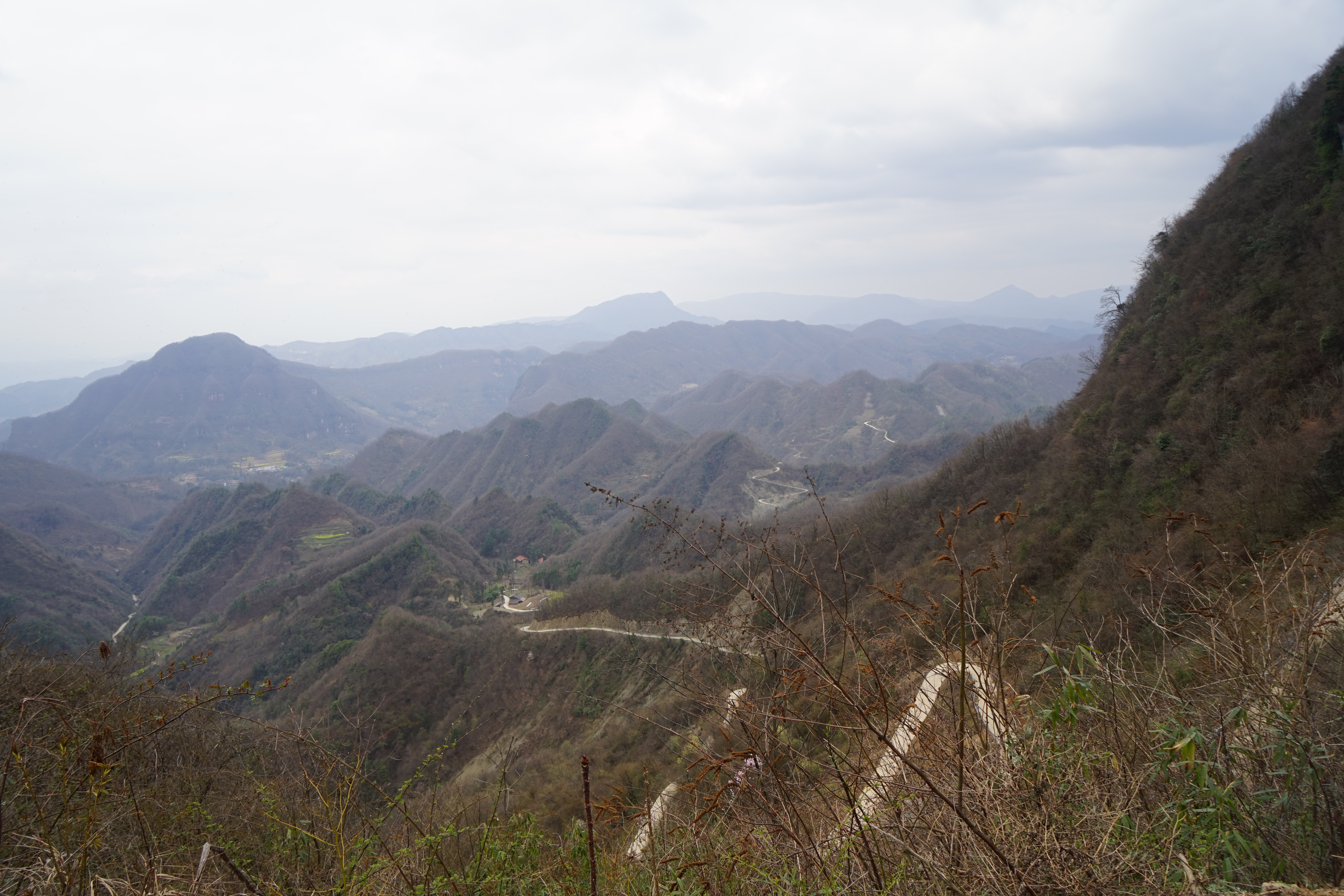
After about three hours of walking, my feet had warmed up, and my back began to sweat under the pressure of my pack. For two days, we had been following the Riverside Road on the west bank of the Yellow River. It was the end of March; the sunlight had grown stronger, and the icicles and snow patches we occasionally encountered in the shady areas of the mountains and valleys since leaving Yan'an had gradually disappeared. The long-tailed pheasants darted through the treetops, their calls urgent and joyful, as if they knew that lush greenery and warmth were about to return to the earth. With clear skies and a bright sun overhead, the sandstorm we experienced five days ago was now a distant memory. The hillsides along the road were filled with date trees, their unharvested red fruit attracting chirping birds that seemed unafraid of the shiny thorns on the branches.
Our continuous descent was a hint that we were approaching a river valley. Only by checking the map did we realize that ahead of us was the Wuding River, which joins the Yellow River south of a small village called Hekou, whose name means “river’s mouth.” Beyond gently sloping hills dense with date groves, a crack in the Earth stretched from west to east, waveringly visible, and I marveled at how the famous Wuding could be so slender. Yet after another 20 minutes of walking, the crack emerged as deep, sheer cliffs, bottomless to the eye. As we got still closer, the sight of the plunging cliffs made me dizzy, too disoriented to take photos.
I couldn't recall having seen such a stunningly beautiful and dazzling bedrock canyon before. Only about a hundred yards wide but incredibly deep, its layers resembled brownish-yellow and dark grey fabric. The Wuding River, after meandering through the Muu-Us Desert and across the Loess Plateau in a leisurely, winding path, seemed in no hurry, yet here it had cleaved the mountainous terrain as if eagerly rushing to meet the Yellow River.
"Amazing," Paul whispered in awe. We stood quietly for a few minutes on a high plateau close to the riverbank. I looked at Paul, who seemed deeply absorbed, as if he was trying to gauge the channel of the Wuding, his silver hair shimmering in the afternoon sun. Indeed, the rare beauty of the canyon was praiseworthy. Although Paul had walked halfway around the world for more than 10 years, witnessing various landscapes and peoples, experiencing momentous events, it impressed me that he could be so stirred by this sight.
I recalled for Paul words by the ninth-century poet Chen Tao, who wrote about a battle on the Wuding River, “A Walk at the Once Frontier Battlefield”:
Pledged to quell the nomads at the cost of their own life,
Five thousand young men were fallen into the dust of the battlefield.
What a pity the bones in the banks of Wuding River,
Are still the men to be dreamed of in the deep boudoir.
"So beautiful, and so sad,” Paul said. “Chinese literature must have a great anti-war tradition."
Yes. Yet I thought too about the many lines I had read that swelled with heroic sentiments: "Swearing not to return until defeating Loulan" and "Soldiers from Hunan Province have covered the Tien Shan Mountains." There were equally great—or greater—traditions in Chinese literature that romanticized bloody wars.
A tributary of the Yellow River less than 300 miles long, the Wuding rises in Mongolia, where it flows through the Muu-Us Desert and the Loess Plateau in Shaanxi Province. Its Mongolian name, Shar-Us, means Yellow Water, and it contributes the largest sediment load to the Yellow River—more than 220 million tons a year. Upstream of its junction with the Wuding, the Yellow River is not very yellow; in fact, during the Tangut and Mongol dynasties, it was called Qara Mören, Black River. (The famous Tang dynasty poet Wang Zhihuan wrote the words I chose for the title of my story, “The Yellow River falls from the white clouds.”)
Wuding in Chinese means “unstable,” and indeed its sediment bed changes constantly. Long ago, that posed a challenge for those trying to cross the river. Shen Kuo, an 11th-century writer, described the flowing sediment as "live sand" and witnessed its disastrous effects: "When people and horses tread on it, the movement is felt hundreds of steps away." And, he wrote, "Even if the surface feels solid, a single collapse can swallow hundreds of people, leaving no survivors." Nowadays, reduced rainfall in Ordos and northern Shaanxi have reduced the water level and sediment burden in the river, and such catastrophes are unheard of. The Wuding we saw that late winter day was a clear trickle, with no yellow sediment.

Luo XIn navigates an eroded gully on the descent to the Yellow River in Shaanxi.
Paul Salopek
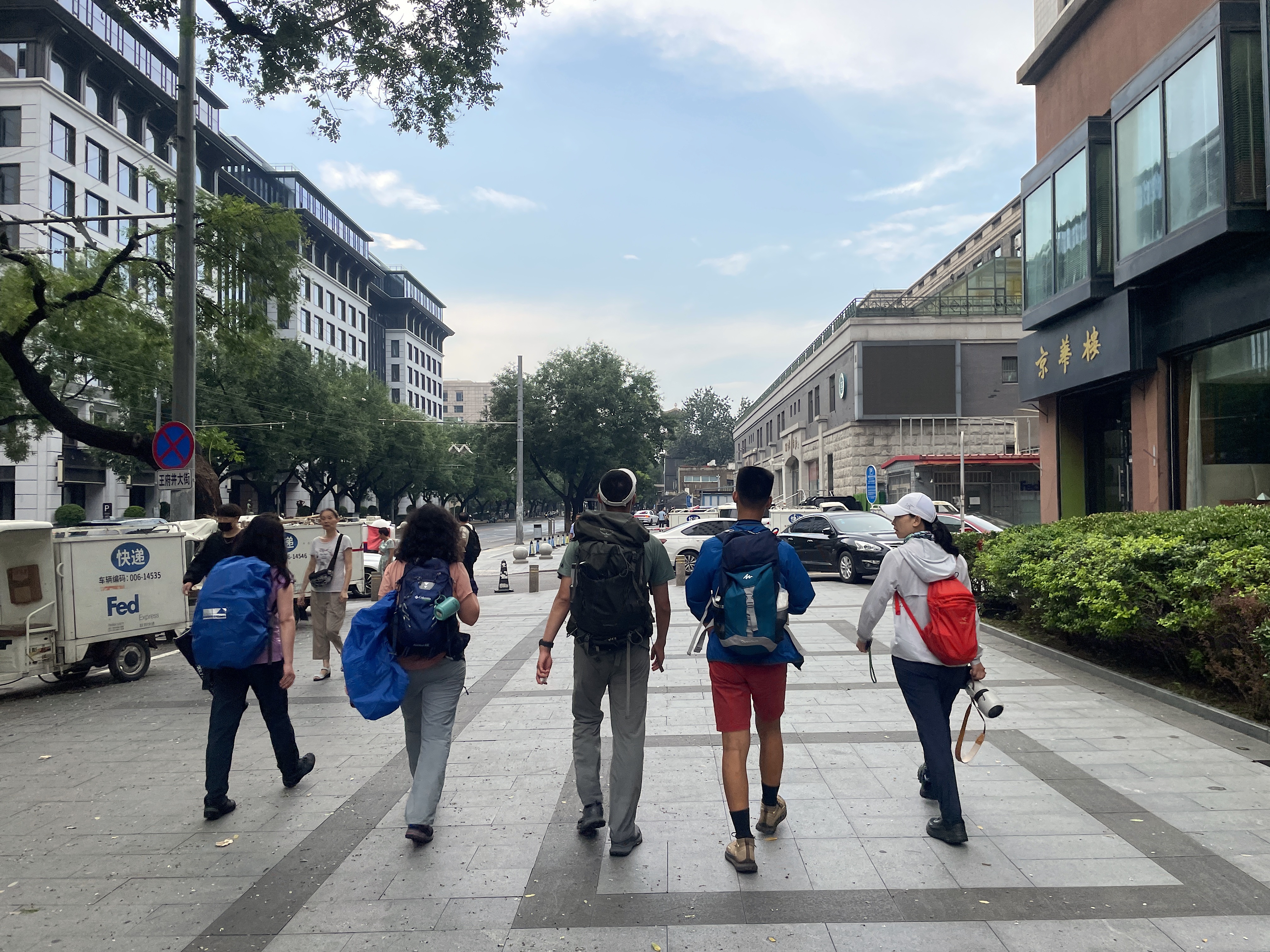
I was now getting readjusted to long-distance hiking. Having suffered consecutive infections of COVID-19 and influenza A during the previous three months, there had been some days when I was so weak that carrying a 20-pound backpack seemed impossible. The initial days of our journey had been difficult, making me doubt whether I could continue. Fortunately, after about a week, the ease and joy I had experienced walking with Paul during the hot summer of 2022 in Sichuan Province returned. Our group (Paul calls us "walking partners”) numbered five. Apart from Liu Lifeng, who began walking with Paul from Xi'an (they had both contracted COVID in Tongchuan the previous winter and then trudged through snow to reach Yan'an), I and two others had joined in Yan'an: Liu Kankan, from Dali (she had walked with Paul in Yunnan Province) and Luo Ying, from Yulin (she had accompanied me on a more than 60-mile hiking survey of the Great Wall in May 2020).
After several days on concrete roads, separated from the Yellow River by cliffs and deep gullies, we were on the lookout for an off-road path. We studied the map and decided to leave the main road before crossing the Wuding River and proceed into the Yellow River valley and head north along the western bank. Taking a shortcut down the mountainside, we entered date groves, likely unharvested because of their inaccessibility on the steep slope. To my surprise, the red dates were quite sweet, without the stale, moldy or sour taste typical of year-old fruit. I picked more. Amid the groves were bursts of dazzling pink and white—apricot blossoms heralding the return of spring and the awakening of all things. The cloud-like apricot trees looked exceptionally peaceful and beautiful, and somehow melancholic.
In less than an hour, we reached Hekou village, where the Wuding runs into the Yellow River. Outside Hekou, we saw no one but were regaled by a chorus of chickens and dogs; cows grazed on dry grass by the roadside, indifferent to our passing. Luo Ying had driven ahead to the village and found a couple who ran a small store and were willing to prepare a meal for us. Luo Ying described Hekou as a Shangri-La, with its blossoming apricots that created a secluded orchard around the modest, somewhat dilapidated, dwellings. Entering the village, we headed straight to the store, where the owners warmly welcomed us into their backyard to set down our backpacks. Visible just beyond the yard wall was the slightly greenish Yellow River, with the western sun casting a streak of white light on the water.

The confluence of the Wuding and Yellow Rivers outside Hekou village.
Luo Xin
The early spring breeze brought comforting warmth. I took off my shoes and socks. Luo Ying called the woman who was busily serving tea and setting chairs "big sister," and we later learned her name, Liu Qingping. (Qingping means “green duckweed.”) She looked young but was already a grandmother. The little girl running around in the yard was her granddaughter, in her care while her daughter and son-in-law were away working in Xi'an, the provincial capital. The little girl wasn't shy and quickly warmed to everyone, especially Luo Ying, treating her like family. The couple explained that a few years ago Hekou was a ferry crossing point. On the opposite bank of the Yellow in Shanxi's Shilou County, a road wound down to the water's edge to the deserted ferry site. Hekou must have been more lively back then. Losing the ferry meant that people rarely pass through these days—much as it is for places that had depended on now defunct rail service.

A fortifying reward after an 18-mile walking day near the Yellow River in Shanxi Province.
Paul Salopek
Our hosts busily prepared dinner, and soon the rectangular table in the courtyard was filled with plates and bowls, a pot of red-date porridge, a plate of stir-fried shredded potatoes, a plate of spinach salad, another with fried cabbage, and one with leek and egg stir-fry. The sun had already set, but there was still some evening light, and dogs from nearby houses were barking loudly. Everyone was really hungry—we hadn't eaten much since breakfast—and it had been many days since we had enjoyed such a hearty meal. Everything was especially delicious. I even had two bowls of the date porridge and forgot to mention how tasty it was! Luo Ying introduced each dish to Paul, proudly saying that these were specialties of our northern Shaanxi countryside. Paul, as always, praised everything on the table.
The walking partners were deeply touched by Paul’s caring nature. If he noticed a companion experiencing physical problems, he would immediately announce a later departure the next day or simply call for a day off. The same applied to meals; sometimes, Paul might not feel hungry or want to eat, but as soon someone suggested having a meal, he never objected. Speaking of eating, we noticed that Paul ate very little, like an ascetic monk. He could go a whole day with just one meal, and he usually skipped lunch. I rarely saw him eat breakfast. If there was a small grocery store, he might buy some snacks in the evening, probably for late-night writing sessions. He always went to sleep late and woke up early.
The previous night, we had stayed in an inn—a small cave house—in a village called Zhaojiapan, where Paul and I shared a room. When I went to bed at midnight, he was still writing on the big round table covered with white plastic. When I awoke at six, he was already packing his backpack. I believe this had been his routine for the past 10 years. Last year, when we walked in the plains and foothills north of Chengdu, I tried to write notes and read books every night, but I got so tired that all I could do was summarize the journey using a voice recorder. Six or seven years ago on the way to Xanadu, I couldn't write detailed journal entries every night, either. I felt that maybe after walking all those years, Paul had evolved into a different species.
After dinner, we bought some bottled water and food from the village store, said goodbye to Liu Qingping, her husband, and their granddaughter, and left Hekou, heading back into the wilderness to the north. Soon, as the sun touched the deep grey peaks to the southwest and the cold seeped out of every shadowy corner, it was time to set up camp. Luo Ying had found a flat spot by a roadside date grove, and we started pitching tents. Our anticipation of camping on the floor of the Yellow River’s “grand canyon,” falling asleep under the stars to the sound of the river, and waking up to the morning mist had been a frequent topic of discussion since leaving Yan'an.
For Paul, camping out was not a romantic dream but a necessity. Even in densely peopled areas, few hotels are allowed to host foreign guests, and in the sparsely populated villages of northern Shaanxi, any accommodations are typically more than a day's walking distance apart. Paul, of course, was well accustomed to making do, having camped along the trail countless times from East Africa all the way to China, including in Yunnan and Sichuan. He had a tent and sleeping bag with him in Shaanxi, and Lifeng, who had been accompanying him, carried the same gear. My situation was different—I hadn’t anticipated camping when I left Beijing, and given my weakened state, I couldn't carry much weight. When I reached Shaanxi, I urgently arranged with a friend in Beijing to send some gear. Thanks to Luo Ying, who picked it up and transported it in her car, my backpack wasn't as heavy as Paul's and Lifeng's. And luckily, since we had several sets of equipment, Kankan and Luo Ying didn't lack anything, either.
A fortifying reward after an 18-mile walking day near the Yellow River in Shanxi Province.
Paul Salopek
Our hosts busily prepared dinner, and soon the rectangular table in the courtyard was filled with plates and bowls, a pot of red-date porridge, a plate of stir-fried shredded potatoes, a plate of spinach salad, another with fried cabbage, and one with leek and egg stir-fry. The sun had already set, but there was still some evening light, and dogs from nearby houses were barking loudly. Everyone was really hungry—we hadn't eaten much since breakfast—and it had been many days since we had enjoyed such a hearty meal. Everything was especially delicious. I even had two bowls of the date porridge and forgot to mention how tasty it was! Luo Ying introduced each dish to Paul, proudly saying that these were specialties of our northern Shaanxi countryside. Paul, as always, praised everything on the table.
The walking partners were deeply touched by Paul’s caring nature. If he noticed a companion experiencing physical problems, he would immediately announce a later departure the next day or simply call for a day off. The same applied to meals; sometimes, Paul might not feel hungry or want to eat, but as soon someone suggested having a meal, he never objected. Speaking of eating, we noticed that Paul ate very little, like an ascetic monk. He could go a whole day with just one meal, and he usually skipped lunch. I rarely saw him eat breakfast. If there was a small grocery store, he might buy some snacks in the evening, probably for late-night writing sessions. He always went to sleep late and woke up early.
The previous night, we had stayed in an inn—a small cave house—in a village called Zhaojiapan, where Paul and I shared a room. When I went to bed at midnight, he was still writing on the big round table covered with white plastic. When I awoke at six, he was already packing his backpack. I believe this had been his routine for the past 10 years. Last year, when we walked in the plains and foothills north of Chengdu, I tried to write notes and read books every night, but I got so tired that all I could do was summarize the journey using a voice recorder. Six or seven years ago on the way to Xanadu, I couldn't write detailed journal entries every night, either. I felt that maybe after walking all those years, Paul had evolved into a different species.
After dinner, we bought some bottled water and food from the village store, said goodbye to Liu Qingping, her husband, and their granddaughter, and left Hekou, heading back into the wilderness to the north. Soon, as the sun touched the deep grey peaks to the southwest and the cold seeped out of every shadowy corner, it was time to set up camp. Luo Ying had found a flat spot by a roadside date grove, and we started pitching tents. Our anticipation of camping on the floor of the Yellow River’s “grand canyon,” falling asleep under the stars to the sound of the river, and waking up to the morning mist had been a frequent topic of discussion since leaving Yan'an.
For Paul, camping out was not a romantic dream but a necessity. Even in densely peopled areas, few hotels are allowed to host foreign guests, and in the sparsely populated villages of northern Shaanxi, any accommodations are typically more than a day's walking distance apart. Paul, of course, was well accustomed to making do, having camped along the trail countless times from East Africa all the way to China, including in Yunnan and Sichuan. He had a tent and sleeping bag with him in Shaanxi, and Lifeng, who had been accompanying him, carried the same gear. My situation was different—I hadn’t anticipated camping when I left Beijing, and given my weakened state, I couldn't carry much weight. When I reached Shaanxi, I urgently arranged with a friend in Beijing to send some gear. Thanks to Luo Ying, who picked it up and transported it in her car, my backpack wasn't as heavy as Paul's and Lifeng's. And luckily, since we had several sets of equipment, Kankan and Luo Ying didn't lack anything, either.
Out of Eden Walk
Pitching tents is always an exciting part of outdoor activities. We were quite efficient: They went up after the sun had set, by the dimming light in the southwestern sky, painted with swathes of red clouds. My friend in Beijing had also sent two camping chairs, which felt like a luxury under the date trees and spurred a burst of enthusiasm for taking group photos. Luo Ying carried camp stoves in her car, so we were even able to enjoy hot tea, which gave us a sense of bliss.
While the others were drinking tea, I left the date grove, crossed a small plowed cornfield, and made my way to the riverbank. I walked over a bed of pebbles to reach the shallow water, where I could clearly see the riverbed sloping downstream. The drop was significant, and the rushing water, colliding with rocks of various sizes, made a continuous din. When I crouched down and touched the water, I was startled by its icy chill, which sent a shiver through my spine.
At that moment, the sky darkened. I couldn't see upstream where the water came from or downstream where it was rushing to. The opposite bank, less than two hundred yards wide, was vaguely discernible, the only recognizable features being the towering black mountains surrounding us and the blue-black sky overhead. The cold became more intense, and the sound of water seemed to come from all directions. I felt immersed in an unseen, intangible, boundless dark matter.
Returning to the campsite in the dark, I saw that everyone had already retreated into their respective tents. Luo Ying and Kankan were speaking in hushed tones. Paul's tent had multiple light sources, indicating that he was probably working on his computer with a headlamp. I entered my tent, wrapped myself tightly in my sleeping bag, and sat cross-legged. I pulled on a headlamp, turned on the computer, and recorded the events of the past few days. Typing was uncomfortable in this temperature. My fingers seemed unusually sensitive, causing a slight stinging sensation each time they touched the keyboard. The previous night in the cave when Paul typed for several hours in the cold, I recalled being amazed by his extraordinary perseverance. For 10 years, he had been jotting down observations and thoughts in a small notebook during the day, then writing and organizing them into more detailed records on the computer at night.
As Paul walks, he is always scouting for topics and gathering material for stories—“dispatches”—to be published here on the National Geographic Society’s Out of Eden Walk website. This means that every conversation with passersby is an interview, a possible spark of inspiration for the next dispatch. He once said that compared to his writing, the daily, monthly, yearly repetition of walking was the easier part. Interviewing and writing while on the move is challenging enough, but what adds to his pressure is the diversity of Paul's writing commitments. In addition to regularly contributing the digital dispatches, he writes a print story every year for National Geographic magazine, contributes articles to other publishers, such as the New York Times and the New Yorker, and is completing the first of several books based on his journey. (He also makes himself available for TV and radio interviews.) I asked Paul if he could compile the hundreds of digital dispatches into a book. He said it wasn't that simple: Those stories are varied in themes, lack the necessary depth for a book, and don't connect with each other. His first book will be a blend of travel writing, memoir, and feature reporting.

Approaching the Yellow River, Paul Salopek helps a villager collect tree branches she planned to use for cooking.
Luo Xin
By the summer of 2022 in Sichuan, where we often talked about his writing, he had finished the draft and was revising it daily. As we walked on concrete roads in scorching heat, he recounted experiences from his youth in Mexico and pre-university days, including riding motorcycles around Australia, cutting sugarcane for money when funds ran out, and working on deep-ocean fishing boats to earn a living. I speculated that these stories would appear in the book, perhaps as narratives he was reliving from the past in the midst of this global walk.
Paul is a master storyteller. He has the ability to skillfully organize meanings, dialogues, and past experiences into scenes and anecdotes rich with depth and nuance. He can also be playful and lighthearted. In the fall of 2022, I came across a news story about a cameraman who while filming at Sanxingdui, a famous Bronze Age archaeological site in Sichuan Province, accidentally fell into a pit full of artifacts from the 11th and 12th centuries B.C. He landed on a bronze mask, leaving bloodstains on the shattered object. I shared the video with Paul, whose tongue-in-cheek response caught me off guard: "After 3,000 years,” Paul said, “the gods of Sanxingdui finally once again tasted human blood sacrifice!"
On another occasion, while we were walking in the mountains of Shifang, Paul recounted being imprisoned in Sudan while on a reporting trip in the Sahel region. One of the guards became friendly and even took to playing chess with his prisoner. Several months after Paul returned to South Africa (where he had been based for nine years), he received an international call. It was the prison guard, who asked him to write a letter of recommendation for his promotion. "You know, when you're trapped in a prison as a prisoner,” Paul told me, “you hope that those in power aren't too loyal to their duties, because corruption and dereliction of duty are sometimes expressions of humanity, and humanity is the only hope in dark moments."
Thinking of our forced lockdowns during the pandemic, I feel that these words offer a profound insight into the human condition.

Rest with a purpose for the Out of Eden Walk's master notetaker.
Luo Xin
I first learned about Paul's world walk in 2013. That year, National Geographic magazine published his first story about it, and I was reading his online dispatches. In the summer of 2016, when I planned to walk from ancient Khanbaliq (today’s Beijing) to Xanadu, in Inner Mongolia, I wrote a manifesto-style article, partly to motivate myself not to give up halfway. I mentioned various role models from different times and places, including Paul.
When I began planning my journey to Xanadu, the greatest contemporary walk had been unfolding. Dubbed the Out of Eden Walk, this unprecedented walk is by Paul Salopek, a two-time Pulitzer Prize-winning journalist and a writer to the National Geographic magazine. He embarked on this extraordinary walk on January 22, 2013, and as of now, he has been walking for three and a half years. His plan is to retrace the path of human migration out of Africa, completing a 21,000-mile (33,600 kilometers) journey in seven years. The route spans from Ethiopia in Africa to Tierra del Fuego at the southern tip of South America, traversing the Middle East, Central Asia, and China, entering Siberia, crossing the Bering Strait by ship, and finally traversing the Americas from north to south. Over the past few years, I have been following his website and have read three articles he wrote for National Geographic. I am curious whether after this grand and epic journey, he will discover a completely new world, or perhaps, he will come to a new understanding of himself.
As I walk on the road to Xanadu, Paul Salopek is still trekking through the desert grasslands of Kazakhstan. Compared to the Out of Eden Walk, my journey to Xanadu could be considered only a leisurely stroll within the backyard. With this leisurely stroll, I pay my respects to him.
When I met Paul in the city of Guanghan, where he was visiting the archaeological site of Sanxingdui, in late July 2022, our conversations often revolved around the changing duration of the Out of Eden Walk, from seven years as first conceived to 15 years, or even longer. Certainly, any grand plan that transcends time and space undergoes multiple adjustments in practice, with many unforeseeable factors leading to changes in the route and to time delays. For instance, Paul was unable to enter China from Central Asia as he had intended, so he had to detour southward, through Pakistan, India, and Myanmar before arriving in China. In Myanmar, he faced twin challenges: the COVID-19 pandemic and the military coup of February 1, 2021. After finally entering China, his progress through the country was often delayed and rerouted because of COVID quarantine measures. These twists and turns, while allowing him to explore the country more fully, also caused him personal disruption.
Paul mentioned that the ever-lengthening duration of the walk is first and foremost unfair to his wife, Ana, who is Georgian. Ana is a journalist and documentary filmmaker, but despite her busy schedule, she manages to set aside time each year for a walking reunion with Paul. In the spring of 2022, she flew to Shanghai with the intention of directly connecting to Chengdu to join him on the trail in Sichuan Province. Unexpectedly on landing in Shanghai, she encountered extreme lockdown measures, and Paul had to fly to Shanghai as well, where they spent two months isolated in a small hotel room.
In late July of that year, I joined Paul and walking partner Li Huipu to visit Dujiangyan, a famous irrigation system built in about 260 B.C. and still in use; the site was added to the World Heritage List in 2000. At a temple there, we saw an old tree laden with “wish tags”—wooden plaques people had bought from a nearby shop, written their wishes on, and hung on its branches. Paul bought one and wrote, "Ana, I wish you were here."
In his younger years, Paul crossed the high mountains of Mexico on a mule. In middle age, he reported from war zones and confronted lions on the African savanna. Now past 60, with the heart of a youth and as vigorous as ever, Paul sat in his tent by the Yellow River after a hard day of walking on the Loess Plateau documenting his experiences and conversations. I wondered: Perhaps he was reliving the Daoqing folk performance by an 80-year-old artist we had heard that morning.
In the stillness of the night, even within the depths of a dream, the sound of the Yellow River's waters could be heard, along with the occasional clucking of pheasants flapping their wings as they flew by. When I awoke in the morning and emerged from the tent, the sun was still hiding behind the mountain to the east, but the sky was already bright. Lifeng, Kankan, and Luo Ying were preparing hot tea and bread; Paul had already taken down his tent and backpack and was sitting on the ground, writing notes. I quickly packed up my tent, sleeping bag, and other items, using all four limbs to compress everything into their respective small bags, before enjoying breakfast in the chilly date grove. Luo Ying mentioned that during the night, several officials had come to the camp, shining flashlights around and making inquiries. Earlier, Luo Ying and I had encountered a local police patrol. Even in Shangri-Las, as Paul knows from long experience, authorities are never far away.

Yellow River walkers at their campsite: Luo Xin (far left), Luo Ying (front), Liu Kankan (center left), Paul Salopek (center right), and Liu Lifeng (right).
Luo Xin
After breakfast, we loaded the equipment into Luo Ying's car (Paul insisted on carrying his tent and sleeping bag), shouldered our backpacks, and started a new day of walking. From here, we would follow sandy trails northward, hugging the Yellow River for another eight or so miles before leaving the valley and climbing up to the mountains.
The Yellow River deposits most of its sediment during flood season, usually from June to August. In places, the alluvium covers a large enough area for villagers to grow crops. Even where the material is less widespread, there may be enough to support strips of willow trees or grassland suitable for grazing cattle and goats—and to ease the feet of walkers. But because of the intense erosion on opposite sides of the river, no continuous walkable route at the bottom of its canyon presented itself. Luckily, a makeshift road along the west side gave us uninterrupted passage. The road had been cut by a sand mining company, and we saw small iron boats—dredgers—at intervals along the riverbanks, badly scarred by the extraction. During the country’s rush of urban development and infrastructure, fine sand—indispensable for construction—has been a crucial commercial commodity. I’ve read environmental reports claiming that in recent decades, sand mining has become one of the most environmentally damaging activities in China, affecting rivers of all sizes. Now I was witnessing firsthand that not even the Yellow, often revered as the “mother river,” has been spared this fate.

Sand-mining boats on the banks of the Yellow River.
Luo Xin
After about an hour on the mining road, the sun rose high, and the valley quickly warmed up. We encountered a man in his 50s or 60s wearing camouflage military pants and a blue sports fleece jacket, leaning against a tree with a leisurely air. He said he was a shepherd. "Where are the goats?" we asked. He pointed to the western slope—“They are all on the mountain.” Paul conducted an interview with him, interpreted by Lifeng and Kankan. He asked whether there had been changes in rainfall and snowfall and flood levels during the past few decades, and about aspects of the shepherd’s life.
I enjoy listening to Paul doing interviews—he has a knack for asking the right questions. During a visit to Qinglian, the famous eighth-century poet Li Bai's hometown in the summer of 2022, Yang Xiao and I interpreted for Paul as he interviewed a poet and calligrapher who had changed his name to Li Bai in admiration of the ancient bard of that name, considered by some to be China’s greatest poet. Paul's questions slowly uncovered that more than two decades ago, the man had been laid off from his job in a sugar plant in in northeastern China. It was a revelation to learn that he was one of the millions of workers who lost their jobs when that whole region suffered an economic recession. None of the profiles I had read by Chinese journalists about this locally famous latterday Li Bai had mentioned this.
Generally, Paul doesn't dwell on such specific social or personal details but seeks to understand common issues in communities across different regions, such as the loss of traditional ways of life and means of production because of technological advances and the ways climate change affects people’s lives. Paul asked the shepherd if ferries were still operating on the river—yes, he replied, at a few places, but they were all motorized. "When we leave Shaanxi and head to the other side of the Yellow River, instead of taking modern highways and bridges,” Paul said, “we'll find an old ferry crossing by boat.”
After another two or three hours, we came to a dilapidated temple alongside a cave dwelling. The cave, whose stone walls had been coated with yellow clay and brushed with white lime, was about five square yards in area, oriented north to south. It had a yard of similar size, whose stone wall had partially collapsed, making it a perfect resting place. To the west of the temple’s gate was a stone monument. On its weathered surface was an inscription: Eternal Fame. Judging from the style and color, it was probably from the Qing Dynasty or the Republic of China period—likely a merit monument to honor those who helped build the temple. Enshrined in the temple were three colorfully decorated deities sculpted in clay. The main figure, wearing a yellow helmet, a yellow cloth on the shoulders, and a blue suit of armor, was three times larger than the ones flanking it. The eyes were wide open in apparent anger, and the hands were placed on the knees. The smaller deity on the east side resembled, at first glance, the Ganesh in Hinduism, but on closer inspection, it turned out to be a bird. It had two wings and a long beak, easily mistaken for an elephant's trunk. The smaller deity on the west side had a facial appearance similar to the main deity’s, with exposed muscles and only a yellow cloth around the waist. Judging from the style and color, these were probably crafted in the 1980s or slightly later.

Mural of a bird-headed deity, possibly the god of thunder, inside an old shrine on the Yellow River in Shaanxi Province.
Paul Salopek
Both the east and west walls of the cave had painted murals that had mostly peeled off. On the east wall, a figure with the head of a bird holding a hammer and chisel was walking in clouds; it appeared to be a craftsman. The mural on the west wall showed turbulent river water, clouds above, and small figures wearing pointed felt hats, unlike those worn by Han people. The peeling surface revealed that there were at least three layers of murals. The bottom layer, vivid red, and the middle one, in red and yellow, were markedly different from the newest outer one, which was blue. With modern technology, it might be possible to “see” the innermost mural to help determine the age of the temple. My preliminary judgment was that it was a small temple honoring the river god. According to local chronicles, both banks of the Yellow River were dotted with river god temples between the 17th and 20th centuries.
I explained to Paul the significance of the three layers of murals: People of different eras followed the same beliefs and traditions of their predecessors, but they used different imaginative representations, materials, and colors. In our time, this age-old pattern has been interrupted—part of the process we historians call continuity and discontinuity. But continuity is not repetition, and discontinuity is not entirely new. When we observe society, we usually see only what is now, at this very moment; it is difficult to see deep into the past, to gain understanding of people in different times. During the past decade, as Paul has walked, step by step, through so many countries, cultures, and overlapping beliefs and ideas, he undoubtedly has come to an understanding of how continuity and discontinuity shape life on Earth. In this sense, Paul's long walk is not just a journey across vast spaces but also a winding path through expanses of time.
Mural of a bird-headed deity, possibly the god of thunder, inside an old shrine on the Yellow River in Shaanxi Province.
Paul Salopek
Both the east and west walls of the cave had painted murals that had mostly peeled off. On the east wall, a figure with the head of a bird holding a hammer and chisel was walking in clouds; it appeared to be a craftsman. The mural on the west wall showed turbulent river water, clouds above, and small figures wearing pointed felt hats, unlike those worn by Han people. The peeling surface revealed that there were at least three layers of murals. The bottom layer, vivid red, and the middle one, in red and yellow, were markedly different from the newest outer one, which was blue. With modern technology, it might be possible to “see” the innermost mural to help determine the age of the temple. My preliminary judgment was that it was a small temple honoring the river god. According to local chronicles, both banks of the Yellow River were dotted with river god temples between the 17th and 20th centuries.
I explained to Paul the significance of the three layers of murals: People of different eras followed the same beliefs and traditions of their predecessors, but they used different imaginative representations, materials, and colors. In our time, this age-old pattern has been interrupted—part of the process we historians call continuity and discontinuity. But continuity is not repetition, and discontinuity is not entirely new. When we observe society, we usually see only what is now, at this very moment; it is difficult to see deep into the past, to gain understanding of people in different times. During the past decade, as Paul has walked, step by step, through so many countries, cultures, and overlapping beliefs and ideas, he undoubtedly has come to an understanding of how continuity and discontinuity shape life on Earth. In this sense, Paul's long walk is not just a journey across vast spaces but also a winding path through expanses of time.

Luo Xin walks by an old shrine on the Shaanxi Province bank of the Yellow River.
Paul Salopek
Walking along the Yellow River is truly wonderful. But we had reached a point where we could no longer continue next to it—cliffs and rapids blocked us. We had to climb up the steep west side of the valley, panting and gasping for breath. The higher we went, the thicker the loess, and the cooler the wind. Far below, the river was a pale green ribbon, and the massifs on the opposite side were closer now. In a few days, we would descend again to the river, where, at an ancient ferry crossing, we would board a modern motorboat (unfortunately, not one of the traditional sheepskin rafts), cross over to Shanxi Province on the opposite bank—and keep on walking northward.
Luo Xin is a professor of medieval history at Peking University. He walked with Paul Salopek in several provinces in southwestern and northern China in 2022 and 2023.
Liu Kankan, a writer, translator, and editor based in Dali, in Yunnan Province, has walked with Paul and helped translate this essay from Mandarin to English.