Beijing, China: 39°56'02” N,116°24'11” E
Welcome to the latest Out of Eden Walk city map: Beijing.
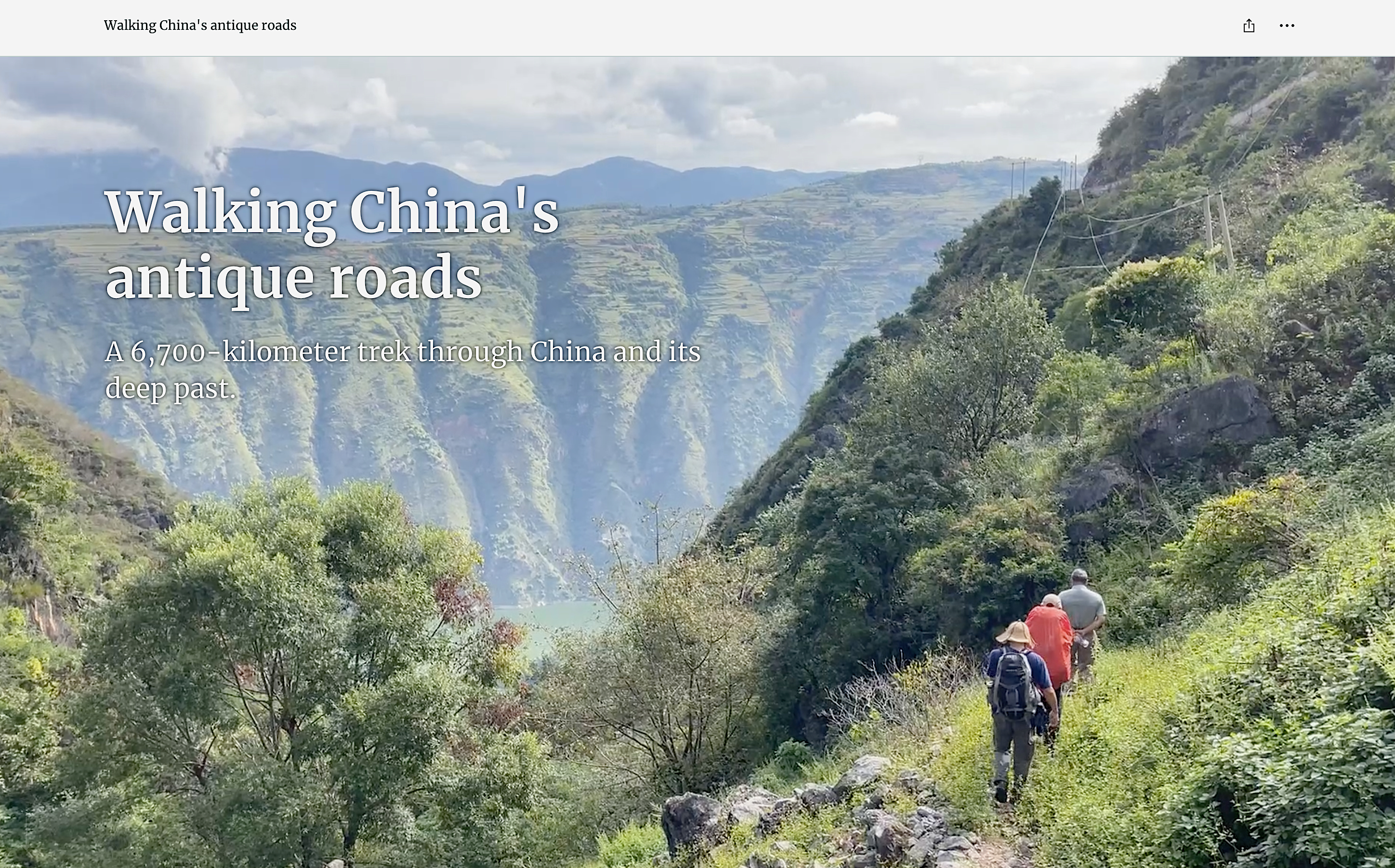
I walked into Beijing on a goat trail.
This may surprise readers. It certainly startled me. The rocky western hills above China’s vast capital—the 21 million residents inhabit 1,763 square miles (4,567 square kilometers) of concrete, or roughly six times the urban space occupied by New York City—proved jarringly remote. One dusty day, I met a gentleman watering his sheep from plastic barrels below a limestone pass that required bouldering techniques to summit. I squinted down, sweating, on the shining backs of hawks circling a scrubby and roadless valley below. The next day my phone’s e-commerce barcode secured a room at a spotless hotel next to a busy subway station. Like a hawk, I circled the lobby’s cappuccino machine. Robots shaped like small waste bins and with burbling feminine voices made deliveries to the rooms as well.
By then, I’d trekked more than 2,700 miles (4,300 kilometers) across China. I needed a break from the trail.
Hoofing it to a cappuccino machine. Walking partners Liu Kankan and Rachael Strecher climb the hills west of Beijing.
Paul Salopek
But where to stay in Beijing—China’s capital since Kublai Khan relocated his tent there from the Mongol steppes in the 13th century? The modern city features oceanic government squares, a Forbidden City that admits 19 million tourists year, a relict 2008 Summer Olympics village, six ring roads, and one Georgian restaurant. All my Chinese artist friends advised me to go micro: Stay in the last, human-scale, historic “village” spaces within Beijing: the hutong neighborhoods.
Hutong comes from the Mongolian, meaning “water well,” but in colloquial Chinese it refers to the gray-brick, a residential alleyway that a century or more ago exemplified much of the metropolis. Back in dynastic days there were hutongs for aristocrats and hutongs for the commoners. Yet the basic design remained the same—a pleasing, organic maze of single-story, courtyard homes (called siheyuan) lining narrow, crooked lanes often only an arm-span wide. Much of this hive-like architecture was bulldozed for urban renewal projects after the Communist revolution of 1949. City authorities belatedly have preserved a few remnants.
I moved into a hutong flatlet in the somewhat less touristy Beixinqiao Subdistrict (北新桥).
There was a mom-and-pop store shoehorned into a house across my alley. The proprietress offered for sale 99 percent of the material culture of our civilization. There were blue pools of shade cast on the lanes by old Chinese scholar and willow trees. There was a public toilet just outside my door (most hutongs are plumbed by now). Everywhere, there were clotheslines and potted-plant gardens, and even a few carved stone lions still guarding red gates. A limpet-hatted man on a trishaw pedaled by every three days, hawking his brooms and basket wares. The old uncles playing mahjong in their singlets beneath my window each sweltering afternoon came cost-free.

A mom-and-pop shop stays open until midnight in a hutong near Salopek's flat.
Paul Salopek
“People will need a GPS to find you,” joked Yi You, an architectural designer who agreed to take me on a hutong-focused city walk in Beijing.
He brought along his friend Zhang Ningxin, who worked for the railroad office in distant Chengdu. We spent a sunny day of rambling through the dogleg corridors of a disappearing China. And if you click this map link, you can clap on a hat and join us.
Out of Eden Walk Chief Cartographer Jeff Blossom, of Harvard's Center for Geographic Analysis, created the interactive walking tour map of Beijing.