“Sorry!”
It is the Djiboutian gendarmes. They smile from their roadside guard post. They hold up their hands in a sympathetic gesture.
One of their patrols has detained us, confiscated my passport and impounded the camels A’urta and Suma’atuli. They have marched us here, to the official frontier checkpoint, for an explanation. Because we have staggered down a mountain trail, lost. Because we have blundered into the blurry no-man’s-land between Ethiopia and Djibouti. Because no battery-powered gimcrack, no alien gewgaw, no child’s toy called a GPS, was going to tell my proud Ethiopian cameleers where they stood on the face of the Earth: that we had crossed, unwittingly, into Djibouti.
But all is now smoothed over. Cleared up. Illuminated. Justified. The Djiboutians instruct us—apologetically—to return to a distant Ethiopian guard post. I must have my exit visa stamped. How far away is it? It’s at least four miles back. I will ping pong, in this way, between nations whose edges are drawn on the sand, on the wind. I slog for miles along a melting, truck-clogged road, across a phantom divide that parses nothing from nothing.

The new caravans: a mile of trucks at the Galafi border crossing to Djibouti.
Paul Salopek
Or so it seems. For borders do rule the most powerful topography on the planet: the corrugations of the human mind.
Ethiopia: ancient, sprawling, crowded, buzzing with purpose, with nationalist slogans, the top dog in the Horn of Africa. Djibouti: only 36 years old as a country, a miniscule former French colony, fewer than a million people, a sleepy afterthought on the Red Sea.
Ethiopia: The ear prickles with a babel of Amharic, Oromo, English—and 87 other minority languages. Djibouti: only French, Afar and Somali.
Ethiopia: Police stand at attention in camouflage battle fatigues, signaling a martial government forever on war footing with its nemesis, Eritrea. Djibouti: Here the uniforms, often disheveled, are gaudy blue and green with white patent-leather belts, like bandstand musicians, as befits a statelet with no enemies.
Ethiopia: The Afar nomads bestow traditional names on their camels—“Branded on the Ear,” “Traded for a Cow.” Djibouti: When I ask my new Afar camel guides, Houssain and Musa, the names of our two cargo beasts, Houssain says, “Houssain.” And Musa replies, “Musa.” Then they laugh.

My chapeau gets a long overdue washing by Houssain Mohamed Houssain—in boiling sulfur water. Delousing was included.
Paul Salopek
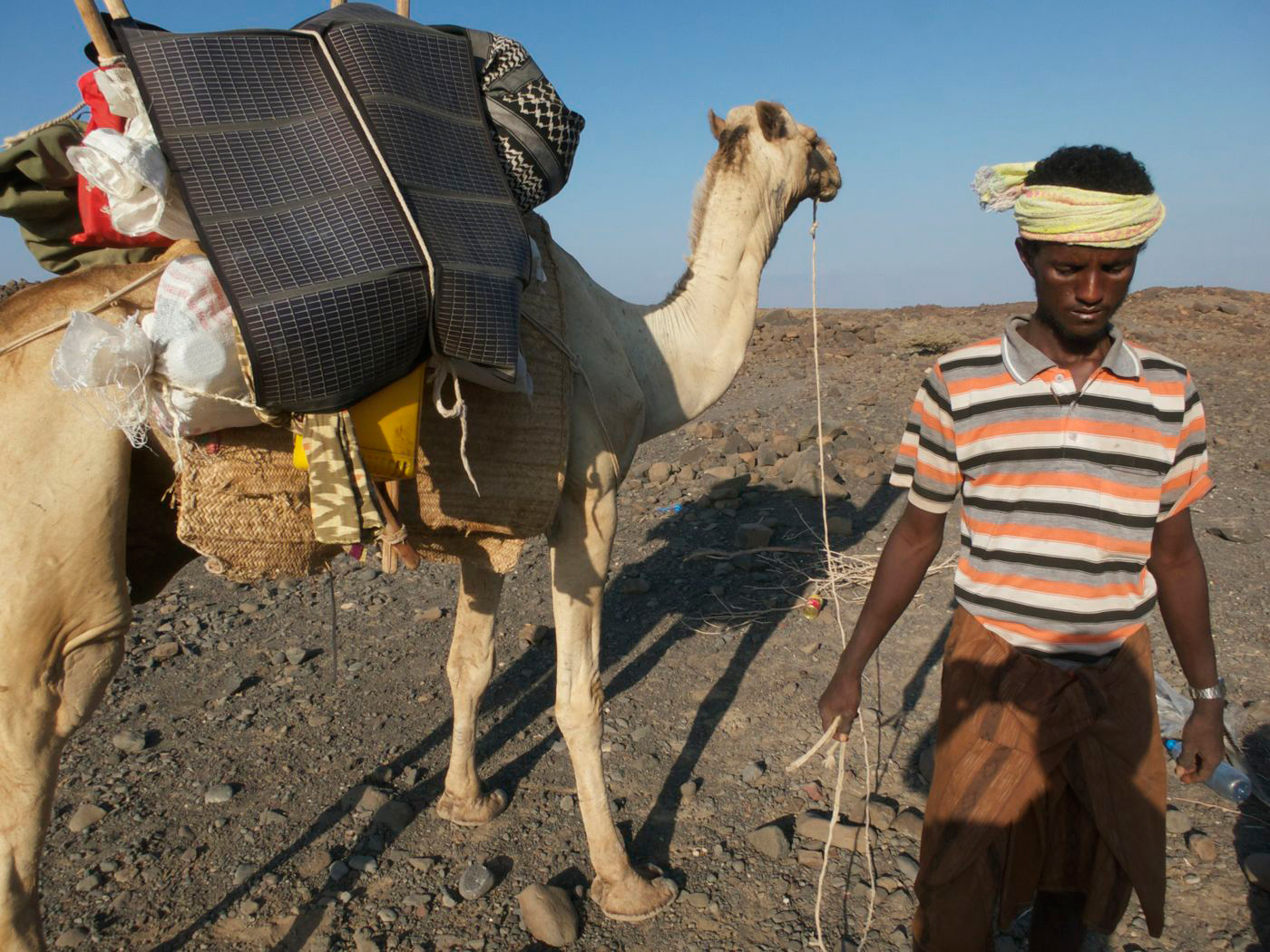
The Djiboutian cameleers wear knockoff Ray-Ban sunglasses and cargo pants. They are better equipped than I. They pack a stainless steel pasta strainer. The chief of the caravan, a debonair man named Houssain Mohamed Houssain, offended by my grubby hat, snatches it off my head and scrubs it in a hot spring. He carries a large black wireless telephone, like some prop from an ancient James Bond film, through the searing desert. As we walk, he shouts into it constantly. What is he talking about? “I am running for parliament,” he tells me. “I am managing my campaign.”

Guides Houssain Mohamed Houssain (Bond) and Musa Lubak (Moneypenny) share a multimedia moment in the Gagade desert.
Paul Salopek
That afternoon, nine glary miles into Djibouti, huddled under the watery blue shade of a doum palm, we break for lunch: haricots verts in mustard sauce, rice pilaf, curry sauce, boiled eggs and baguettes, coffee, and tea. For the past week I have been walking on biscuits. On noodles and water. I set aside a fork. (A fork!) Reverently, I photograph my plate. Vive la francophonie.

Paul Salopek