“The sea never changes.”
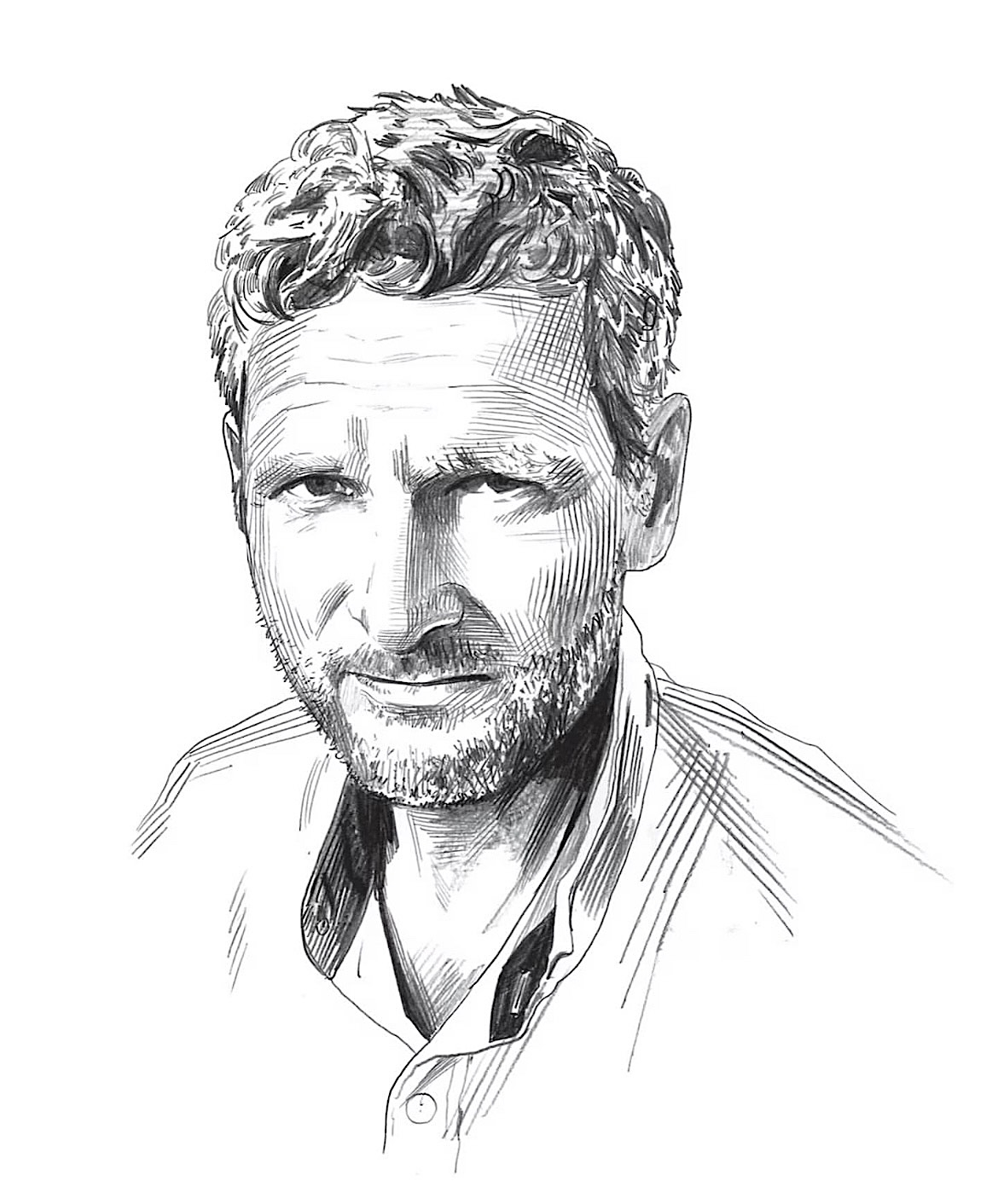
Meet Wojciech Lechowski. A merchant captain from the Baltic coast of Poland. Wry. Friendly. Burly and big-boned, if under-exercised in the way of ship’s officers after years spent at sea. Lechowski is prone to such Olympian statements. It is a laconic tic of command.
What he means is this:
One day the wind blows; the next day the ocean waves grow. The currents of the subpolar gyre spin across the Pacific Ocean in just one direction: clockwise. The Arctic greys at 50 degrees north latitude—metallic skies and graphite seas near the Aleutians—freeze out every other color in nature, and will likely do so until the end of time. Against such primal forces of salt water, it is human affairs that seem fickle, unsettled, ephemeral, puny, even absurd. The sea never changes.

Capt. Wojciech Lechowski.
Photograph by Paul Salopek
Three decades ago, when Lechowski was a smooth-cheeked cadet, cargo ships employed people with titles like “radio operator” and “carpenter.” Today, life at sea is utterly transformed, digitized, automated, containerized. Aboard gargantuan vessels of the sort that Lechowski skippers, technology has halved the crew sizes from more than 40 to about 25. Instant communications now reach every horizon. Corporate traders, government regulators, even an anxious Hokkaido farmer shipping a pallet of Wagyu beef to California can easily track the position of any freighter at sea, down to a heartbeat, via satellite.
Capt. Wojciech Lechowski.
Photograph by Paul Salopek
Three decades ago, when Lechowski was a smooth-cheeked cadet, cargo ships employed people with titles like “radio operator” and “carpenter.” Today, life at sea is utterly transformed, digitized, automated, containerized. Aboard gargantuan vessels of the sort that Lechowski skippers, technology has halved the crew sizes from more than 40 to about 25. Instant communications now reach every horizon. Corporate traders, government regulators, even an anxious Hokkaido farmer shipping a pallet of Wagyu beef to California can easily track the position of any freighter at sea, down to a heartbeat, via satellite.
Such individuals might even be able to pinpoint captain Lechowski’s waypoint at this very instant: Standing in the navigation bridge of the Maersk San Vicente, a NeoPanamax class container vessel moored in Yokohama, Japan. (Tied up at pier MC4, to be exact.) Peering down through a plate-glass window, Lechowski sips slowly from a white mug of coffee. He does everything like this: In a measured way, deliberately, gingerly, as if he were steadying the entire deadweight of the 112,224-ton ship across his shoulders. Far below unscrolls the ship’s deck. It’s as long as the Eiffel Tower is high.
Gantry cranes are onloading and offloading hundreds of shipping containers. The boxy cargo units, big as railway cars, are stacked 17 high in the holds. Exactly 4,439 containers, packed with consumer products, personal belongings, raw materials, and manufacturing components beyond all imagining will cross the Pacific Ocean to North America. The stowage operation is complex and astonishingly brisk, a task of mere hours. An onboard computer in effect erects a cubic mountain of cargo in the precise configuration required to be disassembled later, in equally meticulous order, at various ports ahead—in Canada, China, South Korea, and, two months hence, back in Japan. Dock cranes tilt 30 stories up into the sky. They swing the 20-ton containers like Lego toys.
A journey across the North Pacific in a cargo ship as long as the Eiffel Tower is high.
Out of Eden Walk
I’m less than an afterthought in this whirling, titanic, and otherworldly ballet: a journalist crossing the planet on foot, displacing 80 kilos of mass aboard ship. Thirteen years ago, I trekked out of Ethiopia to retrace the pathways of our nomadic Stone Age ancestors. I conduct interviews. I scribble what I see along the way. Now, having reached the last rim of Asia, I’ve run out of solid ground. So I’m hitching a ride to the Americas on the Maersk San Vicente. The quirks of my journey don’t leave Lechowski particularly impressed. All manner of foolishness washes up with the tides. The sea never changes.
“You are free to use our gym,” he tells me, without the least flicker of sarcasm, “to stay in shape.”
Look at the ship.
Painted swimming-pool blue, its hull rises above the docks at Yokohama like a steel tsunami. Above the deck railings towers another rampart of stacked orange, grey, and red containers. And then, even higher: the glassy wheelhouse that is Lechowski’s floating office. I squint up at it. My yellow plastic helmet—safety kit required by Japanese port authorities—drops from my head and spins on the concrete pier.
By the latest engineering yardsticks, the Maersk San Vicente ranks as only a mid-size container ship. Yet its sheer scale—the fantastical, outsize, Willy Wonka hugeness of its construction—is impossible to take as a matter of course.
The vessel measures 300 meters from bow to stern, about four city blocks. Jog eight circuits around its deck and you’ll complete a five-kilometer run. The engine room is a floodlit cavern gaping inside the hull, spacious as a commercial aircraft hangar. The engine cranks a propeller as wide as a school bus is long. Each of the motor’s nine pistons stands tall as a grain silo and weighs more than five tons. At full throttle, the Maersk San Vicente generates 49,558 horsepower. (Alexander conquered the bulk of Eurasia with a cavalry of only 6,000 horses.) The ship’s anchor is heavier than 10 cars. And so on.
Owned and operated by the second-largest shipping company in the world, A.P. Moller-Maersk, headquartered in Copenhagen, the Maersk San Vicente is one of at least 57,000 merchant vessels plying the oceans today.
Deckhands lay out heavy docking lines.
Photograph by Paul Salopek
This international fleet—container ships, bulk carriers, oil tankers, towed barges—functions as the red blood cells of the planet’s economic corpus. Ninety percent of all commodities traded across borders skims atop the immense membrane that separates two fluids, seawater and air. Virtually everything imported that you eat, wear, drive, furnish your home with, entertain yourself with, medicate yourself with, bury your dead in, covet and despise arrives in your life via cargo ships. Without this watery caravan, our modern consumer culture would stall, shrink, simply collapse.
Yet 1.9 million seafarers who keep this vast conveyor belt of globalization moving remain anonymous, unacknowledged, all but invisible to the public. Where are the blockbuster films set in the wheelhouse? Where are container ship shanties? The merchant marine bestsellers? The nautical memes?
“Friends back home still ask if I see pirates,” says John Cruz, the courtly chief officer aboard the Maersk San Vicente. Cruz cups a hand over one of his eyes, mimicking a buccaneer’s patch. “It’s crazy. Nobody understands our world.”
Cruz is a romantic. Four days out of Yokohama, he takes me out onto the ship’s bridge wing, an exposed walkway high above the deck. Feet planted apart as on a mountain top, his hair yanked sideways by 30-knot winds, he grips an old-fashioned sextant rummaged from a drawer. He wants to demonstrate how in olden times sailors shot the sun for celestial navigation. It is a gesture of remembrance, a nod to a tradition of seamanship before Doppler weather radar, corporate management, GPS navigation, Facebook messaging, and a topnotch karaoke machine thumping in the crew’s recreation room. But such nostalgia is superfluous. Because water’s magic abides. The sea never changes.
In my spartan cabin that night I lie awake listening.

Obsidian waves.
Photograph by Paul Salopek
Thousands of cargo containers rub against each other inside the holds. They groan and squeak through the steel bulkheads in a doleful, low-decibel symphony as the ship torques its way atop a plain of water. Maybe a herd of dinosaurs sounded like this.
Cartoon safety placards on the Maersk San Vicente feature women sailors. (Don’t run on the stairs!) Training videos also dutifully include women. Notices in the crew’s dayroom—a pocket lounge stocked with Majesty brand mayonnaise from the Emirates, Sun Dip currant jam from Pakistan, Skyflakes saltines made in the Philippines, and Paleolithic jars of Italian Nutella—warn sternly against sexual harassment.
Yet the container ship is woman-less.
In fact, only 7 percent of A.P. Moller-Maersk’s total workforce at sea is female. And as it turns out, even this bleak figure is something of a win. Despite years of labor shortages and targeted recruitment efforts, less than 2 percent of the shipping industry’s mariners worldwide are women. More women hammer iron in the blacksmithing trade, proportionally speaking, than female merchant sailors lurch at sea. Barnacled traditions, issues of safety, stubborn gender discrimination: The ocean remains a deeply masculine enclave.
Twenty-one men operate the Maersk San Vicente.
Their ages range from 20s to 50s. Their passports reflect the industry’s postwar shift toward recruitment from geographies of cheap labor: the Philippines, India, Poland, China. The polyglot crew communicates at the mess table in Seaspeak, a clipped, nomadic version of English. (A drifter of questionable allegiances, I feel at home at their elbows.) They sign seafarer’s contracts that last from three to nine months. The shipboard environment they inhabit is less gritty man-camp than regimented space-station. They toil, sleep, and relax inside a massive factory—a warehouse—requiring constant attention and maintenance. Waking hours are rigidly parsed by shifts. Breakfast is served at 7:30 a.m., lunch at 11:30 a.m., and dinner at 5:30 p.m. They enjoy two coffee breaks. They chat with loved ones via satellite-linked WiFi but can’t stream films or video games. The beige passageways of the accommodation decks are clean and eternally lit. Order and manners are observed. At first, I suspect it's because I’m a reporter. Or because of Asian cultural politeness. But it could hardly be otherwise. The cost of mistakes at sea are almost grave and irreversible as those in orbit. They live with the boss.
Meet Dan John Caballero.
Twenty-nine years old. Husky. Driven. No-nonsense to the point of blunt. The second officer of the Maersk San Vicente. “I want to be a captain pretty soon,” he tells me matter-of-factly. “I have dreams.”

Dan Caballero.
Photograph by Paul Salopek
Early in his young career Caballero was forced to abandon a container ship on fire. He recalls smoke and shouting. And diving from the deck railings as though from a high cliff . . . falling, falling, falling into the moiling waves below. This disaster occurred on an older vessel, with a different company, in a different ocean. He is writing a book about it. He taps out words on the glowing screen of his smart phone during breaks from the brutal middle watch, which lasts from midnight to 4 a.m. Every 12 minutes, an automatic alarm clangs on the blacked-out bridge. Its loud jangling shakes the calm oceanic darkness. Caballero gets up from the captain’s seat to disarm it, again and again, with the press of a red button. It is meant to keep the watchman alert through the night. Caballero is from Cebu, the Filipino port where Ferdinand Magellan planted a cross before falling to a blow from a Filipino cutlass. Derived from the Cebuano word sugbú, the city’s name means “to dive into water.”
Dan Caballero.
Photograph by Paul Salopek
Early in his young career Caballero was forced to abandon a container ship on fire. He recalls smoke and shouting. And diving from the deck railings as though from a high cliff . . . falling, falling, falling into the moiling waves below. This disaster occurred on an older vessel, with a different company, in a different ocean. He is writing a book about it. He taps out words on the glowing screen of his smart phone during breaks from the brutal middle watch, which lasts from midnight to 4 a.m. Every 12 minutes, an automatic alarm clangs on the blacked-out bridge. Its loud jangling shakes the calm oceanic darkness. Caballero gets up from the captain’s seat to disarm it, again and again, with the press of a red button. It is meant to keep the watchman alert through the night. Caballero is from Cebu, the Filipino port where Ferdinand Magellan planted a cross before falling to a blow from a Filipino cutlass. Derived from the Cebuano word sugbú, the city’s name means “to dive into water.”
Or meet Sagar Pandey.
For a decade, Pandey filmed commercials and TV series in Mumbai. Then COVID throttled videography gigs. His father was a mariner. So at age 25, Pandey tacked back into the family business. The accordion of his forehead wails a song of frustration recalling this.
I follow Pandey on his shift. He is a deckhand: intense, lean, and jokey, with a showman’s patter. On the back of his coveralls he has inked his name with a $ instead of an S.
The immense ship is a labyrinth of solitude.
Its superstructure—six decks of hallways lined by cabin doors, a galley, officers’ meeting rooms, a laundry, a rudimentary “slop-chest” store selling discount sodas and chips—gives way to empty industrial passageways snakey with steam pipes and electrical cabling. The ceilings above the closed cargo holds are so high they disappear into darkness. Anchor chains with links the length of my body coil inside lockers that could easily accommodate a two-story building. Everything is painted fun-house shades: fire-engine red, lime green, snowy white. The crew’s overalls are deep sky-blue. Their plastic helmets are phosphorescent yellow. It is like wandering through an elemental Mondrian painting that rocks subtly underfoot.

Sagar Pandey.
Photograph by Paul Salopek
I ask Pandey about the Himalaya of cargo onboard. It is impossible to avoid apocalyptic reveries: How long might we 22 survive, I wonder, cut off from land, aboard a ship the size of a skyscraper, laden with tons of endless possibility—maybe even refrigerated containers of champagne? Or shelves of kiwi fruits? Or pallets of iPhones? Or truckloads of kitty litter?
“We have a manifest,” shrugs Pandey, “but who wants to know? Our main job is to move it."
I hear this reply from other crew members. Like mail deliverers, they are concerned with process.
Sagar Pandey.
Photograph by Paul Salopek
I ask Pandey about the Himalaya of cargo onboard. It is impossible to avoid apocalyptic reveries: How long might we 22 survive, I wonder, cut off from land, aboard a ship the size of a skyscraper, laden with tons of endless possibility—maybe even refrigerated containers of champagne? Or shelves of kiwi fruits? Or pallets of iPhones? Or truckloads of kitty litter?
“We have a manifest,” shrugs Pandey, “but who wants to know? Our main job is to move it."
I hear this reply from other crew members. Like mail deliverers, they are concerned with process.
Pandey chips away at cracked deck paint with a power descaler. The electric tool spins a brush of steel needles at up to 5,000 revolutions a minute, screeching away at the metal surfaces in what Pandey calls “the sailor’s never-ending war against rust.” Pandey puts his weight into it. Sparks fly. I watch him. Silhouetted against the Pacific’s impeccable grey horizon, he could be one of Jason’s Argonauts. Or a monk braced inside Saint Brendan’s coracle. Or a Holocene seafarer paddling off an icy Beringian surf. The only human profession older is hunting and gathering. Pandey still produces films: He uploads puckish YouTube travelogues of port stays in Vietnam, Malaysia, Panama. Thanks to the efficiencies of containerization, shore leaves have shrunk from days to hours.
"People back home don't understand the sacrifices. It's a movie to them: Oh, cool! Look at the rough storms! But it's not cool. It can be tough,” he says. “You don't see family for months. There are guys on this ship with kids who are one or two years old. I see their videos. The kids start crying."
Pandey switches to a bucket and a brush. He coats the freshly polished metal deck with a polymer glaze. The substance chemically rebuilds itself if scratched or corroded. Sailors call it “self-healing” paint.
We will never find the oldest ship.
Artifacts that float rarely last—at least not on the timescales of the earliest human migrations. Until little more than a century ago, most boats were wood. They rot away to atoms. Some 50,000 years ago, for instance, Homo sapiens sailed to Australia. Nobody can fathom how. Possibly by bamboo raft. The same reasoning applies to the first peopling of the Americas during an interglacial thaw more than 15,000 years ago. Growing evidence points to coastal dispersals down the western shores of the continent, perhaps at first via skin-covered boats like Inuit kayaks.
“We know that people were making and using watercraft by 13,000 years ago because of the presence of a person’s remains dating from that period on Santa Rosa Island in the Channel Islands, off the coast of Southern California,” writes Jennifer Raff in Origin: A Genetic History of the Americas. “It would have taken a boat to reach the site during that period.”

Capt. Wojciech Lechowki (left) and third officer Sherwin Tumambo on the bridge. The red light preserves night vision after dark.
Photograph by Paul Salopek

The tops of high waves are illuminated like stars on the radar display of the Maersk San Vicente.
Photograph by Paul Salopek
Svante Pääbo, the eminent Swedish paleogeneticist, has his own queries about these mysteries. They concern the currents of the mind.
Our nearest prehuman ancestors, the Neanderthals, stood perplexed on beaches for hundreds of thousands of years—Pääbo believes—neither imagining nor daring to cross open waters. Homo sapiens, by contrast, must have horsed logs into surf and paddled into blank horizons.
“It’s only fully modern humans who start this thing of venturing out on the ocean where you don’t see land,” says the Nobel Laureate. “Part of that is technology, of course; you have to have ships to do it. But there is also, I like to think or say, some madness there. You know? How many people must have sailed out and vanished on the Pacific before you found Easter Island? I mean, it’s ridiculous. And why do you do that? Is it for the glory? For immortality? For curiosity?”
The Maersk San Vicente is a workhorse of commerce. It is also a time machine.
During our 11-day traverse of the North Pacific, we transit 17 time zones. What does this mean? It means clocks become idiot instruments. It means time itself dissolves. It means sleep drains away.
Chipping paint in cavelike cargo holds.
Out of Eden Walk
I roam the ship’s passageways at all hours, confused, groggy-eyed, strung out in a fog of misfiring neurons. My parietal cortex, that quadrant of my brain cued to time perception, stretches like warmed rubber in four directions:
First, my body is synced to Japan time. (GMT +9.) Second, my mind is cued to a slew of “daytime” work communications—phone calls, emails, text messages—all pegged to my ultimate destination, Alaska. (GMT -9.) Then there is the palpable tug of a chronological bubble called “ship’s time.” According to calculations that only captain Lechowski understands, he orders the ship’s clocks to advance with the push of a button from the bridge. On the fourth day at sea, he compresses an afternoon by three hours; on the sixth day he skips ahead two hours more, etc. In this way, the crew maintains equitable work shifts as we swallow time zones on our eastward journey into dawn. And finally, there is the gauzy reality of “natural time.” Glance out a porthole: Light or darkness mark the hour, minute, and second that slips beneath the keel at our actual longitude. One morning it is Philippines time. Two afternoons later, it becomes Vanuatu time. Steaming over the International Dateline, marked at 180 degrees longitude and squiggling from pole to pole east of Hawaii, we snap backwards into yesterday.
“Seven crossings to the east. Eleven crossings to the west," Lechowski muses of his Pacific travels. "I calculate I am four days younger now.”
Meet Ricardo Pascual. He clocks life with an egg timer.
Born poor in Cabanatuan City, the Philippines, Pascual, 49, has logged more than 20 years as a cook at sea. His father hawked fish balls and salted squash seeds on barrio street corners. Seafaring has buoyed Pascual into the middle class.

Chief cook Ricardo Pascual innovating in the galley.
Photograph by Paul Salopek
"Look, it's not simple,” he explains in the galley, where the Bee Gees are jive talkin’ on an actual boombox and a rolling pin trundles back and forth atop a counter, marking time with the 19-second periods between three-meter waves. “You cater to different tastes. The Indians don't eat beef, so you add fish. No pork for Muslims. You have to know how to mix spices and herbs, especially for Indians and Europeans. We have one guy who's a vegetarian."
Chief cook Ricardo Pascual innovating in the galley.
Photograph by Paul Salopek
"Look, it's not simple,” he explains in the galley, where the Bee Gees are jive talkin’ on an actual boombox and a rolling pin trundles back and forth atop a counter, marking time with the 19-second periods between three-meter waves. “You cater to different tastes. The Indians don't eat beef, so you add fish. No pork for Muslims. You have to know how to mix spices and herbs, especially for Indians and Europeans. We have one guy who's a vegetarian."
Crowned with a chef’s toque, Pascual holds the second-most important position aboard ship after the captain: the morale officer. Food is a refuge, the great mollifier, at sea. He improvises new meals constantly to fight routine. (As he says this, he pours a can of condensed milk into a simmering vat of pineapple chunks and chicken breasts, preparing a batch of pininyahang manok.) Pascual wears the guarded expression of a man professionally hardened against faint praise. He leaves salad and cake out as leftovers. In the mornings, the cake is gone.
The sea never changes.
Or meet Ramesh Kumar, 38, the bearded motorman of the Maersk San Vicente.
“I know your hometown,” I tell him, because I have just learned this improbable fact: Hiking years before across India, I plodded within eyeshot of Kumar’s birthplace in the Thar, a rolling desert where the few roads unspool amid broiling loo winds, staring camels, and dunes of bone-colored dust.
“Really?” Kumar says, feigning interest.
“Amazing, isn’t it?” I insist. “Just imagine—the chances of us two meeting out here in the middle of the Pacific.”
“Yes.”

Ramesh Kumar.
Photograph by Paul Salopek
Kumar is a rationalist. A philosopher. A kind of doctor. He spends his days below deck, palpitating the ship’s many-chambered heart. "In the engine room you must listen,” he says. Machines have their own language, their own music: Amid the deafening tremulo of valves, pumps, pistons, and flywheels, a false note portends trouble. "The lack of water at home made me come here,” says Kumar of his escape from his arid homeland’s worsening droughts. “And all the water out here has allowed me to go back."
Ramesh Kumar.
Photograph by Paul Salopek
Kumar is a rationalist. A philosopher. A kind of doctor. He spends his days below deck, palpitating the ship’s many-chambered heart. "In the engine room you must listen,” he says. Machines have their own language, their own music: Amid the deafening tremulo of valves, pumps, pistons, and flywheels, a false note portends trouble. "The lack of water at home made me come here,” says Kumar of his escape from his arid homeland’s worsening droughts. “And all the water out here has allowed me to go back."
Two decades of seafaring wages have bankrolled a family car repair garage in India. He hopes to turn in his ear muffs for good in five years and go tune engines in the Thar. Along the way, he’s missed two grandparents’ funerals and his sister’s wedding.
"Ninety percent of what I have in this world I earned through this work,” Kumar says, without heat. “But many things too I lost. That is life."
Merchant shipping remains an abstraction to its global customers.
Container vessels steam into the headlines rarely, either as spot-news disasters or avatars of larger policy. Like the bottleneck tolls of COVID. ("Some ships were waiting two to three weeks at anchor in Los Angeles,” recalls Lechowski.) Or Trump’s tariff wars. (U.S. ports are now teetering into double-digit declines in trade.) Or the effects of tens of thousands of ships’ mega-engines on the climate crisis. (Maersk, like many global freight companies, has committed to cutting greenhouse emissions. But the U.S. government, calling the climate crisis a hoax, recently stymied tougher international enforcement mechanisms.)
The Maersk San Vicente slides eastward atop the subpolar gyre.
The current flexes like giant muscle across the North Pacific, adding a knot or more to the ship’s speed. Captain Lechowski “super slow steams” his engines toward Prince Rupert, Canada. We rarely exceed 14 knots, a little over half the ship’s maximum pace. This serves two purposes: reducing pollutants and shrinking the trans-Pacific bunker fuel bill to only $250,000.
We pass one night through a galaxy of Chinese squid trawlers. The boats’ powerful decklamps draw up their quarry and light the waves a weird green. The fishing fleet—scores of vessels—partition out the darkness like a floating city.
We churn above the Daiichi-Kashima seamount, a peak that rises three and a half kilometers from the ocean’s abyssal plain—a drowned volcano. The Pacific plate slips into the Earth’s mantle here at the rate of one handspan a year, triggering frequent earthquakes.
We chug another day past a funnel of grey smoke on the northern horizon: A Liberian-flagged container ship carrying 3,000 Chinese cars is ablaze. The crew has abandoned ship. Nearby container vessels divert to the rescue.
We spot whales. Pelagic birds. A full yellow moon rises above a charcoal sea, its glow sheening on the waves like polished obsidian.
South of the Aleutians, another moon rises during the day: a massive white golf ball set atop a soaring quadrangular tee. The ball is a secret U.S. marine radar, the SBX-1. The tee is a converted and self-propelled oil platform. The whole structure towers 70 meters above the waves.
“It’s radio silent and not showing up on the AIS,” says chief officer Cruz, referring to the global tracking system that ships are required to use to avoid collisions. He suspects it is monitoring rocket launches in North Korea.
“We don't go near,” Captain Lechowski mutters, squinting through binoculars.
On the night of our 10th day at sea, we at last enter Canadian waters.
On Lechowski’s pitch-black bridge, the radar screens show electronic nebulae appearing and disappearing. Star systems and constellations bloom, dissolve, and emerge again on the digital diplays, a cosmos of human design that flickers right under the eyes of the bridge officers. Men thrown together by drought and pandemics. By necessity and chance. The sparkling blips are the tops of thousands of oceanic waves that reflect back the ship’s electromagnetic signals. The waves are ironed flat under the ship’s huge bow. We can’t even feel them. We come bearing everything.

A tug nudges the Maersk San Vicente into port at Prince Rupert, Canada.
Photograph by Paul Salopek