When you jaywalk across the globe, you must expect to be stopped by police. It is that simple. Such is the car-conquered planet we live on.
All motorized societies classify walkers as suspicious beings. People who walk defy traffic controls. They bypass checkpoints. They do not submit passively to the prisons called paved roads. Walkers, more to the point, do not own cars. This is utterly heretical, subversive or at least worthy of contempt: This single fact places most walkers in the underclass of the poor, the marginalized, drifters, potential anarchists, troublemakers, crazies, figures of suspect loyalties. Why are they walking? Don’t they pay taxes? Are they carrying a bomb?
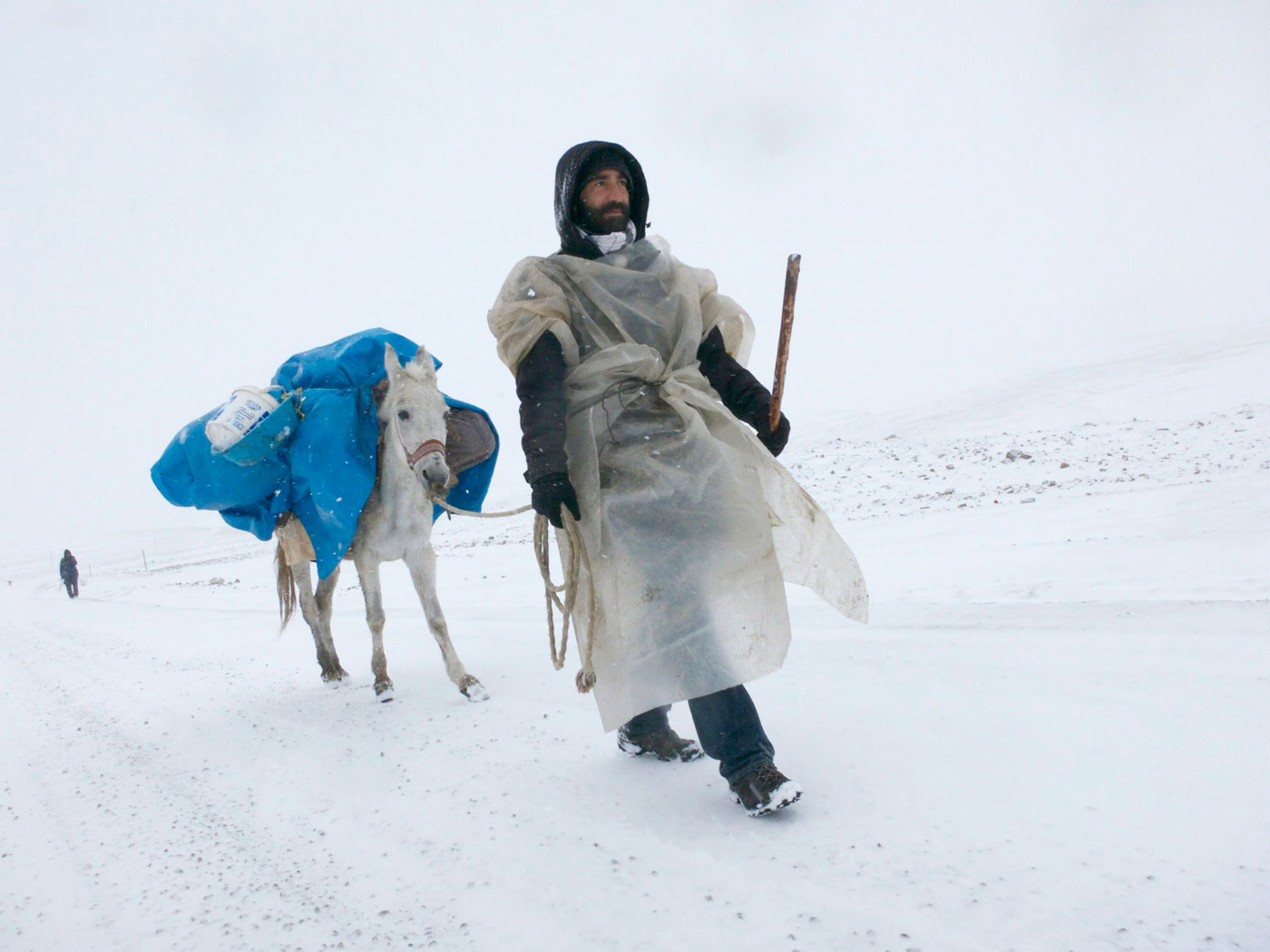
Two years ago, I walked out of the Rift Valley of Ethiopia to reconstruct, by foot, our ancestral journey out of Africa and across the world. So far, I have trekked more than 4,000 miles through the deserts of the Horn of Africa, the conflict zones of the Middle East and the pistachio orchards of Asia Minor. Local security forces—police, militia, soldiers, plainclothes intelligence officers, immigration officials—have detained me 42 times. This is an average of one stop about every 100 miles. In Cyprus, I was detained once. (By a British policewoman at the Green Line.) Turkey, admittedly a large country, holds the record with 17 stops. (Including an ambush by Kurdish militia that nearly got me shot.)
During each of these encounters, I recorded my latitude and longitude with a hand-held GPS device. My partners at the Center for Geographic Analysis at Harvard and the Knight Science Journalism Fellowship at MIT then poured these data into a digital map. The idea is to create, albeit in a purely anecdotal way, a personal record of freedom of movement across the globe.
Many of my interactions with police are positive: Officers often check on my safety. And even my toughest experiences with police fade in comparison with the plight of the truly powerless walkers I encountered on the trail—destitute Ethiopian migrants, for example, or war-displaced Syrians. But there is a lesson here. Walking may make you free. But it by no means makes you invisible.
My most melancholic police stop so far: