“The high stillness confronted these two figures with its ominous patience, awaiting for the passing away of a fantastic invasion.” — Joseph Conrad
We stand atop a tall guard tower under a metallic grey sky—a sky the color of polished lead.

Former military guard tower repurposed as a bird-watching blind at the Georgia-Turkey border.
Paul Salopek
A quarter of a century ago, Red Army soldiers gazed into enemy territory from this spot. It was a no-man’s-land, a tense front line between two competing global empires: the frontier between a Soviet ally and an American ally, a no-go zone between the Soviet Socialist Republic of Georgia and NATO-member Turkey, a political gash dividing East and West. Barbed wire slunk across the hills. There were patrols, flags, telescopes, land mines. Today, the steel tower, about 50 feet high and a relic of the Cold War, has been refurbished as a bird-watching blind in the brand-new Javakheti Protected Area of Georgia. Tourists climb such towers today to witness the vast flocks of little egrets, Dalmatian pelicans, Armenian gulls, Eurasian hoopoes, and other species that overfly the Caucasus on their boggling annual migrations, hurtling from the sub-Arctic to Africa and beyond. These flocks pool like confetti in the wetland bellies of grassy valleys. Like all animals, the only border that birds abide is the oldest one. It lies between the moment of living and dying.
Georgia has a long history with such fortified edges. It has been endlessly overrun by empires, warlords, religious zealots, buccaneers, revolutionaries: by Alexander the Great—by the Persians, Romans, Byzantines, Arabs, Khazars, Mongols, Ottomans, Russians, and, starting a heartbeat ago, by the nomadic hordes of suit-clad experts: the global purveyors of development advice, of bills due, of foreign aid.
Legions of birds. I imagine the atmosphere humming with their approach.

High perch for an avian show: In the coming weeks some 150 species of birds will pass through here on their southward migrations.
Paul Salopek
Loren Eiseley, a brilliant if almost forgotten essayist of the middle of the last century, wrote of waking up one early morning in a hotel room high above Manhattan and imagining that city emptied of humans and reclaimed, in some future dawn, by birds:
“At this hour the city was theirs, and quietly, without the brush of a single wing tip against stone in that high, eerie place, they were taking over the spires of Manhattan. They were pouring upward in a light that was not yet perceptible to human eyes, while far down in the black darkness of the alleys it was still midnight.”
From the former military tower, we stare out over Javakheti. At the round lakes that shine like crinkled aluminum foil. At the vast steppes. A few crows and hawks spear the air, and some pale but indistinguishable wading birds stand sentinel in the swamps. It is too early yet for the grand migrations. Next month, hundreds of thousands of birds—about 150 species—will begin to pour south.
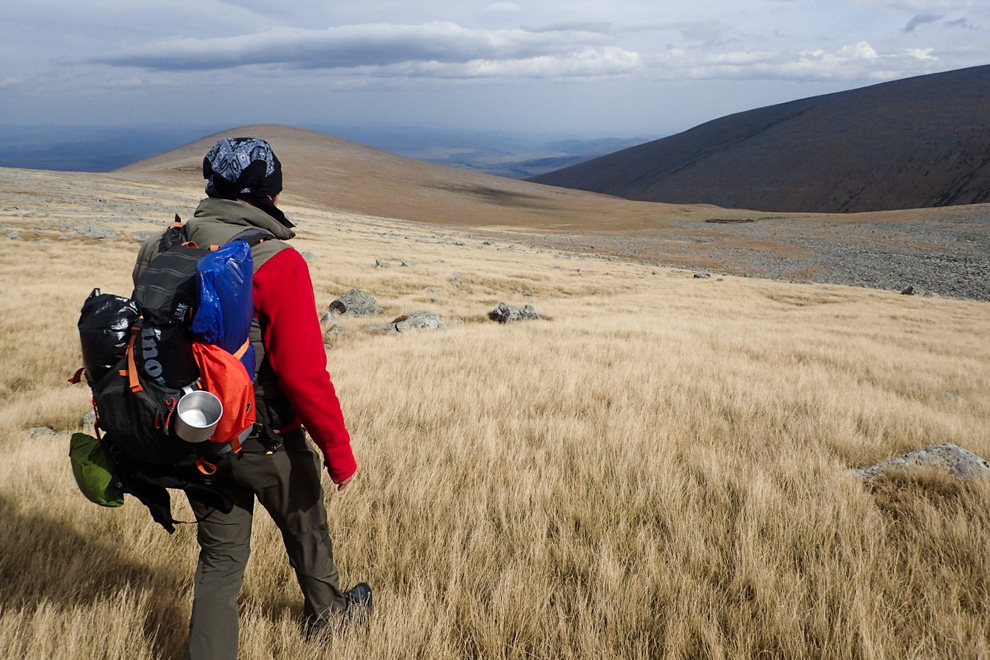
I look at the sky. No borders up there. I feel its curved immensity tugging me eastward. When the birds stop here on their way to the warmth of Kenya, I will be walking under them, to China. But my Georgian friend, Teona Shelia, is not craning her neck toward the clouds. Like any good archaeologist, she always looks down.

“All that’s left.” Archeologist Teona Shelia with a Soviet-era unfiorm button. Georgia-Turkey border.
Paul Salopek
“Look what I found,” she says, smiling, holding out her hand.
It is a button from the tunic of a Soviet soldier. It will be gone tomorrow, rusted to nothing. Already, it looks one-thousand years old.