“The past is never dead. It’s not even past.”
— William Faulkner
They lie piled inside stone huts, the dead.
They are the men, women and children of Anatori village. They were ethnic Khevsuretis, a tough, warlike, and honor-bound mountain people reputed to be the descendants of wandering Crusaders. When did they die—200, 300, 500 years ago? Nobody knows. All that is told is that every soul perished—the village was erased. Wiped out. Today, its strange hut-like crypts built of grey rock dot the slopes of a high and remote river canyon in Georgia, near the wild frontier with Chechnya. Peer into the vaults’ portholes: skulls and delicate tibias rest on dusty shelves, as do pelvises, a scattering of finger bones. An important detail: These people entered the chambers alive. They bricked themselves inside, stone by stone.
The story goes like this:
Anatori was a rich village, and happy. Its men wielded broadswords and bows, and were renowned for courage in battle. (Khevsureti warriors wore medieval chain mail well into the 20th century.) The village’s women were faithful and strong: They practiced stsorperi, sleeping chastely next to visiting male guests, an antique tradition of trust, discipline, and hospitality. The Caucasus Mountains were fat with wild sheep. Hunts were bountiful.
Maintaining this harmony was the solemn duty of the mkadre: the village wise man, or elder.

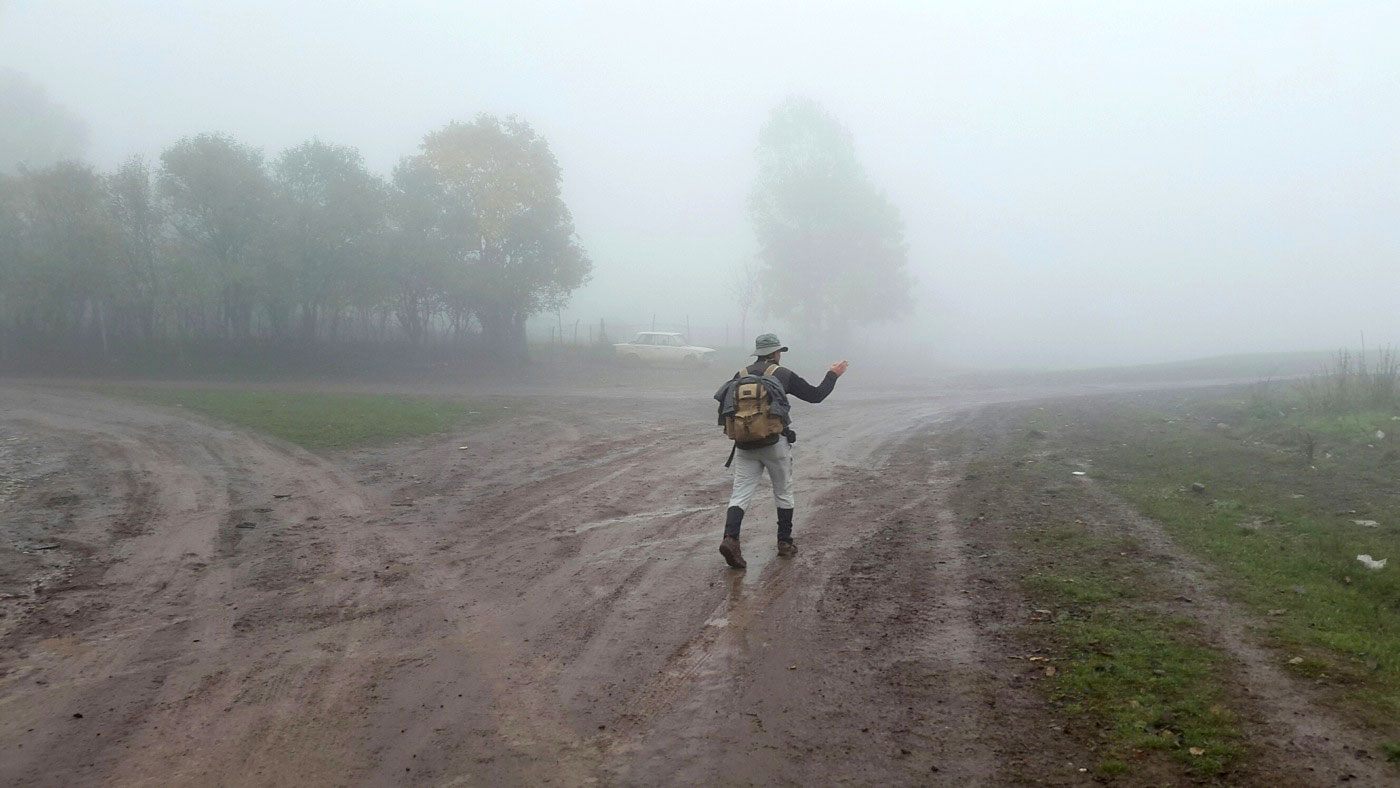
Lonesome road in the Khevsureti region.
Paul Salopek
God issued his blessings to the people of Anatori through a white dove. This shining bird plummeted from the sky. It landed in the mkadre’s upstretched hand. As the deity spoke, the old man’s heart hummed with joy. And here creaks the hinge of primal tragedy. Between divine visitations, the old man, growing feeble and lame, began to long ever more for the intoxication of the plumed messenger. So he plotted with the village blacksmith. They forged two golden nails. They pinned the dove to the Earth. But its power vanished. So began Anatori’s curse.
One by one the villagers sickened. One by one they bade goodbye to their weeping families. They staggered into the bulging crypts. Tottering among stacks of corpses, they walled themselves in. Sixty warriors fell in one day. A child went to his doom plucking a merry tune on his lute. In this way, the poxed hoped to save the uninfected. (By some accounts a sole boy survived, to be raised nearby by Muslim mountaineers called Kists.)
“It would be interesting to know what epidemic that was,” says Eter Tataraidze, an eminent poet and oral historian at the Folklore State Centre of Georgia, in Tbilisi. “Many villages in our eastern mountains built such crypts. People sacrificed themselves for others whenever disease came.”
Tataraidze has just spent two hours recounting the tale of Anatori with great care, with precision. It is the eternal parable about what we must hold onto, what we must give up.

Visitors peer into a crypt.
Paul Salopek
I look into her face—smiling, kind, wise, ringed with white hair. I look at the face of her gracious translator, Tamar Akhobadze. Each has the Georgian bone structure, like Picasso portraits. I could fall in love with these women. The October sky outside the window is seamless and pale as the inside of a shell, and soon I will be walking out of this city.