Kublai Khan: “Is what you see always behind you? Does your journey take place only in the past?”
Marco Polo: “Futures not achieved are only branches of the past: dead branches.”
—Invisible Cities, by Italo Calvino
We are moving slowly through the world.
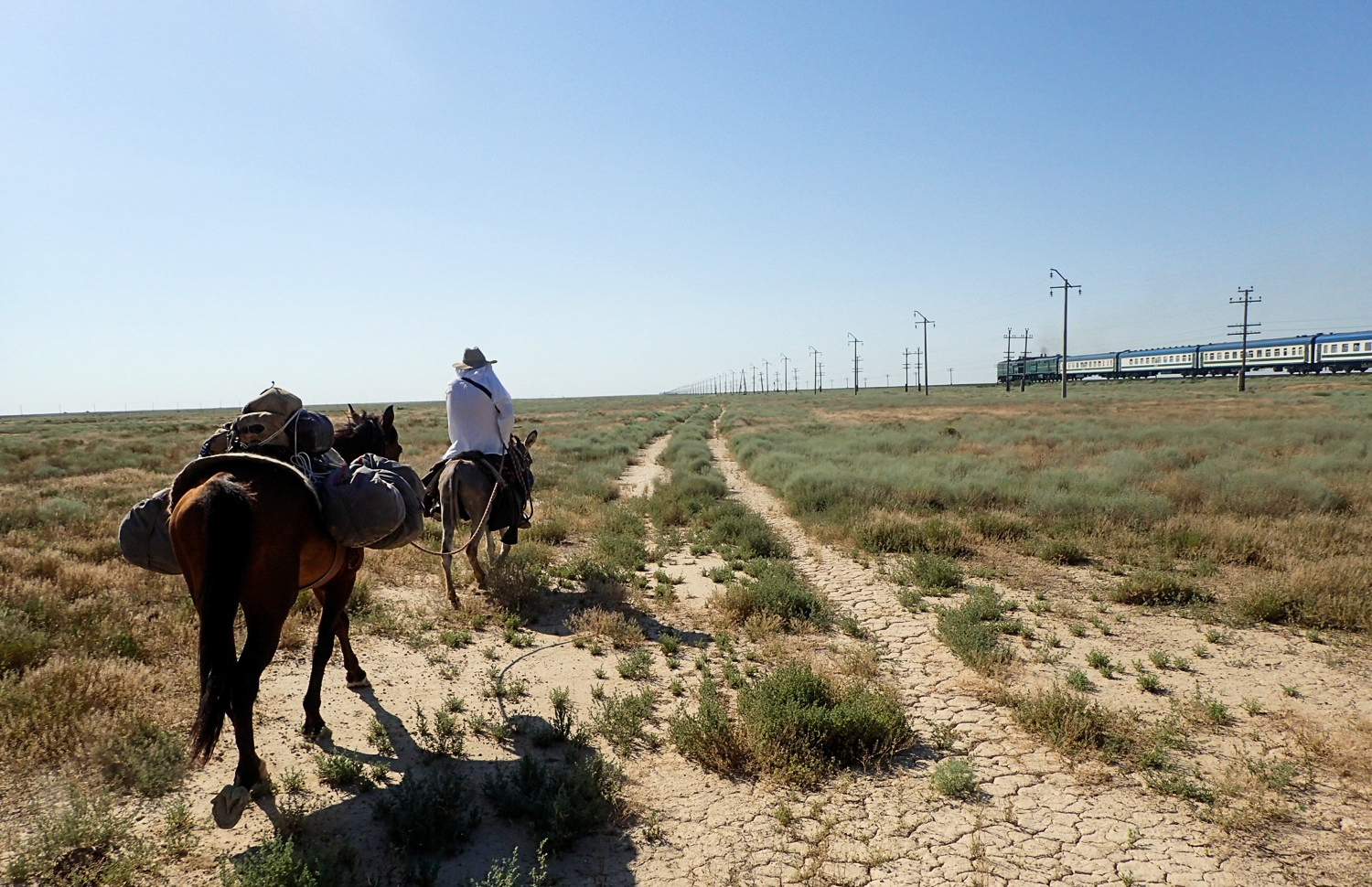
The sun melts a hole in the sky: white-hot as the focused beam of a magnifying glass. The steppe is sweltering. Cloudless. Windless. We create our own paltry wind by walking.
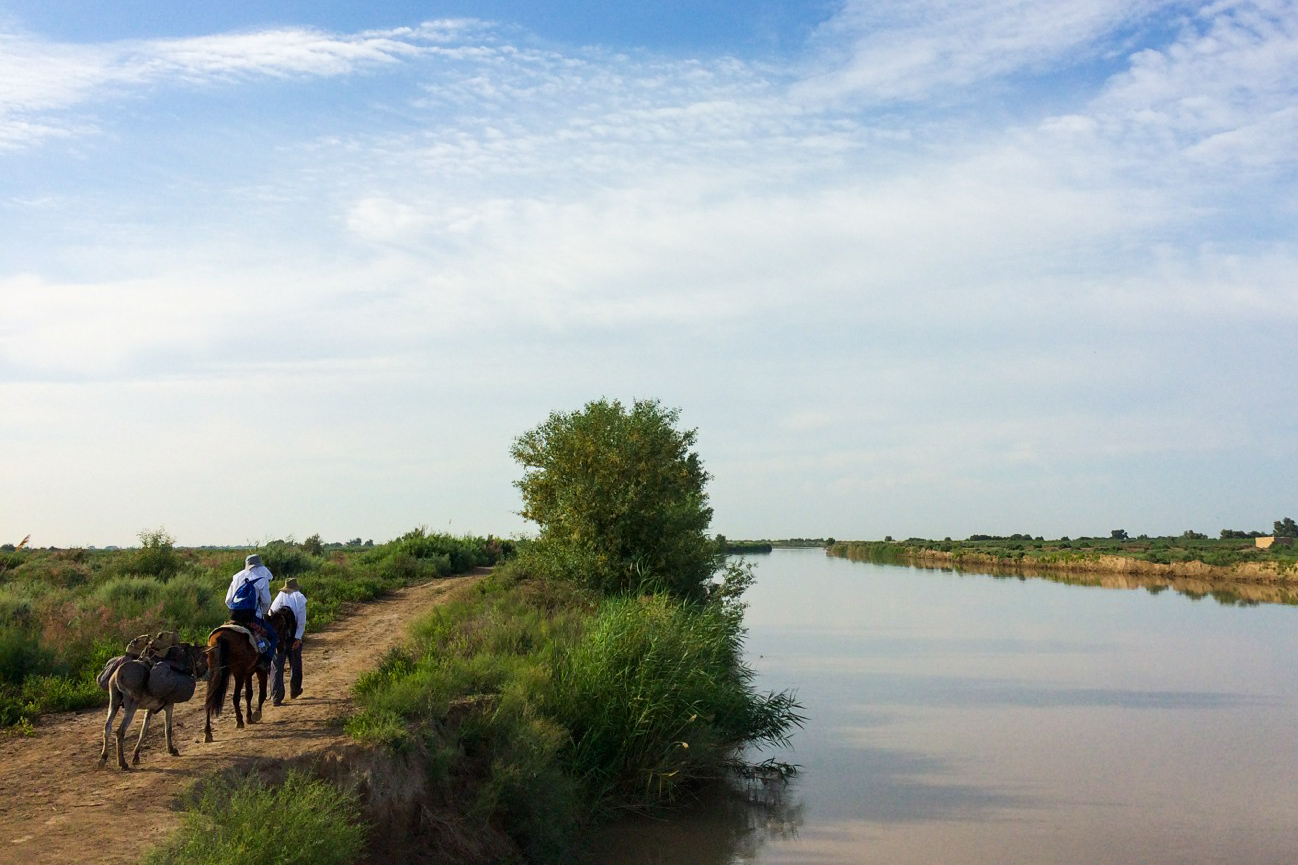
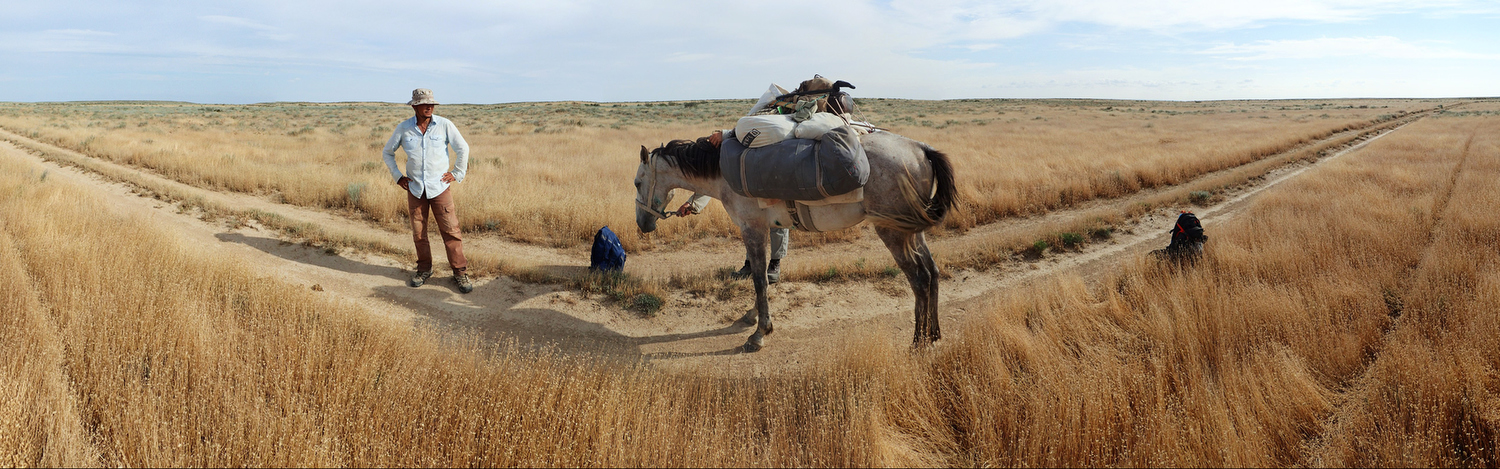
There are three of us. Aziz Khalmuradov, my Uzbek guide, limps behind on blister-broke feet. The donkey wrangler, Jailkhan Bekniyazov, is dizzy with some mysterious ailment—sunstroke, or perhaps extreme homesickness. We slog eastward 15 or 20 miles a day across the burning steppe, deeper into Karakalpakstan, the most obscure “stan” of Central Asia, a vast, arid, semiautonomous region of Uzbekistan. The planet creaks underfoot, carrying us forever toward sunrise. Toward Khiva—the old mud-walled khanate. Toward the unimaginable cold of Siberia. Toward Beleuli.
Beleuli: a stone ruin. A Silk Road caravanserai lost on the grasslands of Karakalpakstan. Built in late 13th century. A pioneering artifact of globalization. A work of art. A cautionary tale.
We find the site far from any paved road. (There is but one paved road spanning all of the 64,000 square miles of Karakalpakstan.) Beleuli is rarely visited. Its buildings long ago crumbled to piles of brick, stone, gravel. Yet to stand, squinting, beside Beleuli’s limestone corpse is to be moved. It was a masterpiece of Central Asian ingenuity, architecture, design.
“The construction was clever,” Shamil Amirov, an archaeologist with the Karakalpak branch of the Academy of Sciences of Uzbekistan, tells me. “Beleuli was extremely remote. So they built it for self-sufficiency.”
The outpost’s defensive walls were turreted to protect treasure-laden caravans against local nomad attacks. To catch the stray breezes, passing merchants occupied second-floor apartments above a grand central square. (The ground-level rooms served as stables for camels, horses, donkeys—the cargo animals.) There were market stalls, craftsmen’s workshops, baths, soldiers’ barracks. Shipments of gold, spices, silks, medicines, carpets, porcelain, and other luxury goods packed the warehouses. At the center of Beleuli’s courtyard: a public drinking reservoir the size of a hotel swimming pool.
Video by Paul Salopek
Beleuli was a medieval moon base.
Wheat was sown nearby on the banks of seasonal ponds. These crops supplied the caravanserai’s bakery and fed its cattle herd. Most impressive of all, a system of stone-domed cisterns, called sardobas, stored scarce rainwater. This water was collected—via a complex network of underground brick gutters—from erratic steppe thunderstorms. While Beleuli’s traders sipped clean water from faucets, London’s 40,000 unwashed citizens waded through ankle-deep slops.
Who conceived Beleuli?
The answer is improbable: the Mongols. Warrior-nomads. The supposed destroyers of civilizations, the horsemen of apocalypse, the urbanite’s nightmare, the human locusts.
Having destroyed the powerful Central Asian trading empire of Khorezm in 1221, Genghiz Khan’s hordes began to impose their own taxes on the commerce bumping through the region by camelback from India, China, and Europe. Pillage and mass slaughter were dandy. But business was business. To promote this lucrative traffic, the Mongol overlords ordered a string of travelers’ inns, spaced a day’s camel ride apart, to be built across the Ustyurt Plateau, an immense wilderness of salt flats and prickly grasses that isolated the rich Central Asian cities of the Oxus River from the mercantile hub of the Caspian Sea. (Today the Ustyurt Plateau, straddling Uzbekistan and Kazakhstan, is more desolate than ever.) In effect, the Mongols bankrolled a primordial interstate highway system, complete with fortified truck stops. The reach of such unlikely commercial arteries was, for their time, truly global. Golden Horde ceramic plates are embedded in the walls of the Orthodox Vlatadon Monastery in Thessaloniki, Greece. Italian graffiti is scratched into the walls of Beleuli.
“They are names of traders,” says the archaeologist Amirov. The scribbles date from the 14th century. This makes them contemporaneous with Marco Polo.
Stone ruins speak of a dead past. Of inert silences. Of static history. Of granite outcomes. But this is an illusion.
Beleuli and the entire Silk Road—like all of history, like the present drift of our own brief sunlit hours—are products of constant change. Of fickle events. Of arbitrary forces. Of flux. Of chance.
“Before the caravanserais, the Silk Road here was on water,” says Amirov. “Ships carried cargo down to the Caspian Sea on the Amu Darya.”
But then the ancient river changed its course. It abandoned its old channel and bent north to the Aral Sea. So the profits shifted overland. And they built Beleuli.
Climate change. The swirl of global economic currents. Tottering empires. A drying river. A Portuguese sea captain timidly rounding the Cape of Good Hope. A bacterium-infected flea riding the scalp of a Mongol archer. (The bubonic plague traveled along the Silk Road: At Caffa, a port at the western terminus of Beleuli’s branch of the fabled trading route, invading Mongols catapulted plague-infected corpses over the walls of the city, igniting Europe’s Black Death pandemic.) All of these chaotic, unpredictable events converge at forgotten Beleuli.
“Are you proud of your ancestors?” I ask Sagun Ezjanov, a young railroad worker who has guided us the last few miles to the astonishing archaeological site.
“They weren’t my ancestors,” Ezjanov says with a shrug.
His face is Sioux. He is a local Karakalpak: a descendant of the steppe nomads who raided these outposts.
We walk on. At dawn we inch steadily toward our own blue shadows that stretch, bending, far behind us: shades that slip backwards over the desert horizon. We will meet them one day. All journeys on Earth describe this eventual circle. Yet nothing is fated.