Xiuyan Crater, Liaoning Province, China: 40° 22' 06" N, 123° 27' 53" E
The god-rock was a football field wide and composed of nickel and iron. It tumbled erratically through space from the Main Asteroid Belt, that vast pinwheel of rubble that whirls around the sun between the orbits of Jupiter and Mars. After millions of years, it finally punched through the sky above the Changbai Mountains of northeast China, and hit the Earth with the explosive force of 500 or 600 Hiroshima atom bombs. Flocks of birds 5,000 kilometers away in what today is India would have startled into flight at the sound of the detonation. This happened at least 50,000 years ago.
“There were Stone Age people living around here at that time,” said Star-Shit Collector, leading the way up to the rim of the remote Xiuyan impact crater, in Liaoning Province. “It is impossible to consider what it must have been like—to have seen such a thing!”
A genial amateur geologist and informal caretaker of the Xiuyan crater, Star-Shit Collector’s real name is Sui Mingku. Sui, 40, gave himself his nickname when he began gathering molten bits of the meteorite that eons ago walloped his rugged backyard, leaving behind millions of fragments that still glitter under the leaf middens of the surrounding hardwood forests. He didn’t understand the rock’s extraterrestrial origins at first. He just admired their shiny, lobed, liquefied shape and strange magnetic qualities. When he learned they arrived from outer space, his interest morphed into obsession. His family thought he was crazy.
“When I was a kid, I lived in a nearby village,” Sui said. “I began gathering up boxes of these stones at home. My mom and dad wanted to throw them out. I told them, ‘They come from the sky! They have dropped on us like star shit!’”

Sui Mingku has collected thousands of rock samples from the impact of a meteorite in Liaoning Province. He turns some into jewelry.
Paul Salopek
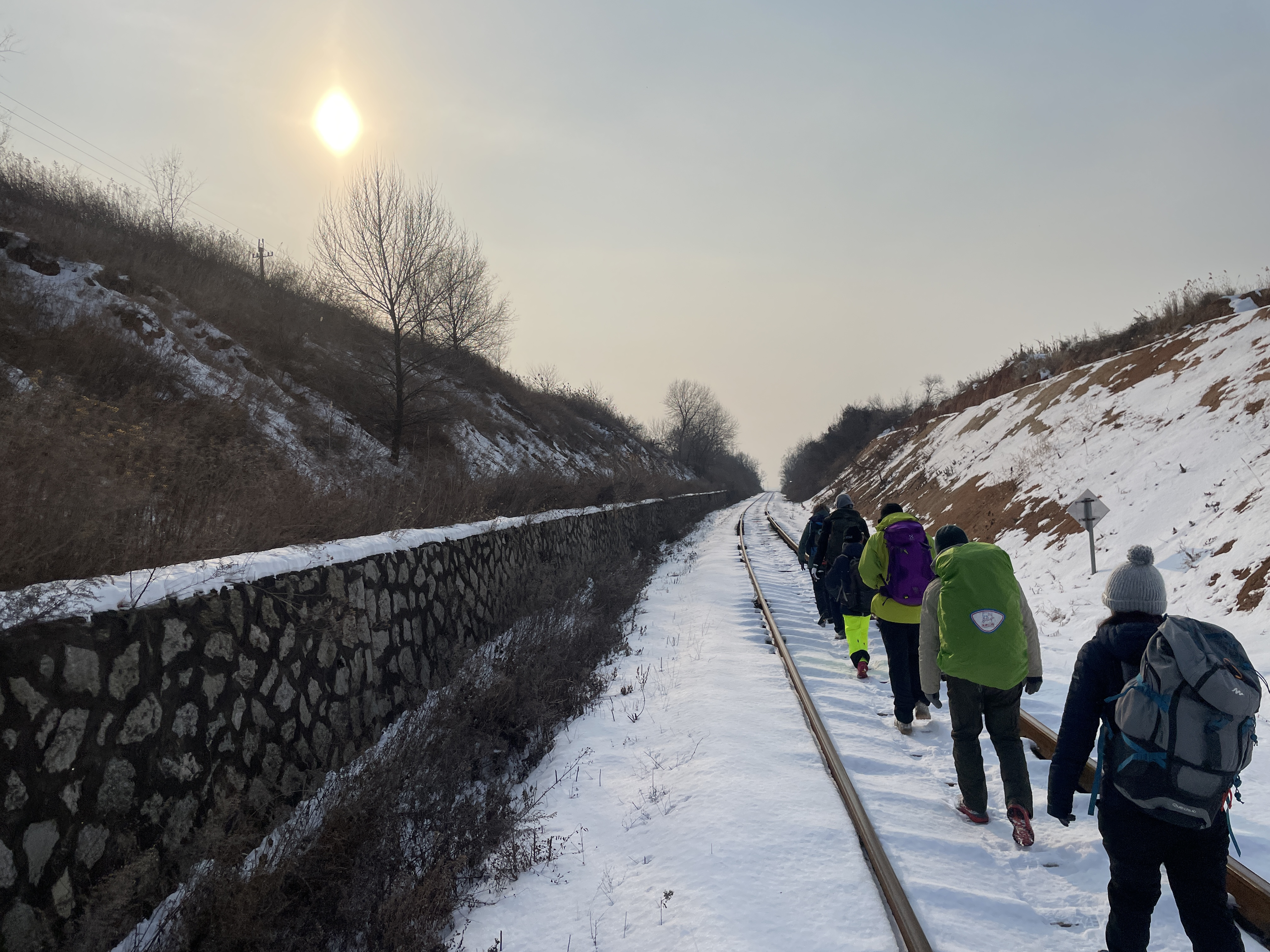
I met Sui in wintertime. I was walking across China. Sui was guiding my walking partners Pan Jun, Xu Haotien, Wang Jiawe, and me around the high, snowy circumference of the Xiuyan crater rim. The crater was 1.8 kilometers across. Its steep craggy walls, maybe 150 meters high, formed a perfect circle and resembled the caldera of an extinct volcano. There was a tiny farming village hibernating in the whitened bottom of the crater. Sui was excited. He didn’t seem to notice the inhuman cold of northeastern China and was dressed only a thin coat, and wore no gloves. His face wasn’t even reddened in the flaying wind. I wore every scrap of clothing I had in my backpack, huffing up the slope in four pairs of socks and two pairs of long underwear that made me walk like a Mongol cowboy, and the freezing air sliced my lungs like razor blades. Sui began to talk about aliens.
“I saw them once a long time ago,” he confided. “I was out playing at dusk with other kids outside my village. Then I saw the ship. It was shaped like a cigarette. It had tubes sticking out. It was horrible. Black, but with a terrible, terrible light. Years later, I came to this crater for the first time. I was 18. I was looking for meteorite stones. I had a strong sense that I’d been here before. A sense of déjà vu. Everyone has a destiny.”
My walking partner Pan, a level-headed woman, gave me the side eye. But I think I understood. Whose life hasn’t been holed, blown through? Loneliness, after all, has its own sort of gravity. Up atop the crater, ghosts and cold sunshine hovered around us.
The Earth has been bombarded by countless meteorites since the planet’s formation 4.6 billion years ago. Surface erosion and the continuous recycling of the geological crust have rubbed away evidence of most of these collisions. Only about 190 cosmic impact craters have been identified globally. The most famous is the gigantic dinosaur-killing hole left by the Chicxulub asteroid, which was about 10 kilometers across (“the size of a city”) and struck near Yucatan, Mexico, about 66 million years ago, raining down beads of molten glass across the entire world. An even bigger rock smashed into South Africa two billion years ago and left a crater more than 250 kilometer wide. And so it goes.
In China, only two impacts have been identified so far.
“In general, among impact craters, bigness correlates with scarcity. That's a good thing!” Paul Warren, a planetary geochemist at UCLA and one of the few foreign experts to visit Xiuyan crater, wrote in an email. The Xiuyan impact is bigger than the famous Meteor Crater in Arizona, Warren added, but more isolated and eroded by water. He expects more impact craters will be discovered in China’s west, where they are easier to spot by satellite in dry, low-vegetation places.
Gift for an amateur geologist: a meteorite from the Main Asteroid Belt.
Out of Eden Walk
Back at Xiuyan crater, our guide Sui told us that he'd wanted to become an astronomer but had to settle on gem cutting to placate his parents’ Confucian practicality. Somewhere out under China’s alien-haunted skies, he had anointed himself the crater’s protector and promoter.
He walked us to his makeshift museum. It was located in the crater’s bowl-shaped cavity. Thousands of artifacts and geological samples were laid out in what appeared to be an abandoned public building, perhaps a former school, and the arrayed material was so meticulously displayed that it was hard not to think of the silent costs of Sui’s mission, and of the absence of family. I stared down at my snow-clogged boots in sudden, sweet self-pity.
“The Xiuyan meteorite destroyed everything for many thousands of kilometers around,” Sui informed me. “The impact gave us back lots of good things, though. It churned the soil with rich minerals. It maybe even exposed our jade deposits here.”
Sui crafted jewelry from the meteorite’s fragments. He’d slung the metallic stones on thongs of rawhide. He showed me how a magnet stuck to their atmosphere-scorched surface, and pressed one of these otherworldly necklaces into my hand, a gift for my girl.
“People wish on a falling star,” he reminded me, smiling. “Just hold this and make a wish!”
Lacing up my thermal boots once again, I assured him that I would.