Last month a co-worker forwarded an e-mail from MIT’s MediaLab asking for help with Paul Salopek’s solar power system, which was proving to be inadequate for charging his computer, satphone, and other devices on the Out of Eden Walk.
I have quite a bit of experience in the technical aspects of powering electronics in remote settings: Part of my job at One Laptop Per Child is to design and troubleshoot power systems for the XO laptop family and its support ecosystems in the developing world. I’ve learned that in a solar-only environment (known as “off-grid” in solar lingo), charging anything larger than a cell phone can be a complex task.
I began by communicating with the Out of Eden Walk team, including Paul himself, to learn more about the problem. Then I set out to investigate solutions. Through my research I’ve found some equipment that I think can help Paul, and by extension, all foreign correspondents, NGOs, local communities, and others who work off-grid in remote parts of the world.
This posting is the summary of my recommendations, with more detailed information available by following the links embedded in the text below.
In his March 5 guest blog for Lab Talk, Nathan Matias of the MIT MediaLab describes Paul’s electronic devices in some detail. Based on battery specifications I found in on-line users manuals, I put together a table estimating Paul’s energy requirements.
The “charge requirement” column reflects my estimates of the energy required to bring each device up to full charge, measured in watt-hours (Wh). The “daily requirement” is an estimate of Paul’s energy needs on a typical day, based on what he told me about his reporting regimen. These numbers, while not precise, represent a reasonable estimate of Paul’s power budget.
Paul Salopek’s Device Power Requirements Device Capacity (Wh) Charging Efficiency Charge Req. (Wh) Duty Cycle Daily Req. (Wh) Hughes 9202 satellite terminal 37 85% 43.53 10% 4.35 11” MacBook Air 35 90% 38.89 100% 38.89 Canon XA10 camcorder 13 80% 16.25 75% 12.19 Inmarsat IsatPhone Pro 10 80% 12.50 20% 2.5 Total 95 111.17 57.93
Paul’s solar panel, the PowerFilm 20W, will output about 17 watts in good solar conditions. For the summer months I’ve calculated that he’ll be able to collect solar energy at least four hours a day (or 17 watts x 4 hours = 68 Wh) in the latitudes where he’s walking.
So that’s 68 Wh of power available from the solar panels. As the chart above indicates, Paul would have a fairly sizable energy deficit if all his devices (with a requirement of 111 Wh) needed to be fully recharged every day. But Paul isn’t using his devices that way. Some days he doesn’t even touch the laptop, his most power-hungry device. In fact, his daily requirement is just under 58 Wh, or 10 Wh below the solar panel’s daily output (68 Wh).
Yet Nathan’s post suggests that right now, only a trickle of power from the solar panels is actually reaching Paul’s devices to recharge them. He quotes Paul, who wonders whether the fan in his inverter, which converts solar-generated direct current (DC) power to alternating current (AC) for electronics, is draining his precious, solar-generated energy to stay cool in the desert heat.
After finding specifications for the inverter, I realized that the fan was not the problem, but the inverter itself. The one in Paul’s backpack, a Duracell 175, was designed to use with a car battery, not solar panels — so its effectiveness is severely limited.
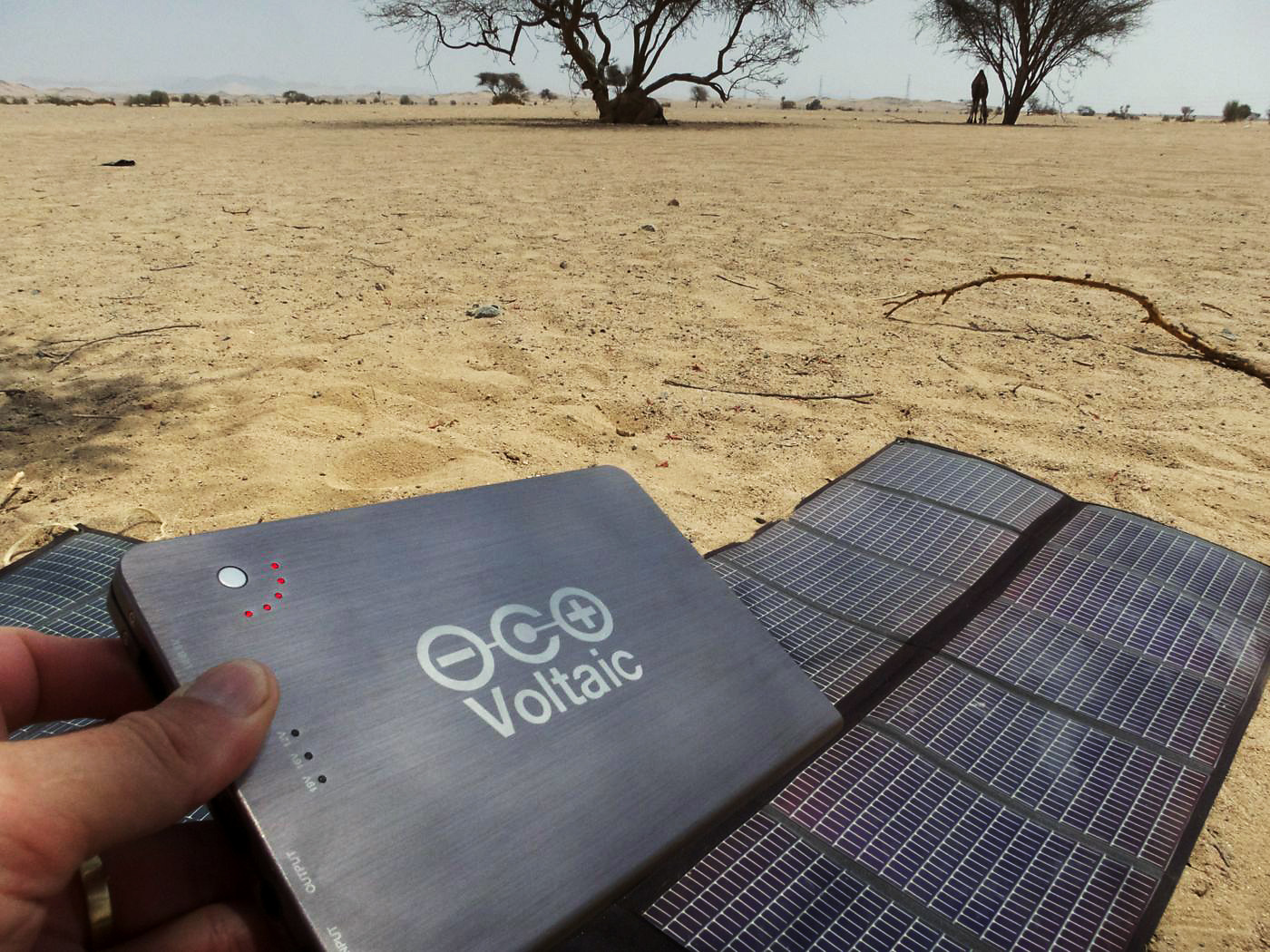
I recommended that Paul replace his inverter with a component like the V60 Universal Laptop Battery from Voltaic Systems, which is designed to connect directly to solar panels and store a charge of up to 60 Wh.
According to the technical support team at Voltaic Systems, the V60 is 92% efficient. So fully charging the V60’s battery will require roughly 65 Wh of energy, or 3 Wh less than the solar panels can generate on an average day. Therefore, I believe Paul should be able to charge his devices using his solar panel until he reaches the northern latitudes in the winter months. There he can supplement his power by using the Duracell inverter to charge from a 12-volt battery in a car, truck, or boat.
This solution isn’t perfect. Paul wanted to decrease his weight load, but adding the V60 plus adapters to connect it to his devices (see details here**) will increase his pack weight by several pounds. The biggest drawback, however, is that the V60 requires him to remain stationary while he’s charging it. Depending on his actual power needs, this can perhaps be accomplished during lunch or rest breaks. And by keeping a close eye on the V60’s charge indicator, Paul should be able to reach some sort of equilibrium.
I hope this helps!
Richard A. Smith is the Director of Embedded Engineering at One Laptop per Child Association where, in addition to other responsibilities, he designs methods for powering XO laptops in remote off-grid locations. He can be reached at richard@laptop.org.